
The AFM AI lawsuit against Universal Music and Warner is becoming one of the more interesting tests of what happens when old music-industry agreements collide with generative AI.
The American Federation of Musicians argues that recordings containing the work of its members were licensed for use by AI companies Suno and Udio without triggering compensation and disclosure obligations the union says are required under its Sound Recording Labor Agreement. Universal and Warner dispute that interpretation and argue, among other things, that the agreement’s “new use” provision does not create the kind of AI royalty obligation the AFM is claiming.
That sounds like a contract dispute. It is. But underneath it is a much bigger infrastructure problem.
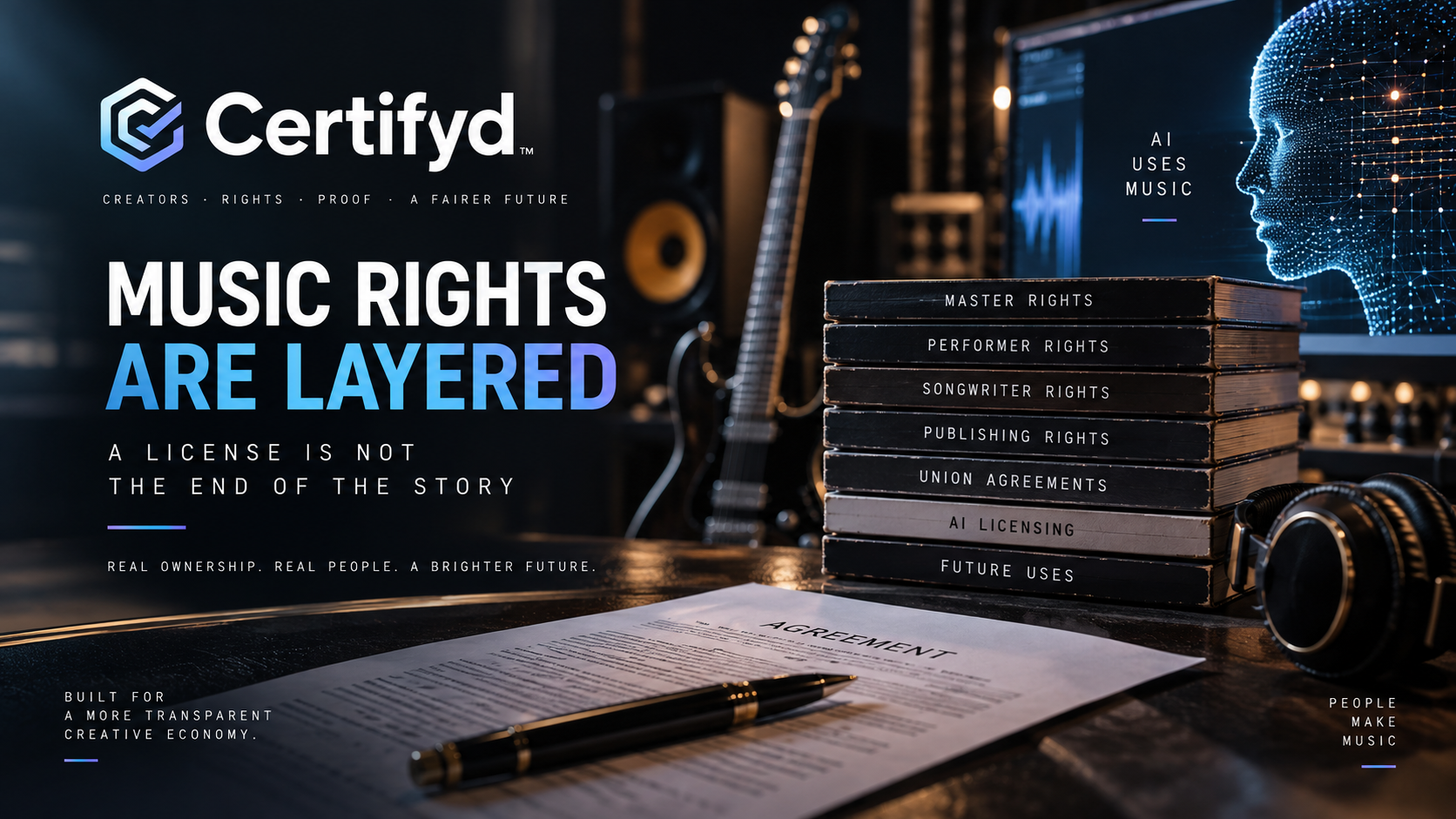
A recording does not have one right attached to it. It has a stack.
A license does not make everyone else disappear
The major labels control enormously valuable sound-recording catalogs. That gives them substantial authority to negotiate licenses involving those recordings.
But control of a master recording does not necessarily erase every contractual obligation connected to the people who made it.
The AFM filed its case in June, alleging that Universal and Warner had licensed recordings involving AFM-represented musicians to AI companies without compensating the musicians or giving the union information about which recordings and performers were involved. The union says those licenses qualify as a “new use” under Article 21(a) of its collective bargaining agreement.
The labels disagree.
Universal has argued that Article 21(a) is essentially a rate-conversion mechanism that applies when another AFM agreement already establishes a rate for a new use, rather than an unlimited right to compensation whenever an unforeseen technology appears. Warner has similarly argued that the agreement does not cover AI licensing.
Those questions will be decided through contract interpretation, not technology architecture.
But the disagreement exposes something technology architecture has largely failed to represent.
Music rights are not binary
Digital systems have a tendency to flatten rights into simple questions:
Who owns this recording?
Is this content licensed?
Do we have permission to use it?
Real music rights rarely work that way.
A recording can involve a master owner, songwriter rights, publisher rights, performer agreements, union obligations, neighboring rights, name and likeness rights, territorial restrictions, contractual approvals and other conditions.
The answer to “Can this recording be used?” may therefore be yes for one purpose, no for another, and yes-with-obligations for a third.
AI makes that distinction much harder to ignore.
If a label licenses a catalog for AI training, the existence of a license may answer one question: whether that label authorized use of rights it controls.
It does not automatically answer every other question attached to the recording.
That is the important part of the AFM dispute.
AI licensing is exposing the rights stack
The original AFM complaint went beyond demanding money. The union also alleged that it had not been given information identifying the recordings involved, the performers whose work appeared on them, the intended uses, or details of the transfers and licenses.
That matters.
Before anyone can determine whether an obligation has been satisfied, the relevant parties have to know what was licensed, who participated in it, what authority was exercised and what conditions traveled with the transaction.
This is where the AI licensing conversation starts becoming an infrastructure conversation.
The industry has spent decades building databases for recordings, compositions, ownership and royalty accounting. But many of the relationships surrounding a creative work are still scattered among contracts, databases, spreadsheets, institutional knowledge and systems that were never designed to communicate with one another in real time.
Generative AI increases the speed of the transaction while exposing the fragmentation underneath it.
A company can potentially license millions of recordings into a computational system far faster than the people connected to those recordings can determine what happened to their work.
"Licensed" is not enough information
The music industry increasingly needs something more expressive than a licensed/unlicensed flag.
Imagine a recording carrying machine-readable relationships describing:
- who controls the master;
- who performed on it;
- which agreements apply to those performances;
- what uses have been authorized;
- what obligations are triggered by particular uses;
- who has authority to grant each permission;
- and where the provenance of that authorization can be verified.
That does not decide whether the AFM is legally correct about Article 21(a).
It does something different.
It makes the underlying relationships visible enough that parties can determine what obligations exist in the first place.
That distinction matters because technology should not attempt to invent rights that contracts or law do not create. But once rights and obligations exist, infrastructure can do a much better job of expressing them.
This is why creator identity cannot stop at a profile
At Certifyd, we have been approaching creator identity as something broader than a verified username.
A creator exists in relationship to works, performances, collaborators, rights holders, agreements and permissions.
Those relationships are part of the identity of the work itself.
The AFM case is a useful example because the musicians at the center of the dispute do not need to own the master recording for their relationship to the recording to matter. The legal question is whether that relationship creates obligations when the recording is licensed for this particular use.
That is a much more sophisticated model than “owner versus non-owner.”
Digital infrastructure needs to be capable of representing that sophistication.
AI did not create this problem
Generative AI did not invent layered music rights.
It made ignoring them much more expensive.
For decades, the music business has operated through complicated chains of contracts, licenses and databases because transactions generally happened slowly enough for institutions and specialists to reconcile them.
AI changes the scale.
When catalogs can become training material for systems capable of generating enormous volumes of new media, rights information has to move closer to the speed of the media itself.
The AFM lawsuit may ultimately turn on the language of a labor agreement written before today’s AI licensing market existed.
But the technical lesson does not depend on which side wins.
A license is not the end of the rights conversation.
It is one event inside a much larger rights stack.
And the next generation of creative infrastructure is going to have to understand the difference.