
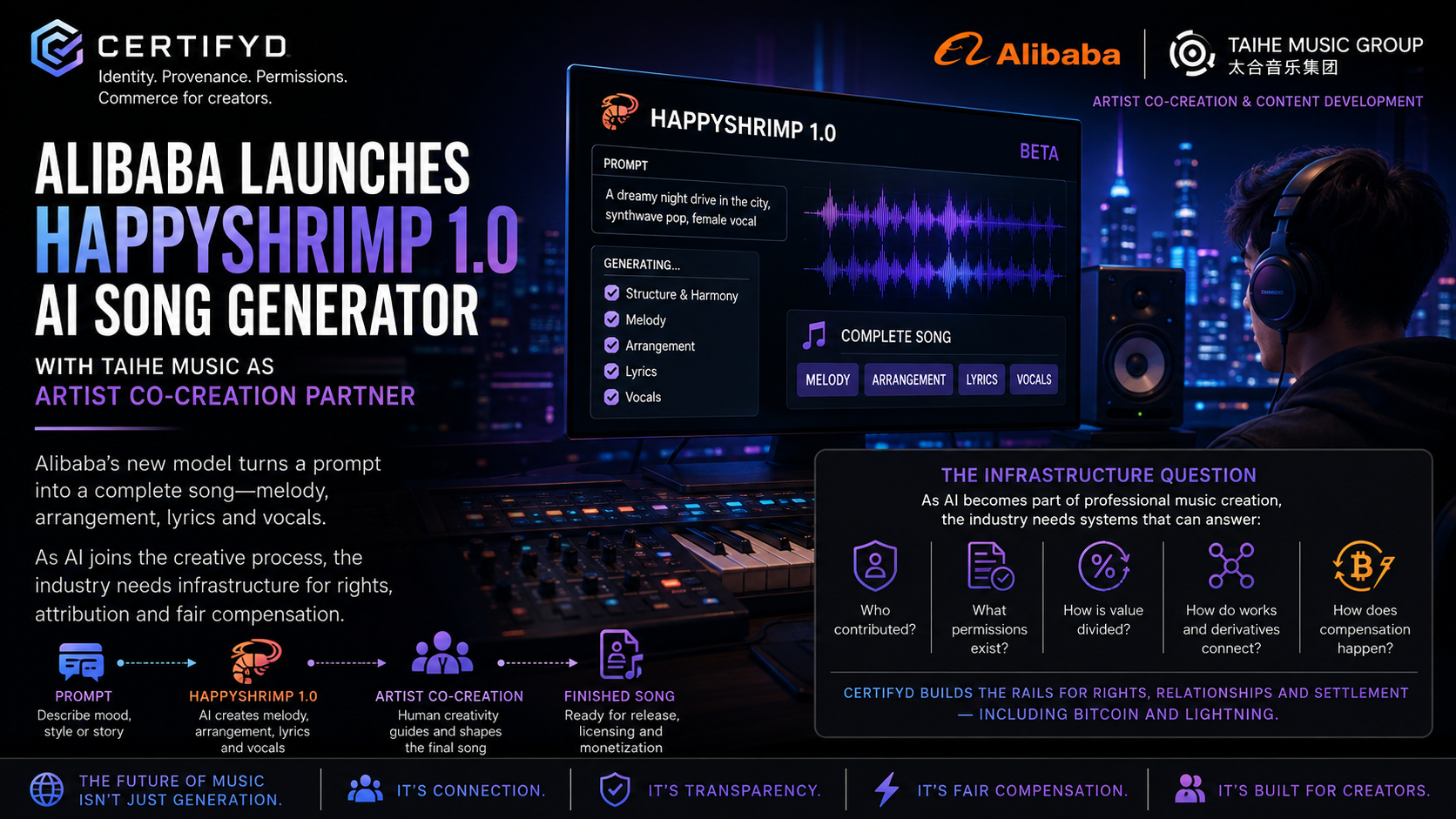
Alibaba Launches HappyShrimp AI Music Generator With Taihe Music as Artist Co-Creation Partner
Alibaba has entered the increasingly competitive AI music market with HappyShrimp 1.0, a new model capable of turning a written prompt into a finished song. The system entered beta on August 17, according to Alibaba, and arrives with an important music-industry connection already in place: Taihe Music Group, the Chinese music company behind Taihe Rye Music and Ocean Butterflies, will work with HappyShrimp on artist co-creation and content development.
That makes the launch about more than another AI song generator. As AI systems move deeper into professional music creation, the industry is going to need infrastructure capable of answering a deceptively difficult question: who contributed what to the finished work, under what permissions, and who should participate in the resulting value?
HappyShrimp Can Generate More Than a Melody
HappyShrimp is designed to generate an entire song from a user's description. According to Alibaba, a prompt can describe a mood, story or musical style and the system can create the melody, arrangement and lyrics before generating the vocals. Users can also provide their own lyrics for the model to set to music or request an instrumental.
The model supports styles including Chinese-style music, pop, R&B and soul, hip hop, rock, funk, electronic, classical and jazz. Prompts can specify instrumentation, vocal characteristics and changes in energy throughout a track. Alibaba says HappyShrimp maps elements including song structure, rhythmic development, harmonic progression, emotional tone, energy and lyrical intent before generating the audio.
That degree of control pushes AI music further toward something resembling a collaborative production environment rather than a simple novelty generator. A creator can increasingly provide creative direction, lyrics or other inputs while a model performs roles that previously might have involved several different human contributors.
Taihe Music Makes the Launch More Interesting
Alibaba says HappyShrimp will work with Taihe Music Group on artist co-creation and content development. Taihe operates businesses including Taihe Rye Music and Ocean Butterflies, giving Alibaba an established music-industry partner as HappyShrimp enters beta.
There is an important distinction, however. Alibaba has announced the collaboration, but it has not said whether its arrangement with Taihe covers licensing of recordings. That matters because the AI music industry is already dealing with major disputes over where source material comes from and what permissions were obtained to use it.
Suno and Udio were sued by the major record companies in 2024 over alleged copyright infringement. Both companies have subsequently entered licensing arrangements with parts of the established music industry, while litigation continues elsewhere. Alibaba is therefore entering AI music at a moment when the conversation is moving beyond simply asking what these systems can generate toward asking what rights and permissions exist behind the generation.
AI Co-Creation Creates a Metadata Problem
Consider what happens when an artist uses a system such as HappyShrimp as part of an actual commercial release. The artist might supply lyrics, the AI system might generate an arrangement and vocals, a producer might substantially modify the result, and another songwriter could contribute to the finished composition. A label or publisher could control particular rights, while the finished recording might later be remixed, sampled or incorporated into another derivative work.
The audio file alone doesn't explain any of those relationships. As AI becomes another tool inside creative workflows, the industry needs ways to preserve information about creator identity, attribution, permissions, splits, source relationships and subsequent derivatives. The more complicated the creation process becomes, the more important that information becomes.
This is also why the AI music debate cannot be reduced to whether a finished recording is labelled "AI-generated." That label might describe part of the production process, but it says very little about the human relationships, permissions and economic interests behind the finished work.
Where Certifyd Fits
Certifyd is not involved in Alibaba's HappyShrimp launch or its relationship with Taihe Music. The infrastructure problem exposed by AI-assisted creation, however, overlaps with the problem Certifyd is being built to address.
Certifyd is designed around connected relationships between creators and their works. Creators can establish identities, publish works and preserve relationships between participants, splits and related content. The architecture is also being developed around derivative relationships and permissions so that a new work does not necessarily become disconnected from the people and works that came before it.
That distinction becomes increasingly important when creation itself becomes composable. An AI-assisted work may eventually need to carry information about who created it, what it was built from, which participants approved particular uses, how economic participation is divided and what happens when another creator builds something new from it.
Instead of trying to reconstruct those relationships after a work becomes commercially valuable, the goal is to establish them as part of the work's history.
Attribution Is Only Half the Problem
Knowing who contributed to something is useful, but being able to connect those relationships to commerce is where the infrastructure becomes economically meaningful. Certifyd is being built around direct creator commerce and defined splits, with Bitcoin and the Lightning Network providing settlement rails that can move value between network participants.
That creates an interesting possibility for AI-assisted music. If the relationships surrounding a work can be represented clearly enough, payments do not necessarily have to begin with someone reconstructing the entire creative history in a spreadsheet or royalty database. A transaction can produce a receipt, participants can have defined shares, and upstream contributors can remain connected to derivative works as those works move into commerce.
Bitcoin and Lightning are important to that architecture because Certifyd does not need to become the central custodian of every participant's money. Independently operated participants can control their own infrastructure while the network preserves the context explaining why value is moving between them. The objective isn't simply faster payment; it is creating a stronger connection between the creative relationship and the economic relationship.
AI Makes Derivative Relationships More Important
Generative music also complicates the traditional idea of a finished work. A song generated today can become the input for another creation tomorrow. A human creator might alter it, another artist might remix it, a producer might incorporate elements into a different work, or future tools could make transformations that are difficult to anticipate when the original is published.
The important question is therefore not only whether a work has an identifiable creator. It is whether the relationships between successive works can remain understandable. If permission was required, was it granted? If an upstream participant retained an economic interest, does that relationship survive? If another work was used as source material, can that relationship be demonstrated?
Certifyd's derivative publishing model is intended to preserve those kinds of connections rather than treating every resulting file as an entirely independent object. AI makes that problem more urgent because it dramatically lowers the technical barrier to creating variations and derivatives.
The Bigger AI Music Race
HappyShrimp also shows how quickly the AI music market is expanding beyond Suno and Udio. Alibaba joins other Chinese technology companies already developing music-generation systems. Kunlun Tech operates Mureka, ByteDance has developed music-creation tools, and Tencent Music Entertainment has worked on AI music technology through Tianqin Lab and Tencent AI Lab. Tencent Music has also integrated DeepSeek into creation tools that can generate tracks for publication to QQ Music.
Alibaba brings considerable scale to that competition. The company controls infrastructure spanning AI models, cloud computing and its own chips, and HappyShrimp was developed by Alibaba Token Hub, the AI business group created earlier this year. The company has been rapidly expanding its broader AI operations as it attempts to commercialize models and infrastructure at enormous scale.
HappyShrimp therefore shouldn't be viewed simply as another experimental music application. It represents one of the world's largest technology companies placing generative music inside a much larger AI ecosystem, while simultaneously beginning to work with an established music company on artist co-creation.
The Next Battle Isn't Just Generation
AI systems are becoming increasingly capable of producing convincing finished music, and the technical barrier to generating that music continues to fall. The harder long-term problem is what happens after the music exists: who owns the human contribution, what material was authorized, who participated, what permissions apply, and what happens when the work is subsequently modified or incorporated into something new?
Those questions become economic questions as soon as the work enters commerce. If several people or works contributed to something valuable, infrastructure has to determine not merely that they participated but how that participation relates to ownership, permission and compensation.
HappyShrimp demonstrates how quickly AI-assisted music creation is advancing. Alibaba can supply enormous computing resources and increasingly sophisticated models, while music companies such as Taihe can bring professional creators into the process. The next layer of the industry will have to make the resulting creative relationships understandable and economically usable.
That means identity, attribution, permissions, provenance, derivative relationships and settlement may ultimately matter just as much as the model that generated the song.
Certifyd covers developments in music, intellectual property and creator commerce and examines what they mean for the infrastructure connecting creators, rights, relationships and economic participation.