
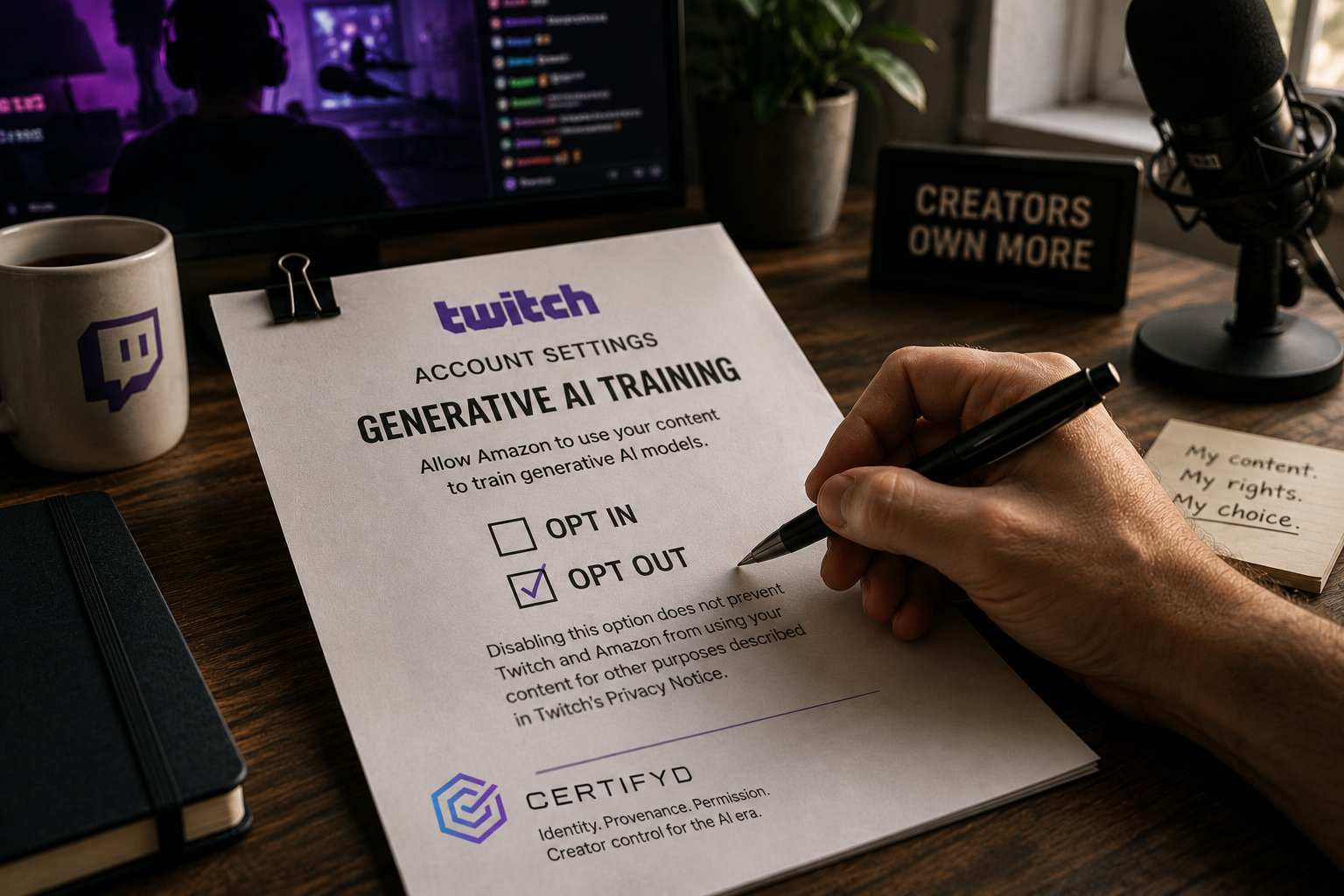
Amazon Can Use Your Twitch Content to Train Its AI—Unless You Opt Out
Twitch creators now have a way to tell Amazon not to use their content to train its generative AI models.
The catch: they have to opt out.
Twitch has introduced a Generative AI Training setting that allows streamers to disable the use of their channel content for training Amazon's generative AI models. The setting is enabled by default, meaning creators who don't want their material used have to actively turn it off.
That has reopened one of the most important questions surrounding AI and the creator economy:
When a creator puts something online, what exactly have they given a platform permission to do with it?
The Opt-Out Matters
The difference between opt-in and opt-out can look like a minor product decision.
It isn't.
Under an opt-in model, a creator actively grants permission before their work is used for a particular purpose.
Under an opt-out model, that use is permitted unless the creator takes action to stop it.
More than 16,000 creators reportedly signed an open letter opposing the default use of Twitch content for Amazon's AI systems.
Twitch product head Mike Minton also acknowledged the practical reason for the decision: requiring creators to opt in would likely produce very low participation.
That may make sense from the perspective of building an AI training dataset.
From the creator's perspective, however, it raises a more difficult question about what meaningful consent should look like.
Twitch Already Has Broad Rights to Creator Content
There is another important layer to the story.
Like many major platforms, Twitch's Terms of Service grant the company broad rights over material uploaded by users.
Those terms cover activities including using, reproducing, modifying, adapting, publishing, distributing and creating derivative works from user content.
But according to WIRED's reporting, the terms did not explicitly state that creator content could be used to train generative AI models.
That's significant because AI has introduced uses that may not have been obvious to creators when older platform agreements were written.
A creator agreeing to have a livestream distributed globally may not necessarily think they are also agreeing to have that stream incorporated into the development of a future generative model.
The legal interpretation of platform agreements is one question.
What creators reasonably understand themselves to be authorizing is another.
Opting Out Doesn't End Every AI Use
The new control is also narrower than it might initially appear.
Disabling generative AI training doesn't mean Twitch and Amazon stop processing creator content through AI altogether.
Twitch has said channel content may still be used for other purposes described in its privacy notice, including AI-powered features associated with discovery, sponsorships and safety.
That distinction illustrates how complicated digital permissions are becoming.
"AI use" isn't really one permission anymore.
Training a generative model, recommending a livestream, detecting harmful content, matching sponsors and creating a derivative work can all involve processing creator material in fundamentally different ways.
A single blanket permission may become increasingly inadequate for describing all of them.
Publicly Available Isn't the Same as Universally Authorized
There is an even larger problem beyond Twitch.
Public content can be collected from the open internet by companies that have no direct relationship with the creator at all.
That means an opt-out switch controlled by one platform can only go so far.
It also exposes a weakness in how the internet has historically handled creative rights.
We are very good at determining whether something can be accessed.
We are considerably worse at communicating what someone is actually authorized to do with it.
Those are different things.
A song can be publicly streamed without being free to sample.
A photograph can be publicly viewed without being free to reproduce commercially.
A livestream can be publicly watched without every conceivable future use automatically being authorized.
AI is forcing that distinction into the foreground.
Permission Is Becoming Infrastructure
For decades, much of the creator economy has relied on permissions buried inside contracts, platform terms, licensing databases and private agreements.
That becomes increasingly difficult when a single work can move through multiple platforms, collaborators, AI systems and derivative projects.
The industry may eventually need permissions that are more granular and easier to verify.
Who created the work?
Who controls the relevant rights?
What uses have been authorized?
Does that permission include AI training?
Does it include derivative creation?
Can the permission expire or be withdrawn?
And can someone encountering the work later verify those answers?
These are questions of provenance and rights management as much as they are questions about artificial intelligence.
They are also part of the problem Certifyd is exploring: how identity, provenance, permissions and derivative relationships can remain connected to creative works rather than existing only inside the databases of individual platforms.
AI Is Exposing an Older Problem
The Twitch controversy isn't really just about Amazon training an AI model.
It exposes a much older tension between creators and the platforms that distribute their work.
Platforms need broad permissions to operate at enormous scale.
Creators increasingly want more precise control over what happens to their work once it enters those systems.
AI makes the gap between those two positions much harder to ignore because entirely new uses of existing content can emerge long after the content was originally uploaded.
Twitch has now given creators a way to refuse one of those uses.
The bigger question for the creator economy is whether the next generation of digital infrastructure can make permission clearer before that refusal becomes necessary.
Because the important question isn't simply whether content is available.
It's what its creator actually authorized.