
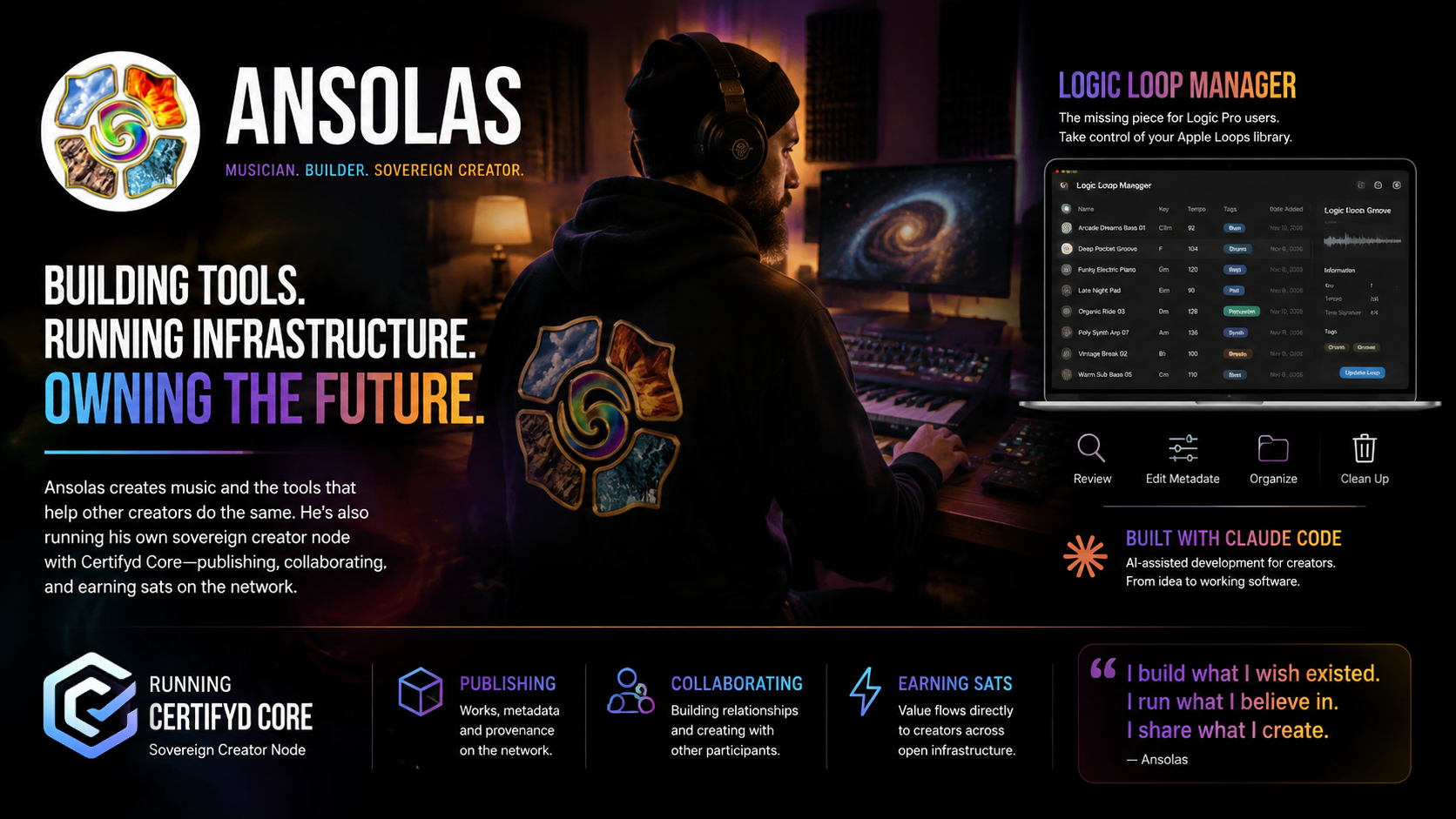
He’s Building What He Wishes Existed: Ansolas and the Independent Creator Mindset
Some creators wait for a platform to solve their problems. Marc Wensauer aka AnSolas has spent much of his career taking a different approach: when something he needs doesn't exist, he starts thinking about how to build it himself.
I've known Ansolas for years. He's a musician, software developer, builder and friend who has consistently approached technology from the perspective of an independent creator rather than someone waiting for an industry platform to tell him how he should work. Music and technology aren't separate interests for him; they're two parts of the same creative practice.
His latest project, Logic Loop Manager, is a particularly good example of that mindset. It isn't software invented after searching for a market opportunity. It came from repeatedly encountering a frustrating problem while making music and eventually deciding there had to be a better solution.
He's building what he wishes existed.
A Musician Who Also Builds Software
It's important to understand that Ansolas didn't suddenly become a software developer because modern AI tools made programming accessible. He has been coding professionally since 2013, giving him more than a decade of professional software experience alongside his work as a musician.
That combination matters because it changes how he approaches building software. He isn't an outside developer trying to imagine what a musician might want. He's encountering problems inside his own creative workflow and has the technical experience to investigate them from the other side.
Like many developers today, Ansolas uses AI-assisted tools where they are useful. They're tools within an established development workflow, however, rather than the reason he's capable of building software in the first place. The more interesting story isn't AI writing software for a musician; it's an experienced musician and developer using the tools available to him to solve problems he understands personally.
Logic Loop Manager grew directly out of one of those problems.
The Problem Hiding Inside Logic Pro
Ansolas creates a lot of Apple Loops while working in Logic Pro. Apple's software makes turning an idea into an Apple Loop and adding it to the Loop Browser relatively easy, which is exactly why the feature can become such an important part of a musician's workflow.
The difficulty appears later. Once a loop has been created and added to the library, managing it isn't nearly as flexible as creating it in the first place.
Something as simple as correcting a key or tempo can mean returning to the original material, importing it again, entering the metadata again and creating another Apple Loop. Meanwhile, the previous version can remain in the library, creating duplicates and outdated entries that gradually make the collection harder to manage.
For someone who occasionally creates a loop, that might be a minor inconvenience. For a musician who creates and reuses them regularly, it's a workflow problem that compounds over time.
Ansolas didn't want to replace Logic's Loop Browser. He likes using it. What he wanted was control over the part of the workflow that Logic wasn't handling particularly well.
Logic Loop Manager
That became the purpose behind Logic Loop Manager.
The application is designed to let musicians work with Apple Loops they've already created rather than repeatedly recreating them whenever something needs to change. Existing loops can be reviewed and organized, metadata such as key or tempo can be corrected, and unwanted entries can be dealt with without forcing the musician through the entire creation process again.
It's a deliberately focused piece of software. Logic Loop Manager isn't trying to become a generic sample-management platform or reinvent the way musicians organize every sound on their computer.
Its purpose is much simpler: keep using Logic's Loop Browser while regaining control over the library behind it.
That focus is one of the things I find most interesting about the project. Some of the best creator tools don't begin with a giant product vision. They begin with somebody doing real work, encountering the same friction repeatedly and finally deciding to remove it.
Building From the Workflow Out
There's an important distinction between building software for creators and building software from inside a creative workflow.
A product team can interview musicians, collect feature requests, study analytics and construct a roadmap. Those methods can produce excellent software, but they're still attempts to understand a workflow from the outside.
Ansolas already lives inside the problem he's solving.
He knows why changing the metadata matters because he has needed to change it. He understands why duplicates become irritating because he has dealt with them. He knows why replacing Logic's existing browser would be unnecessary because he's actually using the browser as part of his music-making process.
That creates a very different starting point for product development. The first question isn't "what software could we sell musicians?" It's "what keeps getting in the way while I'm making music?"
Logic Loop Manager is the answer to one of those questions.
Test It With Real People
Ansolas is currently testing Logic Loop Manager with a small group of users rather than immediately pushing it toward the largest possible audience.
There's a practical reason for that. Software working correctly on the developer's own computer doesn't prove that it will behave the same way across other systems, libraries and workflows.
The same feature that feels intuitive to the person who designed it can become confusing when someone else encounters it for the first time. Real users expose assumptions that are almost impossible for a developer to see while working alone.
So the early testing group is intentionally small. The objective isn't to manufacture impressive user numbers; it's to discover problems, understand them and improve the application before putting it in front of a much larger audience.
That philosophy should sound familiar to anyone who has built something from scratch.
Independence Has Been the Pattern
Logic Loop Manager also fits a much longer pattern in the way I've seen Ansolas work.
He has always had a strong independent streak as a creator. He makes music, develops software, experiments with technology and builds around his own needs rather than waiting for a company or platform to provide every piece of his creative environment.
That's a form of creator sovereignty that has very little to do with slogans. It's practical independence.
If there's a tool he needs and it doesn't exist, he can build it. If a workflow isn't working, he can change it. If technology gives him greater control over his creative process, he's willing to understand the technology rather than treating it as somebody else's responsibility.
That same mentality is part of why his participation in the Certifyd technical beta has been useful.
Running His Own Creator Infrastructure
Ansolas is currently running a Sovereign Creator node as part of the Certifyd network. He's publishing into the network, collaborating with other participants and has already been earning satoshis through the infrastructure he operates.
For me, what's interesting isn't simply that he's testing Certifyd. It's that running his own creator infrastructure is consistent with the way he was already working.
The same person who doesn't want to recreate an Apple Loop every time a piece of metadata needs changing is naturally interested in having more control over the infrastructure surrounding his creative work. In both cases, the motivation is practical: understand the system, control the pieces that matter and remove unnecessary dependencies where possible.
His software-development background also means he's comfortable managing technical systems himself. AI-assisted tools can help with aspects of that work when useful, just as they can elsewhere in modern development, but the underlying capability and independence belong to him.
Certifyd didn't create that mindset.
It gave him another place to apply it.
The Sovereign Creator Already Exists
We talk a lot about the idea of a sovereign creator when discussing where creative technology might be headed, but Ansolas is a useful reminder that these people aren't theoretical.
They already exist.
They're musicians who run their own systems. Developers who make music. Artists who learn how the technology around their work functions instead of treating every technical layer as a black box. Creators who use platforms when they're useful without assuming those platforms should permanently control the work underneath them.
They aren't necessarily trying to become technology companies. They simply want enough control to build the creative environment that makes sense for them.
Logic Loop Manager captures that philosophy in an unusually tangible way. There was a problem in Ansolas' music workflow, the existing software didn't provide the solution he wanted, and he had the experience to do something about it.
So he started building.
He's building what he wishes existed.
And in many ways, that's what being an independent creator has always been about.