
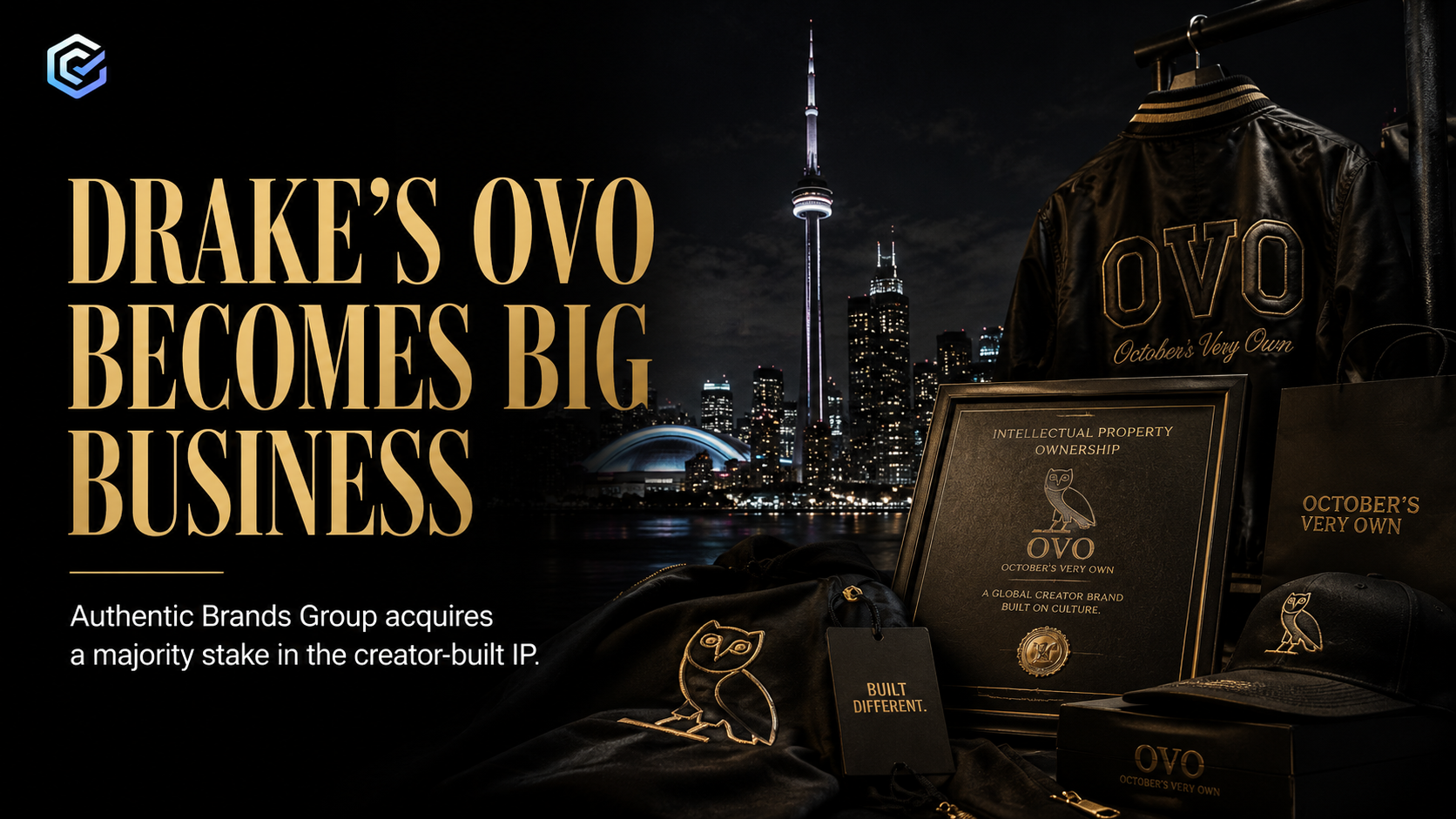
Authentic Brands Group Acquires Majority Stake in Drake’s OVO Intellectual Property
Authentic Brands Group has acquired a majority stake in the intellectual property of October’s Very Own, the lifestyle brand co-founded by Drake, in a deal that turns nearly two decades of creator-built cultural identity into an asset capable of being owned, licensed and expanded independently of the artist’s music career.
Drake isn't simply walking away from OVO. He will retain a significant ownership stake and continue shaping the brand's creative vision alongside Authentic. Meanwhile, Vince Holding Corp. has acquired OVO's operating business and will oversee design, product development, merchandising and retail as the brand's core apparel licensee. Financial terms for Authentic's acquisition were not disclosed. :contentReference[oaicite:1]{index=1}
The structure is worth paying attention to because this isn't fundamentally a story about another celebrity merchandise deal. OVO has become intellectual property in its own right.
From Artist Brand to Intellectual Property
October's Very Own was founded by Drake, Oliver El-Khatib and Noah "40" Shebib and developed alongside Drake's rise from Toronto artist to one of the world's biggest music stars. What began as an identity closely associated with an artist has grown into a standalone lifestyle business with a recognizable owl mark, apparel and accessories, global e-commerce and 12 flagship stores. :contentReference[oaicite:2]{index=2}
Authentic now sees enough independent value in that identity to acquire majority ownership of its IP.
That distinction matters. Artists have always created value around their names, images, communities and cultural influence, but the modern creator economy has expanded the number of ways that value can become an asset. A creator's economic footprint can extend from recordings and publishing into brands, merchandise, memberships, experiences, licensing, digital products and businesses that continue operating independently of individual releases.
OVO is an unusually large example of what happens when that process works.
The Deal Separates the IP From the Operation
Perhaps the most interesting aspect of the transaction is that ownership of the intellectual property and operation of the business are being handled separately.
Authentic specializes in owning and investing in intellectual property and cultural assets. Its portfolio spans more than 50 brands, while its network includes more than 1,700 licensees and strategic partners across 150 countries. Authentic says brands across its network generate more than $38 billion in annual systemwide retail sales. :contentReference[oaicite:3]{index=3}
Vince Holding, meanwhile, has acquired OVO's operating business. It will own and operate that business as OVO's core apparel and retail licensee, using its infrastructure to handle the commercial machinery behind the brand. :contentReference[oaicite:4]{index=4}
Drake remains connected to the underlying asset and its creative direction.
That creates three distinct roles: intellectual-property ownership, creative stewardship and commercial operation.
For creators, that separation is more interesting than the size of the companies involved.
Creators Don't Just Produce Content
The internet trained an entire generation of creators to think primarily in terms of content: make something, publish it to a platform, attract an audience and repeat.
But a successful creator can be building something considerably more valuable along the way.
Names become brands. Audiences become communities. Designs become trademarks. Recordings become catalogs. Characters become licensable properties. Relationships become commercial networks. The things surrounding the creative work can eventually develop economic value of their own.
OVO demonstrates that at enormous scale. Authentic isn't buying Drake's Instagram followers or acquiring his Spotify account. It is investing in intellectual property that has been developed around a recognizable creator-led identity.
That's an important distinction for independent creators too, even if the numbers involved are radically different.
The question isn't whether every creator can build the next OVO. Most won't.
The question is whether creators are treating what they build as durable assets in the first place.
Ownership Matters Before Something Becomes Valuable
Deals like this can make intellectual property look like something that becomes relevant only after an artist is already famous. In reality, the opposite is true.
The ability to sell, license or partner around an asset later depends on establishing what that asset is, who controls it and what relationships exist around it much earlier.
A creator releasing their first independent work isn't negotiating an international licensing transaction. But they're already making decisions about identity, attribution, ownership, distribution, permissions and commerce. Those decisions accumulate as the creator's body of work grows.
This is one reason we've built Certifyd around creator-controlled infrastructure rather than treating creator identity as simply another platform account.
Certifyd Core allows creators to establish cryptographically verifiable relationships between their identity and their works, maintain provenance around what they publish and participate in direct commerce. The objective isn't to predict which creator will eventually build an asset worth acquiring. It's to give creators infrastructure for establishing and controlling those relationships from the beginning.
OVO shows what the far end of that spectrum can look like.
A Platform Audience Isn't the Same Thing as an Asset
There is another lesson here that becomes more important as the creator economy matures.
A creator can build an enormous audience on a platform without necessarily building an asset they control.
Ten million followers are valuable, but the creator doesn't own Instagram. A billion streams can produce enormous cultural influence, but the artist doesn't own Spotify. A successful YouTube channel can become a business, but its distribution still depends on infrastructure controlled by YouTube.
OVO is different because an identifiable piece of intellectual property exists beyond the platforms used to promote it.
That doesn't mean creators should abandon platforms. Platforms remain extraordinarily useful for distribution and discovery. The distinction is between using platforms to build something and allowing the platform itself to become the thing you've built.
The former can create leverage.
The latter can create dependency.
Drake Built More Than an Audience
This is also why describing OVO simply as "merch" misses what happened.
Merchandise is a product. Intellectual property is the underlying asset that can allow products, licenses, collaborations and businesses to continue being created around an identity.
Authentic's model is explicitly designed around that distinction. It acquires and invests in cultural IP, then works with operating and licensing partners capable of commercializing those assets across markets and product categories. In OVO's case, Vince becomes the operating partner while Drake remains involved in the creative identity and retains ownership. :contentReference[oaicite:5]{index=5}
The creator has effectively helped build something that can now exist simultaneously as culture, intellectual property and commercial infrastructure.
That's a very different outcome from simply monetizing attention.
Creator Sovereignty Doesn't Mean Never Partnering
There is sometimes a tendency to interpret creator ownership as meaning creators should do everything themselves forever.
That's not particularly useful.
Ownership creates the ability to choose what happens next. A creator can operate independently, license something, bring in an operating partner, sell part of an asset, raise capital against it or retain it entirely.
The important thing is having something over which those choices can actually be made.
Drake retaining ownership and creative involvement while Authentic takes majority control of the IP and Vince operates the business illustrates that distinction particularly well. Creator independence doesn't necessarily mean refusing institutional partners. It means entering those relationships with assets, identity and leverage of your own.
For independent creators, the scale is different but the principle isn't.
The Creator Economy Is Becoming an IP Economy
The first era of the creator economy was dominated by audience growth. Platforms competed to give creators distribution, and creators competed for followers, subscribers, views and streams.
The next phase is increasingly about what creators can build on top of that attention.
Music rights can become catalogs. Creator identities can become brands. Communities can support direct commerce. Works can produce derivatives and licensing opportunities. Relationships between creators and fans can become sustainable businesses.
That makes infrastructure around identity, provenance, permissions and commerce more important, not less.
Certifyd's view is that creators shouldn't have to wait until they've built an OVO-sized business before thinking this way. A creator's identity and work begin accumulating relationships and value from the moment they're published.
The infrastructure should recognize that from day one.
OVO Shows What Creator-Built IP Can Become
Authentic Brands Group's acquisition of a majority stake in OVO is obviously an exceptional transaction involving one of the world's most commercially successful artists. It would be silly to pretend the average independent creator is one clever branding decision away from building the same thing.
But that's not the useful lesson.
The useful lesson is that Drake and his partners built something alongside the music that ultimately became identifiable intellectual property with value of its own. Nearly two decades later, that asset can have different owners, an external operating company, a global licensing strategy and continued involvement from its original creative force.
That's what makes the OVO deal interesting beyond celebrity business news.
Creators don't only make content.
They create identities, works, relationships and intellectual property. Some of those things eventually become businesses. A smaller number become assets valuable enough for other companies to acquire.
The smartest time to start treating them like assets isn't when Authentic Brands Group comes knocking.
It's when you create them.