
Most creator platforms start from the same assumption: the platform sits in the middle. Creators upload their work to it, fans discover them through it, payments pass through it, and identity, audience relationships and access are managed inside accounts the platform controls. Even when creators are given better tools, they are still operating inside infrastructure owned by someone else.
Certifyd starts with a different assumption: the creator operates the infrastructure. Instead of building another destination that creators have to join, Certifyd Core gives creators infrastructure they can run themselves. That difference changes the architecture from the ground up.
Start with the creator, not the platform
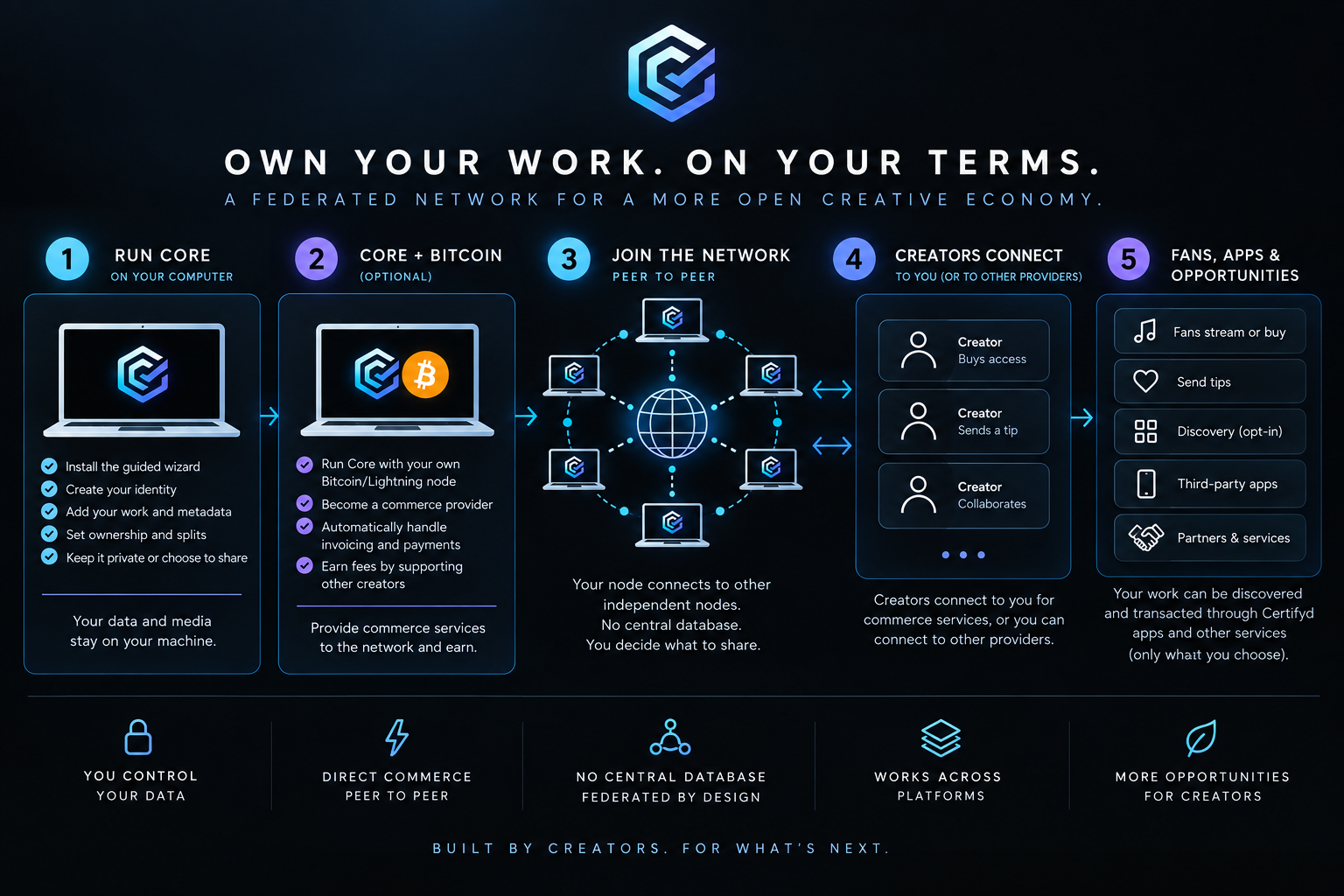
Certifyd Core runs on the creator's own computer. Core gives creators a place to establish their identity, add their work and metadata, define ownership and splits, and decide what stays private and what they choose to share. Their data and media can remain on their own machine rather than beginning inside a central platform database.
The important difference isn't simply that the software runs locally. It's where the authoritative relationship begins. In the traditional platform model, the platform holds the account and the creator operates inside it. With Certifyd, the creator operates Core, and other services can connect around that creator-controlled foundation.
That changes the starting point for identity, work and eventually many of the services creators use to operate their businesses. Instead of repeatedly rebuilding themselves inside different platforms, creators can begin with infrastructure they control.
Core can provide services to other creators
Not every creator needs to run every piece of infrastructure themselves. Certifyd is designed so independent participants can provide services to one another rather than requiring a central company to provide everything.
Bitcoin and Lightning are optional parts of Core. A creator who chooses to operate that infrastructure can become a commerce provider for the network, supporting invoicing and payments for other creators while earning fees for providing that service. Another creator can use that provider without having to operate their own Lightning node.
That creates a different model for creator commerce. Instead of every transaction necessarily flowing through a central platform, independent providers can offer commerce services across the network. The creator gets access to infrastructure without requiring Certifyd itself to become the permanent intermediary in every transaction.
A federated network of independent nodes
When Core joins the Certifyd network, it can connect with other independently operated nodes. There is no single central database containing every creator, every work and every relationship. Each participant operates their own part of the network and decides what they make available to others.
That is what federation means in practical terms. One creator can operate Core from their computer while another operates Core somewhere else. A provider can run services from another node, and those independent systems can communicate without becoming accounts inside one giant central system.
This is a fundamental architectural difference between Certifyd and a conventional platform. Certifyd isn't trying to build another giant repository and convince creators to move everything into it. The network is created by connecting independently operated infrastructure.
Creators can connect directly
Once creators and providers can operate independently on the same network, relationships that normally require a central intermediary can begin moving closer to the participants themselves. One creator can purchase access from another, send another creator a tip, collaborate on work or connect to a provider offering services they don't want to operate themselves.
The network also doesn't require everyone to use an identical configuration. A creator might run Core without Bitcoin or Lightning while another participant operates a more advanced node and provides commerce services. Different participants can take on different roles while remaining part of the same network.
This is an important part of the design because decentralization shouldn't mean forcing every musician, filmmaker, writer or other creator to become a systems administrator. The goal is to distribute control while still allowing creators to rely on other people and services when that makes sense.
Fans and applications connect around the creator
The same architecture changes the role of applications. Fans can stream or buy work, send tips and discover creators where creators choose to participate. Third-party applications, partners and services can also interact with the network without necessarily becoming the place where the creator's entire digital existence has to live.
Today, creators often rebuild themselves inside every service they use. Their identity becomes an account on one platform, their audience exists inside another company's database, their content is uploaded somewhere else, and their commerce relationship is recreated again. Each new service can become another silo.
Certifyd is building toward reversing that relationship. The creator operates the foundation, and applications connect around it. Applications can still provide valuable experiences, discovery and services, but they don't have to own the underlying creator relationship simply because they provide the interface.
Why the absence of a central database matters
Centralized platforms become powerful because many different creator functions eventually resolve back to infrastructure they operate. Profiles, catalogs, audiences, transactions, discovery and access can all become attached to one company's database and rules. As more functions accumulate there, leaving becomes increasingly difficult because the creator isn't simply changing software; they may be leaving behind parts of their operating infrastructure.
Certifyd is designed around the opposite idea: no central database, federated by design. That doesn't mean there are no providers, applications or shared services. It means those services don't have to become the permanent center of the creator's operation.
If one provider disappears, the network doesn't disappear with it. If another provider offers something better, creators can connect to it. If a new application wants to build a better fan experience, it can participate without requiring the entire network to move into that application's database.
The result is an architecture where services can compete around creators rather than requiring creators to continually rebuild themselves inside competing services.
This is bigger than owning your files
Creator ownership is often described in terms of files and portability. Being able to download your work or export your data is useful, but possession of a file isn't the same thing as operating the infrastructure around it.
The deeper questions are architectural. Where does identity originate? Where is the record of the work? Who defines ownership and splits? Who controls access? Who can provide commerce? How do creators connect to one another? Can another application participate without taking control of the entire relationship? What happens when a provider disappears?
Those questions matter because control over creator businesses increasingly comes from control over the infrastructure connecting identity, work, discovery, access and commerce. Certifyd Core is being built to move more of that foundation toward the creator.
From platforms to creator-operated infrastructure
Certifyd isn't being built to become another destination creators have to join. We're building toward an architecture where the destination itself becomes less important because creators can operate the foundation underneath it.
Creators run Core. Independent nodes connect. Providers offer services. Creators transact and collaborate. Fans and applications interact with the network, and each participant decides what they contribute and what they share.
The long-term opportunity is bigger than making today's creator platforms slightly more portable. It is to move functions that currently require centralized intermediaries into a network that creators and independent providers can operate themselves.
That is the architecture behind Certifyd: creator-operated infrastructure for a more open creative economy.
Own your work. On your terms.