
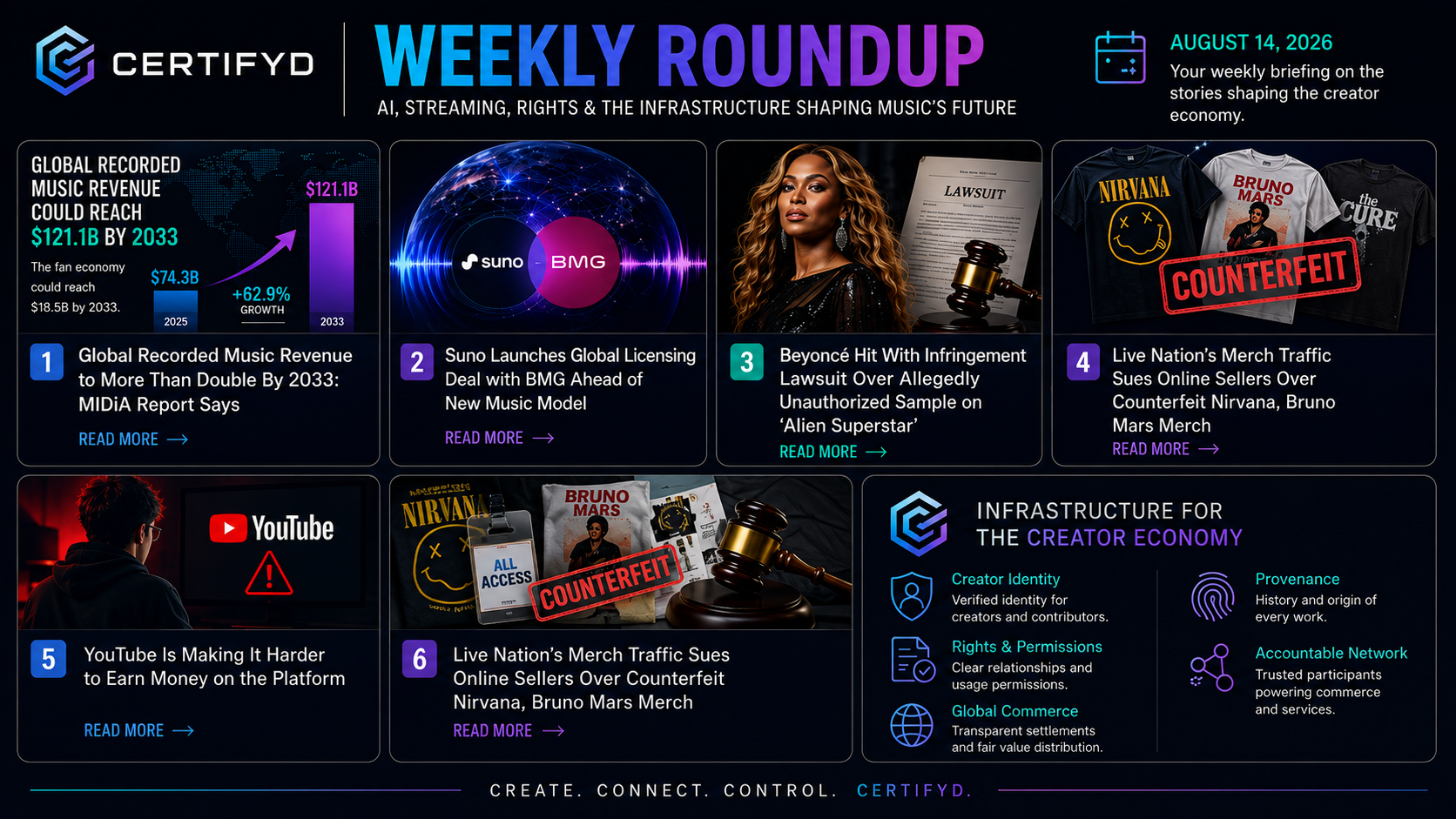
Certifyd Weekly Roundup: AI, Streaming, Rights and the Infrastructure Shaping Music’s Future
The music business stories we covered this week may look very different on the surface.
AI licensing. YouTube monetization. Counterfeit merchandise. Sample clearance. The growth of the fan economy. And the career of a producer who learned that making records and building institutions are two very different jobs.
But together, they point toward the same larger shift.
Music is becoming more participatory, more distributed and potentially much larger economically. At the same time, the relationships surrounding creative work are becoming more complicated.
Who created something?
Who authorized it?
Who contributed?
Who can build on it?
Who can sell it?
And who participates when value is created?
Here are the stories Certifyd followed this week.
Global Recorded Music Revenue Could Reach $121.1 Billion by 2033
MIDiA Research forecasts global recorded music revenue will grow from $74.3 billion in 2025 to $121.1 billion by 2033.
Streaming remains the largest engine, but one of the most interesting parts of the forecast is what MIDiA calls the expanding fan economy.
Physical music, social platforms, fitness, gaming, branding, merchandise, touring and other expanded rights could become increasingly important as traditional streaming markets mature.
MIDiA estimates the fan economy alone could reach $18.5 billion by 2033.
For creators, that suggests the next phase of the music business may not simply be about generating more streams. It may be about creating more ways for fans to participate economically around an artist and their work.
That requires infrastructure capable of connecting identity, intellectual property, permissions, products, services and commerce.
Read: /blog/global-recorded-music-revenue-to-more-than-double-by-2033-midia-report-says/
Suno and BMG Move AI Music Toward Licensed Participation
Suno and BMG announced a global alliance covering BMG's recorded music and publishing repertoire, with participating artists and songwriters able to opt in.
The agreement is notable for several reasons.
It covers rights protection and compensation for participating creators, addresses prior use of BMG repertoire and comes as Suno prepares new models developed with music-industry partners.
Suno has also announced safeguards including download restrictions aimed at mass exporting, audio watermarking and fingerprinting.
The larger direction is becoming clearer.
The AI music conversation is moving beyond a binary argument over whether AI belongs in music. The harder problem is establishing the permissions, attribution, provenance and economics governing what people create with it.
Those are infrastructure problems.
Read: /blog/suno-launches-global-licensing-deal-with-bmg-ahead-of-new-music-model/
Beyoncé Lawsuit Shows Why Sample Clearance Is a Chain-of-Rights Problem
Beyoncé was hit with an infringement lawsuit involving an allegedly unauthorized sample used in the 2022 track "Alien Superstar."
The dispute is especially interesting because the issue isn't simply whether permission was eventually obtained.
The plaintiffs allege that the party granting that permission no longer controlled the relevant rights.
That exposes one of the difficult realities of music clearance.
Permission is only meaningful when the person granting it actually has the authority to do so.
A sample can connect recordings, compositions, producers, publishers, artists and decades of rights transfers. Reconstructing those relationships after a dispute emerges can be expensive and difficult.
This is why provenance and clearance belong together.
A stronger system doesn't merely record that someone clicked approve. It preserves the chain connecting the work, rights holders, permissions and resulting derivative.
Read: /blog/beyonce-hit-with-infringement-lawsuit-over-allegedly-unauthorized-sample-on-alien-superstar/
Counterfeit Merch Shows the Same Problem in Physical Commerce
Live Nation subsidiary Merch Traffic sued anonymous online sellers it accuses of selling counterfeit merchandise connected to artists including Nirvana, Bruno Mars, Harry Styles, Avenged Sevenfold, Eazy-E, The Notorious B.I.G. and The Cure.
The lawsuit brings trademark infringement and counterfeiting claims along with false designation of origin.
But underneath the enforcement story is a broader infrastructure question:
How does a fan know something is actually official?
Legitimate merchandise can involve a chain connecting an artist, intellectual property, licensing partner, manufacturer, distributor, retailer and fan.
Counterfeiters exploit the difficulty consumers have distinguishing the authorized chain from an unauthorized one.
Enforcement asks whether something is counterfeit after it appears.
Provenance creates the possibility of proving the legitimate commercial chain first.
Read: /blog/live-nations-merch-traffic-sues-online-sellers-over-counterfeit-nirvana-bruno-mars-merch/
YouTube Is a Reminder That Audience Doesn't Equal Ownership
YouTube remains one of the world's most powerful creator-distribution systems.
But creators operate inside rules they don't control.
Changes to monetization requirements, content policies, recommendation systems or revenue models can materially change the economics of a creator's business.
That doesn't mean creators should abandon YouTube.
It means distribution and ownership should not be confused.
A creator can use platforms for reach while developing direct relationships, identity and commerce outside any single platform.
The distinction becomes increasingly important as creators build businesses rather than simply channels.
Read: /blog/youtube-is-making-it-harder-to-earn-money-on-the-platform/
Vassal Benford: A Career Built for More Than One Generation
This week we also looked at Vassal Benford's career across music, film, entertainment and technology.
Benford's path spans production, artist development, executive leadership and work across multiple generations of artists.
That makes his career useful for understanding something often lost in discussions about the creator economy.
Creative longevity isn't only about making another record.
It's about building relationships, intellectual property and institutions capable of surviving changes in technology and distribution.
Read: /blog/vassal-benford-career-ownership-technology-hip-hop/
From Producer to Institution Builder
That theme continued in our look back at Benford's relationship with Clive Davis and the VAZ/Arista Records years.
The progression from producer to executive represents an important distinction.
A producer makes records.
An executive has to think about the infrastructure that allows artists, records and businesses to grow around them.
The tools available today are radically different from those of the major-label era, but the underlying lesson remains relevant.
Creators increasingly have the ability to operate infrastructure themselves.
The question is no longer simply whether someone can publish independently.
It's whether they can build something durable around what they publish.
Read: /blog/vassal-benford-clive-davis-vaz-arista-records/
The Pattern Behind This Week's Stories
AI music, sample lawsuits, counterfeit merchandise, platform monetization and music-industry growth appear to be separate subjects.
They aren't.
They're all exposing relationships that the next generation of creator infrastructure needs to handle.
Identity → Work → Attribution → Rights → Permission → Derivatives → Commerce
As the number of ways to create, remix, distribute and monetize intellectual property expands, those relationships become more important—not less.
Certifyd is being built around that premise.
Creators should be able to establish their identity and work.
Collaborators should be attributable.
Derivative works should retain relationships to their sources.
Clearance should involve the people who actually hold the relevant rights.
Commerce should connect accountable participants without requiring one central platform to own every relationship.
And creators should be able to carry those relationships forward as their work moves across an increasingly complex economy.
What We're Watching Next
The most interesting change in music right now isn't any single AI company, streaming platform or licensing agreement.
It's the gradual expansion of what a music business can be.
Streaming remains enormous, but the fan economy is expanding.
AI is turning audiences into participants.
Derivative creation is becoming easier.
Creators are building businesses across music, merchandise, experiences and intellectual property.
That creates enormous opportunity.
It also makes provenance, permissions, identity and accountable commerce increasingly important.
The creator economy doesn't need another layer of middlemen to manage all of this.
It needs better infrastructure for creators and the people they choose to work with.
That's the direction we're watching—and building toward.
Certifyd Weekly Roundup covers the stories shaping music, intellectual property, technology and creator commerce, and examines what they mean for the infrastructure creators use to publish, own and build around their work.