
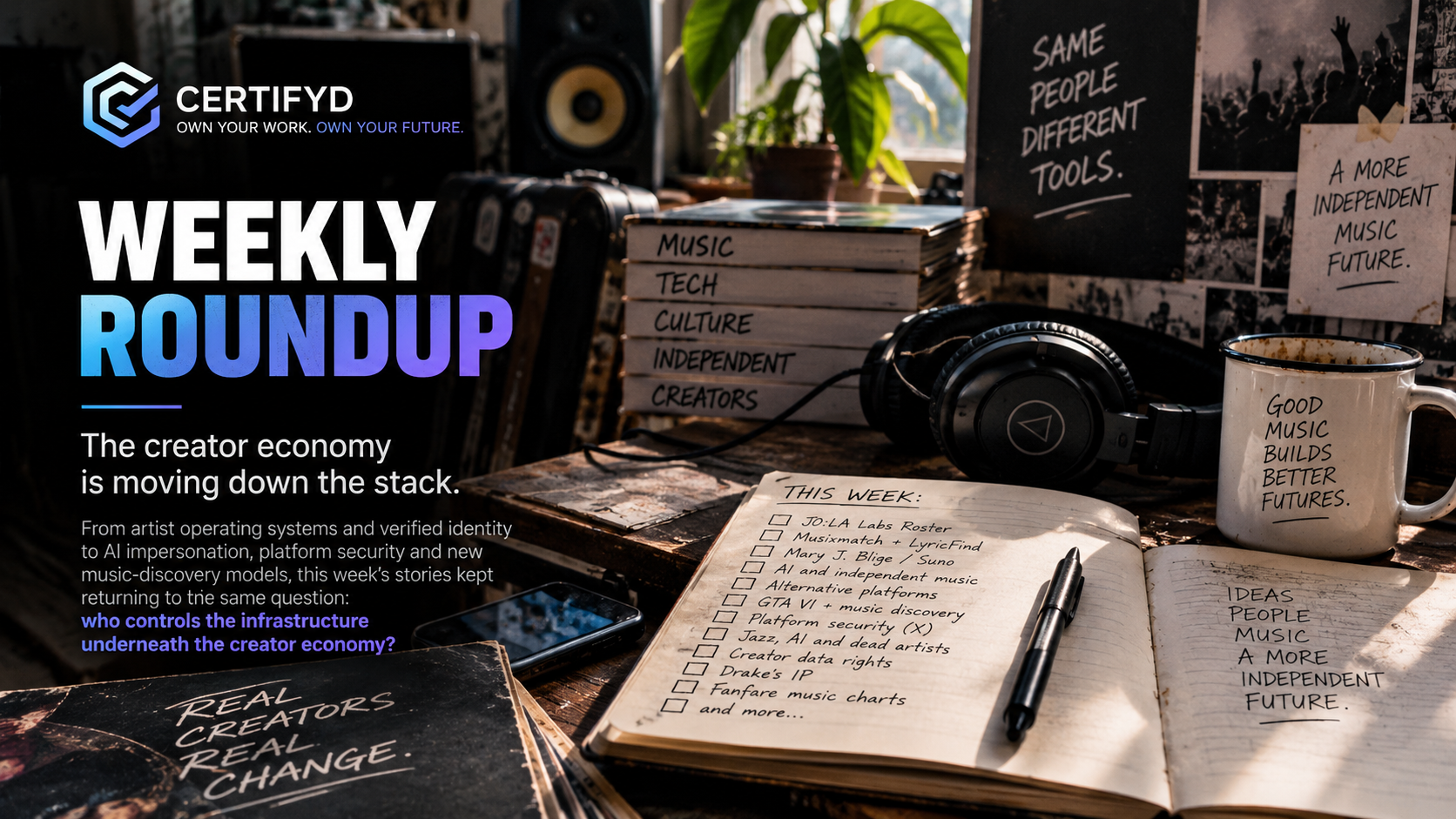
Something interesting happened across the stories we covered this week.
On the surface, they were all over the place. We wrote about GTA VI becoming a music-discovery machine, AI-generated music appearing on the profiles of dead jazz musicians, independent streaming platforms, creator data, X Money, Drake's intellectual property, AI tools for artist management and a new verified artist program.
Underneath them, though, the same question kept appearing:
Where does the creator's business actually live?
That question is becoming harder to ignore as the creator economy moves beyond apps and platforms and starts confronting the infrastructure underneath them.
Artists Are Getting Operating Systems
JO:LA Labs gave us perhaps the clearest example this week with the launch of Roster, which it describes as an end-to-end music business operating system for artists and managers.
Roster brings releases, royalties, publishing, distribution, touring, marketing, CRM, contracts and finances into a conversational AI interface. That's an interesting response to a real problem: independent artists increasingly operate businesses assembled from a pile of disconnected software.
But it also led us to a question we think will become increasingly important:
Who operates the operating system?
Better software can make running an artist business considerably easier. Creator-operated infrastructure asks a different question: whether the identity, catalogue, relationships and commercial activity underneath that business can belong to the creator rather than the software provider.
Those aren't competing ideas. They're different layers of the stack.
Verification Is Becoming Authority
Musixmatch and LyricFind moved another part of that stack forward.
Musixmatch introduced new tools for labels, while LyricFind launched a Verified Artist Program allowing musicians to claim catalogues and submit lyrics and translations. That's useful progress because verification becomes considerably more valuable when it gives creators some authority over information associated with their work.
Then the Mary J. Blige and Suno story showed us the next problem.
Suno pulled an advertising campaign involving Blige after saying the person who arranged the deal had falsely presented themselves as her representative. Suddenly the question wasn't simply whether an artist could be identified.
It was whether someone else had the authority to act for them.
That's a much richer identity problem. Digital creator infrastructure eventually needs to distinguish between identity, relationships and delegated authority: who you are, who represents you, what they're permitted to do and whether that permission is still valid.
AI Keeps Exposing Missing Infrastructure
AI appeared repeatedly this week, but the interesting part wasn't really AI.
Jazz musicians who died decades ago suddenly appeared to have new releases on major music services. Musicians investigating suspected AI tracks found themselves doing detective work to determine whether music was actually created by the people attached to it.
Those look like AI problems until you ask a simpler question:
Why are we trying to determine authenticity after publication?
Detection is useful, but it is inherently reactive. Creator-established identity, authorization and provenance offer another approach: establish trustworthy information about a creator and their work at the point of origin, then allow other systems to verify it.
AI didn't create that architectural gap.
It made the gap much easier to see.
Independent Music Is Having an Infrastructure Conversation
A report from Stvdio and Secretly Distribution examining AI's impact on independent music gave us one of our favorite phrases of the week: "a fight for music's infrastructure."
That's a much bigger framing than another debate about AI-generated songs.
Independent music has spent decades building independent labels, distributors, record stores, promoters, radio stations and communities. The digital era created enormous new opportunities for those creators while also concentrating important parts of their businesses inside infrastructure operated by a relatively small number of technology companies.
That doesn't make those platforms inherently bad. It does make independence increasingly relative.
Owning your music is one thing.
Owning—or at least controlling—the infrastructure through which your identity, audience, catalogue and commerce operate is another.
Alternative Music Platforms Are Starting to Look Like a Network
Our look at alternative music platforms pushed that idea in another direction.
Services such as Cantilever, Lume, Qobuz, Coda and Tapedeck are experimenting with different approaches to curation, discovery, compensation and fan experiences. Cooperative and open-source projects including Subvert, Mirlo and jam.coop are exploring different ownership and organizational models.
The interesting possibility isn't necessarily that one of them becomes the next Spotify.
It may be that none of them needs to.
A future music ecosystem could contain many specialized experiences that do particular things well while interoperating through shared infrastructure. That starts looking less like another giant platform and more like a network.
For Certifyd, that's an important distinction. Creator-controlled identity, works, provenance, relationships and commerce can become connective infrastructure between experiences rather than requiring one application to own the entire relationship.
Discovery Doesn't Have to Look Like Streaming
GTA VI provided the fun version of the same argument.
Games have been music-discovery environments for decades, but the scale and cultural reach of Grand Theft Auto makes the effect unusually visible. A listener might encounter a song while driving through Vice City, associate it with a mission or character, and only afterward go looking for the artist.
In other words, discovery happened somewhere that wasn't primarily a music platform.
That's likely to become increasingly normal.
Games, virtual worlds, social experiences, communities and applications we haven't invented yet can all become discovery surfaces. The important architectural question is whether the creator and work can travel across those environments with their identity and relationships intact.
The discovery surface can change.
The creator shouldn't have to start over every time it does.
Platform Accounts Are Becoming More Valuable — and More Dangerous
X Money showed another side of convergence.
As X adds financial functionality, the account itself potentially becomes considerably more valuable. Losing access no longer means merely losing the ability to post. The same account can increasingly represent identity, audience, communications and financial activity.
That's convenient.
It's also concentration.
The more functions we attach to a single platform identity, the greater the consequences when control of that identity is lost. Creator-owned infrastructure doesn't eliminate security risk, but it does challenge the assumption that a creator's entire digital business should originate from one platform account.
Data Access Isn't the Same as Data Control
That distinction also appeared in our experiment requesting personal data from 100 companies.
Having a legal right to request data is meaningful. Getting a download from a company, however, isn't the same thing as operating the system where that data originates.
That difference matters for creators because enormous portions of their professional lives are represented by data held elsewhere: audiences, engagement, transactions, catalogue information, analytics and relationships.
Platforms can provide increasingly sophisticated access to that information.
The deeper architectural question is whether creators can establish important parts of their digital businesses somewhere they control in the first place.
Music Is Already Bigger Than the Platforms Carrying It
Even our stories about Drake's intellectual property and Fanfare's independent music charts fit the pattern.
An artist's business increasingly consists of more than recordings. Brands, trademarks, catalogue rights, fan relationships, commercial activity and cultural influence can become interconnected assets. At the same time, new chart systems can measure signals such as sales, support or independent activity instead of reducing success to one universal popularity metric.
Different systems can see different parts of a creator's economy.
They don't all need to become the creator's economy.
That's an important distinction.
The Creator Economy Is Moving Down the Stack
For years, creator technology largely meant giving creators better applications.
Better publishing tools. Better analytics. Better monetization. Better discovery. Better dashboards.
All of that still matters.
But this week's stories suggest the conversation is moving deeper.
Who owns the identity?
Who establishes the catalogue?
Who can authorize somebody to act for the creator?
Where does provenance originate?
Can different discovery experiences connect to the same creator?
Where does commerce happen?
Who operates the operating system?
Those aren't really feature questions.
They're infrastructure questions.
And that is where we think the next phase of the creator economy gets interesting.
The future doesn't have to be platformless. Creators will continue using platforms, services, games, AI tools, distributors and whatever comes next.
The more important shift is making those things tools a creator uses to build their business rather than places where the creator's business has to live.
That's the thread we'll keep following.