
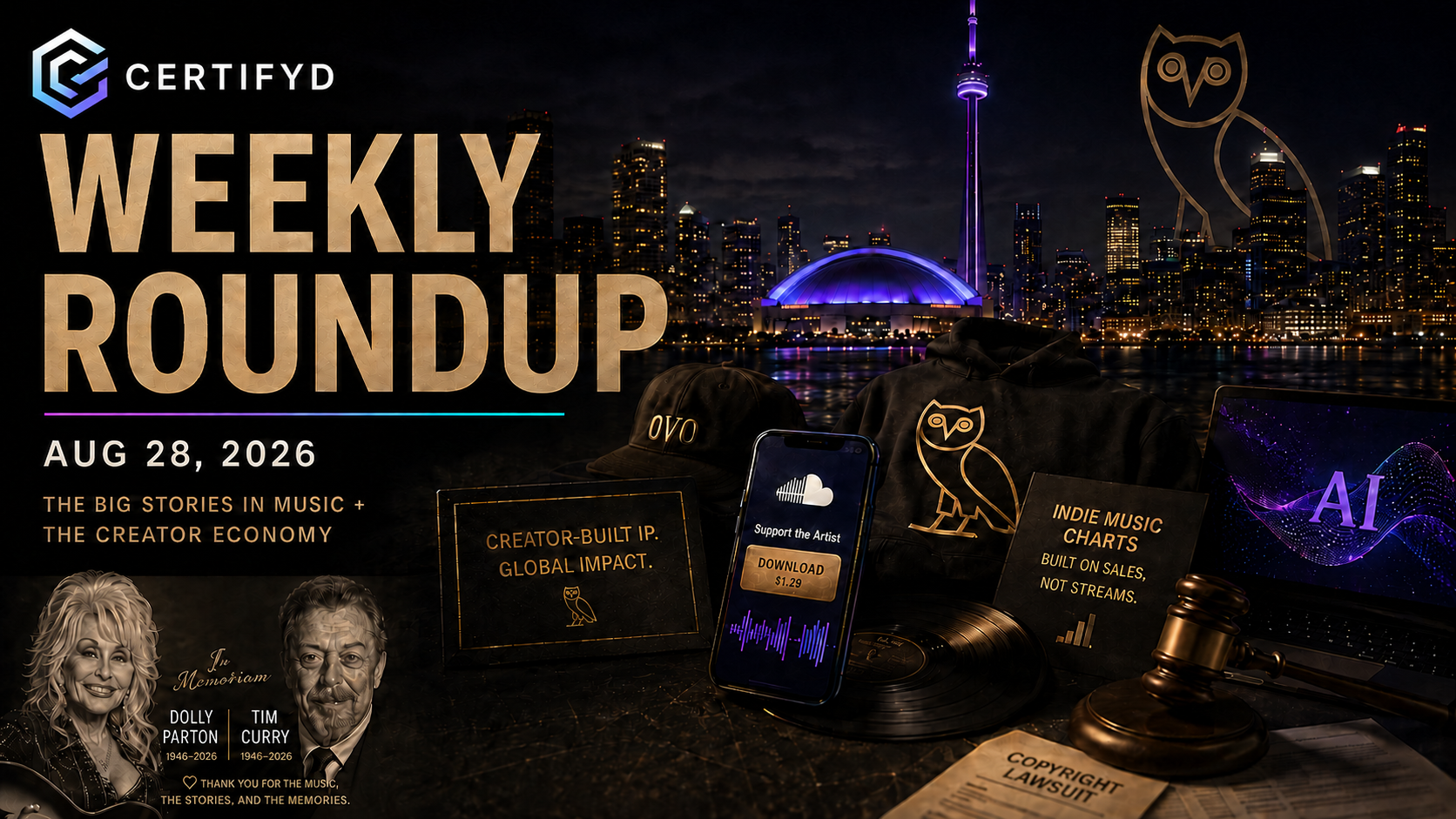
This week produced several stories that look unrelated at first glance: Drake turned part of OVO into institutional-grade intellectual property, the three major music companies invested in Stability AI, SoundCloud added direct paid downloads, Fanfare prepared new charts built around physical sales and merchandise, and Round Hill continued an aggressive copyright fight against generative AI companies.
Look underneath them and a common question appears. Who owns the underlying asset, who controls the transaction, and who gets to define the record of what happened?
That question sits increasingly close to the center of the creator economy.
Drake’s OVO Became an Asset Beyond the Music
Authentic Brands Group acquired a majority stake this week in the intellectual property of October’s Very Own, the lifestyle brand co-founded by Drake. Drake retains a significant ownership position and will continue participating in the brand’s creative direction, while Vince Holding Corp. has acquired OVO’s operating business and will oversee design, product development, merchandising and retail.
The structure is more interesting than another celebrity-brand acquisition because ownership of the IP, creative stewardship and operation of the business have effectively become distinct roles. Authentic now holds majority ownership of an identifiable cultural asset; Vince operates the commercial machinery around it; Drake remains economically and creatively connected to what he helped build.
That is what mature creator-built intellectual property can eventually look like.
OVO began as something closely tied to an artist identity and developed into a recognizable lifestyle business capable of existing beyond individual releases, tours or social accounts. Authentic’s decision to acquire majority ownership of the IP shows that what creators build around their work can eventually have value independently of the content that originally created the audience.
For independent creators, the lesson obviously isn’t that everybody can build an OVO. It is that a creator can be building assets alongside the content itself: identity, trademarks, catalogs, communities, commercial relationships and intellectual property that can have value independently of a platform account.
That is close to the premise behind Certifyd Core. Ownership becomes most useful when identity, works, provenance and commercial relationships are established before the asset becomes valuable enough for somebody else to want it.
The Major Labels Aren’t Sitting Out Licensed AI
Universal Music Group, Sony Music Group and Warner Music Group all participated in a $76 million Series B investment in Stability AI this week, alongside Electronic Arts and technology investors including AMD Ventures. Stability says the round brings funding raised under CEO Prem Akkaraju to $232 million.
The investment is notable because Stability has increasingly positioned its music products around licensed creative inputs. Its Stable Audio 3.0 family of models was described as being trained on licensed data, while Universal and Warner already had strategic relationships with Stability before participating in the funding round.
This is where the AI conversation in music is becoming more sophisticated.
The meaningful divide is unlikely to remain simply AI versus no AI. The harder questions concern authorization: whose work entered the system, what permissions existed, what an artist agreed to, what a generated work derives from and whether those claims can survive outside the company making them.
That makes provenance and permissions more important rather than less. As synthetic and human creation become increasingly mixed, a generic “AI-generated” label tells us very little about the relationships underneath a work.
Certifyd’s interest is therefore not in deciding whether creators should use AI. It is in infrastructure capable of answering more useful questions: who created something, who authorized something, what it came from and whether those claims can be independently verified.
At the Same Time, the AI Copyright Fight Is Getting More Aggressive
If the Stability AI funding round represents one possible future for cooperation between AI companies and rightsholders, Round Hill’s lawsuits against Suno and Anthropic show the other side of the transition.
Round Hill Music filed separate federal copyright complaints against Suno and Anthropic on August 17. The company says each case could potentially reach or exceed $1 billion if claims expand as contemplated, with statutory damages of up to $150,000 per willfully infringed work. Round Hill has also publicly indicated that it does not intend to settle the cases.
The juxtaposition is difficult to ignore. In the same market, major rights companies are investing directly in one generative AI company while another rightsholder is preparing potentially enormous litigation against others.
That isn’t necessarily contradictory.
It suggests that the emerging fight may be less about whether generative tools exist and more about the terms under which creative work enters those systems. Licensing, permission and compensation increasingly separate the AI relationships the music business wants from the ones it is prepared to fight.
That distinction is going to require much better infrastructure than a checkbox saying a track used AI.
SoundCloud Wants the Purchase to Happen Inside SoundCloud
SoundCloud also moved further into direct-to-fan commerce this week, launching a limited beta for paid music downloads with approximately 200 U.S.-based Artist Pro creators who already have Fan Support enabled. The company says participating artists will keep 100% of each sale, excluding standard fees and taxes, with broader eligibility planned later this fall.
There is evidence that demand exists. SoundCloud says it sends more than half a million users each year to outside destinations where they can buy music, while 28% of surveyed artists either already sell downloads or want to.
Giving artists another way to make money from fans is good. The more interesting part of SoundCloud’s announcement is the philosophy underneath it.
CEO Eliah Seton said artists should be able to build their audiences “in one place, on one platform.”
That is where Certifyd reaches a very different conclusion.
Bringing discovery, community and commerce closer together can make a platform substantially more useful. But making the platform better does not eliminate platform dependency; in some cases it can deepen it. If the audience, identity, commercial relationship and transaction all exist inside one company’s infrastructure, the creator may have fewer reasons to leave precisely because more of the business now depends on that company.
Direct-to-fan should ultimately mean more than moving the checkout button closer to the fan.
Our view is that platforms should be able to connect to creator infrastructure, rather than requiring creator identity and commerce to exist exclusively inside the platform.
Fanfare Thinks Independent Charts Should Count Purchases, Not Streams
A new UK company called Fanfare is approaching another part of the problem: how independent artist success gets measured.
The Fanfare Independent Music Chart and Fanfare Independent Merch Chart launch September 1. The music ranking will count physical vinyl, CD and cassette sales, while the merchandise chart will recognize purchases such as shirts, tote bags and other merch. Streaming and legacy acts are excluded, and transactions can take place either online or at gigs.
Fanfare’s argument is that conventional charts increasingly struggle to provide a useful signal for active independent artists. Only sales processed through Fanfare will count toward the rankings, allowing the company to verify transactions rather than relying on artists to self-report them.
That is an interesting step because it recognizes something streaming culture has sometimes flattened: different kinds of fan activity mean different things.
A stream measures consumption. Buying a record measures a purchase. Buying merchandise represents another form of support.
Certifyd has been approaching the same problem from the network layer. Instead of producing a single universal ranking, the Fan experience can surface Top Selling, Most Supported, Fastest Moving, Recently Supported and Top Connected because each signal tells a different story.
There is also an architectural difference worth watching. Fanfare can verify activity because the transaction happens inside Fanfare. Certifyd’s model is built around independently operated creator infrastructure, allowing verifiable activity to originate with network participants and then be interpreted by applications across the network.
The chart does not necessarily need to own the transaction in order to trust the activity.
That could become a significant distinction as independent discovery becomes more closely tied to direct commerce.
Different Stories, Same Direction
Taken together, these developments suggest the creator economy is moving beyond a period when audience size was the dominant measurement of value.
OVO demonstrates that creator identity can become durable intellectual property. Stability AI’s funding round shows large rightsholders trying to shape licensed generative systems rather than merely reacting to them. Round Hill’s lawsuits show how fiercely the industry may respond when it believes permission was never obtained.
SoundCloud is moving the transaction closer to the fan, while Fanfare is trying to turn those transactions into new discovery signals.
The interesting part is that none of these systems ends at content anymore.
Identity becomes intellectual property. Creative works become AI training inputs. Audiences become customers. Transactions become discovery data. Platforms become commerce systems.
The underlying relationships matter more every year.
In Memoriam: Dolly Parton and Tim Curry
This week also brought the loss of two cultural giants.
Dolly Parton died August 25 at 80 after a brief battle with cancer. Her legacy extends far beyond an extraordinary catalog of songs. She was a songwriter, performer, actor, entrepreneur and philanthropist whose career demonstrated that enormous commercial success and genuine creative ownership did not have to be opposing ideas.
Parton wrote thousands of songs across a career spanning nearly six decades, including “Jolene,” “Coat of Many Colors” and “I Will Always Love You.” Beyond music, Dollywood and her other ventures turned her identity into an enduring business, while her literacy work through the Imagination Library became one of the most recognizable philanthropic programs attached to any modern entertainer.
Tim Curry also died August 25 at 80 at his home in California. Over a career spanning stage, film, television and voice acting, Curry created characters that became fixtures of popular culture, most famously Dr. Frank-N-Furter in The Rocky Horror Picture Show and Pennywise in the 1990 adaptation of It.
After suffering a major stroke in 2012, Curry continued working, particularly in voice roles and occasional appearances. His performances in Clue, Annie, Muppet Treasure Island and countless other projects gave him the kind of career that crossed genres and generations without ever becoming predictable.
There isn’t much useful industry analysis to attach to losses like these. Sometimes the right thing is simply to acknowledge people whose work became part of the culture the rest of us inherited.
RIP Dolly Parton and Tim Curry.
The Common Thread Is Control
OVO, Stability AI, Round Hill, SoundCloud and Fanfare are operating in very different corners of the market, but each story ultimately turns on control.
Drake and his partners created intellectual property that became valuable independently of the platforms used to promote it. Stability AI is attracting music-industry investment partly by building around licensed creative inputs. Round Hill is arguing in court that creative works entered AI systems without the required permission.
SoundCloud wants more creator-to-fan transactions to occur inside SoundCloud. Fanfare wants to generate trusted independent charts from transactions it can verify.
None of those developments can be reduced to “artists need more ownership.” The details matter. Ownership, authorization, provenance, distribution and commerce are different problems.
But they increasingly intersect.
Creators are becoming brands. Brands become intellectual property. Creative works become training inputs. Fans become customers. Transactions become discovery signals. Platforms increasingly want to control more of those layers at once.
The creator economy therefore isn’t just becoming bigger.
It’s becoming infrastructure.
And the most consequential question may increasingly be whether creators are simply participants in that infrastructure — or whether they control a meaningful part of it themselves.