
Certifyd Weekly Roundup: Platforms Want More Control. Creators Should Want More Too.
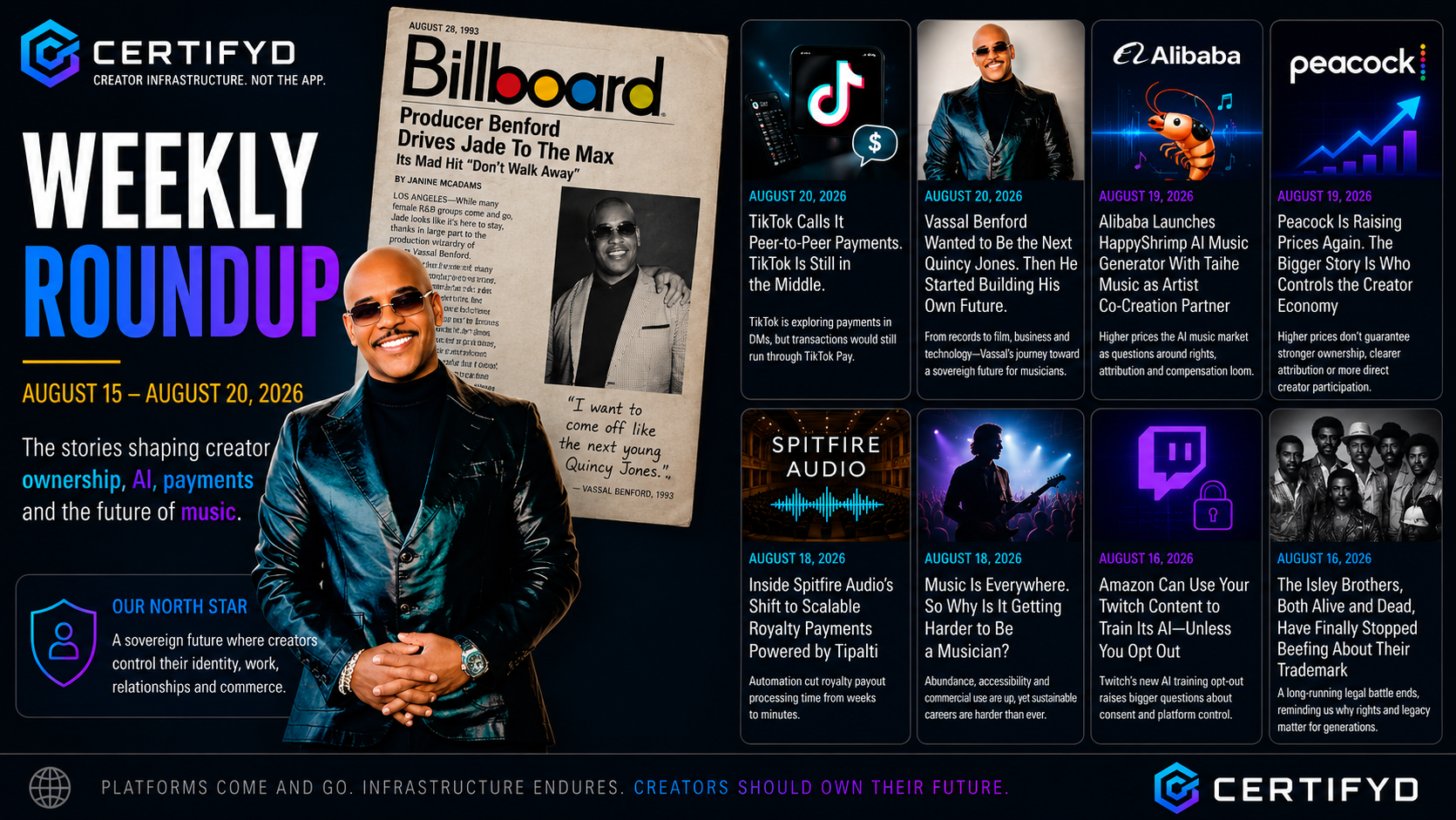
At first glance, this week's stories don't have much in common. TikTok is exploring payments through direct messages. Amazon is giving Twitch creators a way to opt out of AI training. Alibaba has entered the AI music race. Peacock is raising subscription prices, while the music industry continues trying to make royalty payments more efficient.
Look underneath those headlines, however, and the same question keeps appearing: who controls the infrastructure connecting creators, audiences, rights and money?
That question is becoming increasingly important as platforms expand beyond distribution. The companies that once helped creators reach audiences are increasingly involved in payments, AI training, discovery, commerce and the rules governing how creative work can be used.
This week's Certifyd coverage followed that shift from several different directions.
TikTok Calls It P2P. TikTok Is Still in the Middle.
TikTok is reportedly exploring a feature that would allow users to send money through direct messages, with transactions running through TikTok Pay. The feature could be genuinely useful, particularly as social platforms increasingly blur the line between communication, entertainment and commerce.
But calling the proposed system peer-to-peer deserves scrutiny.
If TikTok remains the intermediary through which the payment is processed, then the architecture isn't peer-to-peer in the technical sense. Two users may be transacting with one another, but they're doing so through infrastructure controlled by TikTok.
That distinction isn't academic. A true peer-to-peer architecture reduces the requirement for a central operator to control the relationship between participants. If the platform can determine who participates, how transactions occur or whether access continues, the intermediary hasn't disappeared simply because the payment button moved into a DM.
The story illustrates why architecture matters. Direct-looking isn't necessarily direct.
Amazon's Twitch AI Policy Puts Consent in the Spotlight
Twitch introduced controls allowing creators to opt out of having their content used to train Amazon's generative AI models. That gives creators a choice, but the structure of the choice is worth examining: unless a creator acts, their content may be available for a new use determined by the platform.
The larger issue extends well beyond Twitch. As AI companies seek enormous quantities of training material, creative platforms are sitting on something increasingly valuable: vast libraries of human-created work.
That makes permission infrastructure important.
Creators shouldn't have to rely indefinitely on changing terms of service and buried preference screens to communicate what can happen to their work. A more mature creator economy will need ways for permissions, attribution and provenance to travel with creative material itself.
AI isn't eliminating the need for rights information. It's making reliable rights information more important.
Alibaba Joins the AI Music Race
Alibaba entered generative music this week with HappyShrimp 1.0, an AI system capable of turning prompts into complete songs. The company also announced Taihe Music Group as an artist co-creation and content-development partner. :contentReference[oaicite:1]{index=1}
The technological direction is becoming clear. AI music generation is rapidly moving from novelty toward serious commercial infrastructure, with increasingly capable systems being developed by some of the world's largest technology companies.
That moves the difficult questions downstream. If a human artist contributes lyrics, vocals, melodies or other material to an AI-assisted work, how is that contribution represented? What permissions were granted? What happens when the resulting work is modified again? Who participates economically when it generates revenue?
Generating the song may eventually become the easy part.
Understanding everything connected to the song may be considerably harder.
Peacock Raises Prices. Creators Still Face the Same Question.
Peacock raised its subscription prices again, including an increase to its Premium Plus tier. The development is another reminder that streaming isn't a static business model; platforms continue adjusting pricing as they search for sustainable economics.
For creators, however, rising consumer prices don't automatically produce stronger ownership or more direct participation in the value being generated. The consumer can spend more while the underlying relationship between creator, platform and audience remains largely unchanged. :contentReference[oaicite:2]{index=2}
That's one reason creator commerce matters beyond streaming payouts. Music, video and other creative work can become the beginning of a commercial relationship rather than the entirety of it.
The future creator economy may therefore be less about finding the perfect subscription price and more about giving creators more ways to participate directly in the economic activity surrounding their work.
Spitfire Audio Shows How Complicated the Money Becomes
Spitfire Audio offered a different view of the same infrastructure problem. The company moved away from manual, spreadsheet-driven royalty payments toward automated mass payouts using Tipalti, reportedly reducing processing time from weeks to minutes. :contentReference[oaicite:3]{index=3}
That's an important operational improvement, but it also demonstrates how much machinery is required once creative relationships become complicated. Before money can move, somebody has to know who participated, what rights exist, what percentages apply and where each participant should be paid.
Certifyd is approaching that problem further upstream. If attribution, relationships and defined splits can exist alongside the work itself, commerce can increasingly operate from structured information rather than reconstructing those relationships later.
Payments aren't merely a banking problem. They're also a data and attribution problem.
Music Is Everywhere. Being a Musician Isn't Getting Easier.
One of our broader pieces this week examined a strange contradiction in the modern music economy: music has arguably never been easier to access, distribute or incorporate into everyday life, yet sustainable careers remain difficult for many of the people creating it. :contentReference[oaicite:4]{index=4}
That contradiction should tell us something.
The amount of music being consumed isn't necessarily the same thing as the amount of economic agency musicians possess. Distribution solved one enormous problem, but it didn't automatically solve ownership, discovery, attribution, audience control or direct commerce.
The next generation of music infrastructure has to address those layers too.
The Isley Brothers Show Why Rights Have to Outlive the Moment
The resolution of the long-running trademark dispute involving Ronald Isley and the estate of Rudolph Isley provided a reminder that creative relationships can last far longer than the original collaboration.
Bands change. People leave. Artists die. Estates inherit interests. Businesses evolve, and decades later the names, works and rights created during an earlier period can remain economically significant. :contentReference[oaicite:5]{index=5}
That makes provenance and clearly represented relationships more than administrative housekeeping. Creative infrastructure should be capable of preserving who participated and what relationships existed long after everyone involved has moved on.
The Isley Brothers built something valuable enough that its ownership still mattered generations later.
Creators building today should assume their work could face the same test.
Vassal Benford and the Case for Sovereignty
That brings us to Vassal Benford.
In 1993, Benford told Billboard that he wanted to come off like “the next young Quincy Jones.” More than three decades later, his career has moved through records, film, business, creative legacy and technology. :contentReference[oaicite:6]{index=6}
His involvement with Certifyd reflects an idea that has grown out of that experience: musicians should become more sovereign participants in the digital economy.
Sovereignty doesn't mean creators doing everything themselves or abandoning companies that provide valuable services. It means creators having greater control over the foundations beneath those relationships—their identity, work, attribution, audience connections and ability to transact.
A creator should be able to choose a platform because it's useful without requiring that platform to permanently own the relationship.
That's the direction Certifyd is building toward.
The Common Thread: Infrastructure Is Becoming the Story
TikTok's proposed payments, Twitch's AI controls, Alibaba's music generator, Peacock's pricing and Spitfire Audio's royalty systems appear to address completely different parts of the creator economy. Collectively, however, they show how much power now resides in the infrastructure surrounding creative work.
AI needs permission. Commerce needs payment rails. Royalties need attribution and splits. Discovery determines who reaches an audience. Platforms increasingly participate in several of those layers simultaneously.
Certifyd's thesis is that creators should control more of that foundation themselves.
That doesn't require eliminating platforms. It requires building an alternative architecture in which platforms and service providers can compete to provide value without necessarily becoming the permanent intermediary between creators, their work, their audiences and their money.
The creator economy spent the last two decades making distribution easier.
The next challenge is making ownership, identity, attribution and commerce just as native to the internet.
And judging by this week's headlines, that work is becoming increasingly urgent.
Certifyd covers the people, technology and ideas shaping creator ownership, direct commerce and sovereign digital infrastructure.