
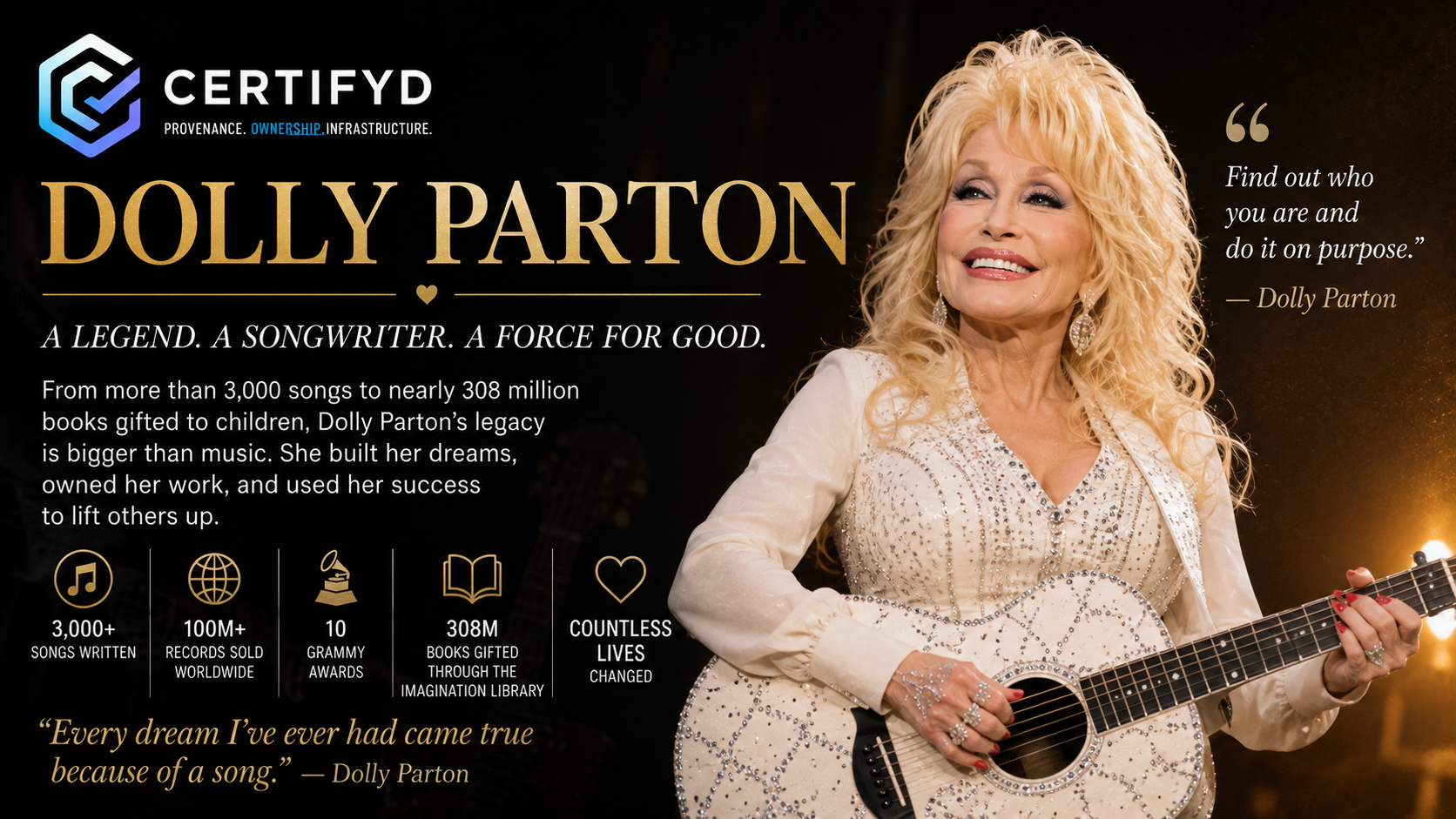
Dolly Parton's Legacy Was Bigger Than Music. She Built Something She Owned.
The tributes to Dolly Parton have been enormous because almost every conventional measure of her career was enormous.
She wrote more than 3,000 songs. She earned 25 No. 1 hits on Billboard's country chart, more than 50 Top 10 country songs and 44 Top 10 country albums. Her global record sales surpassed 100 million units, she won 10 Grammy Awards from 55 nominations, and in 2022 she was inducted into the Rock & Roll Hall of Fame.
Dolly Parton died Tuesday, August 25, at the age of 80 after a brief battle with cancer. The reaction has stretched far beyond Nashville. Musicians, executives, actors, fans and public figures around the world have been trying to describe an artist whose influence became so large that Sony Music Group's assessment feels unusually appropriate: "Every superlative you could apply to her would be accurate."
But there is another part of Dolly Parton's legacy worth talking about.
She didn't merely become extraordinarily famous.
She built something that belonged to her.
It Started With the Songs
Six days before Parton's death, the music industry received an extraordinary reminder of the durability of what she had created.
Her catalog earned 82 new sales certifications across 14 countries since its previous certification round in January 2022. "Jolene" reached Diamond status in Canada and the Netherlands, while "9 to 5" went Diamond in Canada.
That happened more than half a century after Parton began recording professionally.
At the ACM Honors that same week, she received the Academy of Country Music's Poet's Award for her songwriting. Parton couldn't attend, but her acceptance message went directly to the foundation underneath everything else she had accomplished.
At her core, she said, songwriting had always been the most important part of who she was creatively.
That's an important distinction.
Before Dolly Parton became a global celebrity, actress, theme-park owner, entrepreneur or philanthropist, she created intellectual property.
She wrote songs.
And unlike an enormous number of artists who learned the economics of the music business after signing away important rights, Parton understood the value of those songs.
The Famous Decision That Changed Everything
One of the most important business decisions in Parton's career involved a song almost everyone on Earth now knows.
"I Will Always Love You" was already Parton's song long before Whitney Houston's recording turned it into one of the biggest singles in music history.
Elvis Presley wanted to record it.
That should have been the opportunity of a lifetime for a young songwriter. Elvis recording your song could transform a career.
There was a catch.
Presley's manager, Colonel Tom Parker, reportedly required writers to surrender half of their publishing rights when Elvis recorded their material.
Parton refused.
She has described crying over the decision because she desperately wanted Elvis to record the song. But she wouldn't give away half of the publishing.
Years later, Whitney Houston recorded it for The Bodyguard. Her version became a global phenomenon and one of the best-selling singles ever released.
Dolly still owned her song.
That decision has become almost mythical in music-business circles because it illustrates something creators are still learning today:
Exposure and ownership are not the same thing.
Sometimes the biggest opportunity in the room isn't the best deal.
Dolly Understood the Difference Between Fame and Leverage
Parton's career is particularly interesting because she embraced enormous commercial opportunities without allowing any single opportunity to become the foundation underneath her identity.
She worked with record labels. She appeared on television. She starred in Hollywood movies. She collaborated with major artists. She licensed songs. She built businesses. She worked with enormous entertainment companies.
She wasn't anti-industry.
She understood how to use the industry.
That's different.
There is a tendency in modern creator culture to frame independence as refusing to participate in established systems. But creator sovereignty doesn't require isolation.
It requires leverage.
A creator can use a platform without becoming the platform's property. A musician can work with a label without believing the label created their value. A songwriter can license a song without forgetting that the song existed before the license.
Parton seemed to understand that instinctively.
The asset was the work.
Everything else was a relationship built around it.
She Turned Intellectual Property Into an Ecosystem
Eventually, Dolly Parton became considerably more than a recording artist.
Dollywood grew into one of Tennessee's major tourist destinations. Her businesses expanded across entertainment, hospitality and consumer products. Her image became globally recognizable, but unlike many celebrity brands, the Dolly Parton identity remained remarkably coherent.
It all came from the same creator.
Songs created attention.
Attention created cultural relevance.
Cultural relevance created opportunities.
Those opportunities created businesses.
And those businesses gave Parton the ability to do something much more consequential with the wealth and influence she accumulated.
She gave enormous amounts of it away.
Nearly 308 Million Books
If Parton's musical statistics are staggering, one number outside music may eventually become just as important to her legacy.
Nearly 308 million books.
Parton launched the Imagination Library in 1995, initially serving children in her home county in East Tennessee. The program grew internationally and now distributes free books to children across the United States, Canada, the United Kingdom, Australia and Ireland.
Nearly 308 million books had been gifted through the program by the time of her death.
Her philanthropy extended beyond literacy. She supported disaster relief, education and medical research, including funding that contributed to research associated with Moderna's COVID-19 vaccine.
This is where the story becomes bigger than a discussion about musicians retaining publishing rights.
Ownership gave her agency.
The wealth generated from her creative career didn't simply disappear into a chain of platforms and intermediaries. She accumulated enough control over her career and businesses to decide where some of that value went next.
Millions of children received books because of it.
That's creator ownership translated into impact.
What Does a Creator Actually Leave Behind?
Technology has made becoming a creator easier than at any point in history.
It has not necessarily made building a durable creative legacy easier.
Today's artists can accumulate millions of streams, followers, likes, subscribers and views while owning remarkably little of the infrastructure underneath those numbers.
A platform owns the account system.
Another platform owns the audience database.
Another controls distribution.
Another controls monetization.
Another processes the transactions.
The creator can become globally visible while remaining surprisingly dependent.
Dolly Parton's career came from a different technological era, but the principle underneath it feels increasingly relevant.
Build assets, not just attention.
A song is an asset.
A catalog is an asset.
A publishing right is an asset.
A business is an asset.
A direct relationship with an audience is an asset.
A platform metric is useful, but it isn't necessarily an asset the creator controls.
That distinction matters more as creative careers become increasingly digital.
Creator Sovereignty Isn't a Technology Trend
At Certifyd, we use the phrase sovereign creator to describe a creator who maintains control over their identity, work and commercial relationships rather than allowing every part of their career to exist exclusively inside somebody else's platform.
Dolly Parton obviously wasn't running a peer-to-peer creator node in 1974.
But the underlying instinct is remarkably familiar.
Know what you created.
Understand what it's worth.
Be careful about surrendering control.
Work with powerful partners without assuming they should own the foundation.
Build businesses around your creative assets.
And preserve enough agency that success gives you more choices rather than fewer.
Technology changes.
That principle doesn't.
"Every Dream Started With a Song"
One of Parton's final public messages came when she accepted the ACM Poet's Award by video shortly before her death.
She reflected on everything her career had eventually become and traced it back to something extraordinarily simple.
Every dream she had seen come true, she said, started with a song.
That's probably the most useful way to understand her career.
Not as a collection of celebrity accomplishments, but as compounding creative ownership.
One song became another.
Songs became a catalog.
The catalog built a career.
The career built businesses.
Those businesses created wealth.
And that wealth helped put hundreds of millions of books into children's hands.
There are very few creator careers from which the modern creator economy could learn more.
The platforms will change. The formats will change. The technology will change. Even the way music itself is created and distributed will change.
But Dolly Parton leaves behind a much older lesson.
Create something valuable. Know what you own. And don't give it away just because someone powerful offers you the spotlight.
That's a legacy worth remembering.