
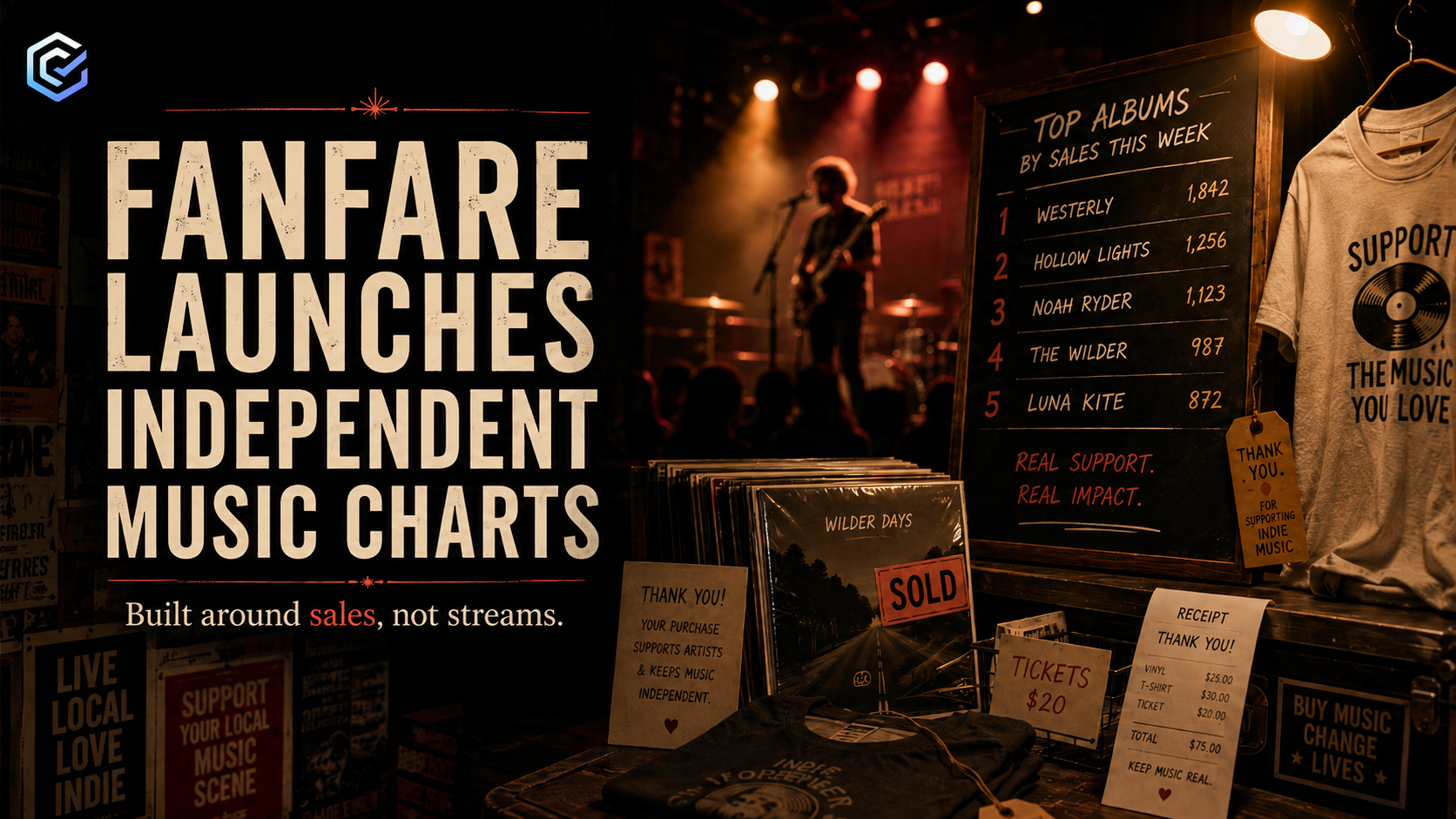
Fanfare Launches Independent Music Charts Built Around Sales, Not Streams
A new UK direct-to-consumer music company is launching with an unusual proposition: if you want to understand what's happening around independent artists, stop looking at streams and start looking at what fans are actually buying.
Fanfare launches September 1 as a platform for independent artists and labels to sell physical music and merchandise online and at concerts. Alongside the commerce platform, the company is introducing two monthly rankings: the Fanfare Independent Music Chart and Fanfare Independent Merch Chart.
The distinction is important. Fanfare's music chart won't include streaming at all. It will count physical sales such as vinyl, CDs and cassettes made through its platform by qualifying artists, while the separate merch chart will recognize purchases such as shirts, tote bags and other merchandise. Fanfare is also excluding legacy acts in an attempt to focus its rankings on artists building audiences now.
It's a very different definition of a music chart, and it points toward a larger change already underway in independent music.
Fanfare Wants to Measure Active Fan Support
Fanfare's argument is that streaming has made conventional charts less useful as a signal for developing independent artists. The company points to its own analysis of UK year-end album charts, which found that legacy acts have accounted for roughly two-thirds of entries since 2015, compared with about one-third before streaming was incorporated.
Whether removing streaming entirely is the right solution is open to debate, but Fanfare has identified a real distinction. A stream measures consumption, while someone deliberately buying an album or piece of merchandise represents a different kind of fan activity.
Fanfare intends to capture those transactions through its own commerce system. Artists can sell online or process purchases at concerts through the Fanfare app using tap-to-pay, and fans can order online with the option to collect at an upcoming show. Only transactions processed through Fanfare will count toward its rankings, which the company says allows the underlying sales to be verified rather than self-reported.
That last part may ultimately be more significant than whether vinyl beats streaming as a measure of independent success.
The Data Behind a Chart Matters
Charts have always depended on deciding which activity can be trusted. A ranking becomes meaningless very quickly if participants can simply report their own numbers, which is why established charts rely on defined reporting systems and eligibility rules.
Fanfare solves that problem by keeping the transaction and the measurement inside the same platform. If a shirt or record is sold through Fanfare, Fanfare can verify that the transaction happened and count it toward the appropriate chart.
It's a logical platform approach, but it also exposes a limitation common to centralized systems: the activity is verifiable because the company operating the chart also controls the system generating the data.
That raises a more interesting question for the next generation of independent music infrastructure. Does trusted activity have to originate inside the company creating the ranking, or can independently operated creators generate verifiable activity that different applications can interpret?
That's where our experience with Certifyd starts to diverge from Fanfare's approach.
Certifyd Has Been Looking at the Same Problem From the Network Level
Certifyd already surfaces multiple charts around creator and fan activity, but we haven't tried to reduce everything happening across the network to one definition of popularity.
Top Selling can surface commercial activity. Most Supported can show which creators are receiving meaningful fan support. Fastest Moving provides a view into momentum, while Recently Supported can expose where economic activity is happening now. Top Connected looks at relationships developing between participants in the network.
These rankings aren't intended to answer the same question. A creator generating the most sales may not be the creator receiving the broadest support, moving fastest or becoming the most connected. Treating those signals separately can reveal creators who would disappear if every form of activity were collapsed into a single popularity score.
The bigger difference, however, isn't the number of charts.
It's where the activity underneath them originates.
Platform Activity and Network Activity Aren't Quite the Same Thing
Fanfare can verify a sale because the transaction happens through Fanfare. That makes sense for a direct-to-consumer platform and gives its charts a clean source of transactional data.
Certifyd Core approaches creator activity from another layer. A creator can operate their own Core infrastructure, establish their identity, publish work into the network and participate in commerce without their creative identity originating as an account inside a central Certifyd marketplace.
Applications can then observe and organize activity occurring across that network.
That distinction creates a different relationship between the creator, the activity and the chart. The ranking doesn't have to be the system of record. It can be an interpretation of verifiable activity generated elsewhere in the network.
For independent creators, that could become an important distinction. A creator shouldn't necessarily have to move their entire commercial relationship inside the company operating a leaderboard just to prove that something happened.
What Does an Independent Chart Actually Need to Measure?
Fanfare's decision to separate music sales from merchandise is a good illustration of why this question matters. A fan buying a vinyl record and a fan buying a shirt have both supported an artist financially, but those transactions tell us different things.
The same applies to activity beyond Fanfare's two categories. A creator receiving repeated direct support is showing a different pattern from someone experiencing a sudden increase in sales. A new artist gaining momentum tells a different story from an established artist with a large cumulative audience, while collaboration and network connections reveal something that sales alone cannot measure.
Streaming belongs somewhere in that picture too. Removing it can make sense when the specific purpose of a chart is to measure purchases, but listening remains a legitimate form of audience activity. The problem isn't that streaming tells us nothing; it's that the industry has spent years allowing streaming numbers to tell us almost everything.
Independent creators are more complicated than that.
One Number Was Never Going to Explain an Artist
The streaming era encouraged the music industry to make enormous audience numbers unusually visible. Monthly listeners, total streams, playlist positions and follower counts became convenient shorthand for an artist's importance.
Those numbers can be useful, but they can also obscure smaller creator economies that are functioning extremely well. An independent musician with a modest audience that consistently buys releases, attends shows and supports new projects may have a stronger underlying business than an artist with substantially more passive consumption.
Fanfare is responding by giving physical purchases and merchandise their own rankings. Certifyd's approach extends the same underlying observation across more forms of activity: don't assume one signal can explain the entire relationship between creators and fans.
That is particularly important when charts are used for discovery. A chart shouldn't only tell us who is already biggest. It can tell us where something interesting is happening.
Charts Can Become Different Windows Into the Same Economy
A sales chart tells us where people are spending money on music. A merchandise chart tells us where fans are purchasing something connected to the artist beyond the recording itself. A support chart can reveal direct financial backing, while a momentum chart can expose activity before the creator becomes large enough to dominate conventional rankings.
None of those measurements needs to replace the others.
That's why Certifyd doesn't need one definitive chart. The network can support different discovery views because different signals answer different questions. As the network develops, those views can evolve without requiring us to declare one metric the official definition of creator success.
The underlying architecture also leaves room for other applications to interpret network activity differently. Certifyd's own Fan experience can surface Top Selling or Most Supported, but a network doesn't have to end with the applications its original developers decide to build.
That's one of the advantages of treating the network as infrastructure rather than treating the platform as the destination.
Fanfare Is Part of a Bigger Shift Away From Stream Counts
Fanfare's launch is useful because it makes an emerging change in independent music unusually visible. The industry has spent more than a decade perfecting its ability to count consumption, while the renewed interest in direct-to-fan commerce is forcing it to pay more attention to transactions and relationships.
Physical music and merchandise are obvious places to start because a purchase is easy to understand. Someone chose an artist, chose a product and spent money. That represents a level of intent that a passive stream cannot necessarily demonstrate.
But the direct-to-fan economy produces more than sales. It produces support, repeat activity, momentum, collaborations and relationships between participants. As creator infrastructure becomes capable of verifying more of those events, charts can become considerably more useful than another list of the biggest artists.
Fanfare is approaching that change by building two new rankings around transactions occurring inside its platform. Certifyd approaches it from a network where different forms of creator activity can become different discovery signals.
Both approaches begin with a similar observation: the conventional streaming leaderboard doesn't tell the whole story.
Where we go further is in asking whether there should be a single story at all.
Independent Music Needs More Than Another Scoreboard
The future of music charts doesn't have to be a fight between streams and sales. Nor does independent music need to replace one dominant metric with another.
What matters is understanding what each signal actually represents.
Streams can show consumption. Sales can show purchasing intent. Direct support can reveal commitment. Momentum can show where activity is accelerating, and network relationships can reveal creators becoming important to an ecosystem before conventional popularity metrics notice them.
Once those signals can be verified, there is no reason to force them into one number.
Fanfare's independent music and merchandise charts are another indication that the industry is beginning to look beyond streams when measuring artist activity. That's significant, but it's also only one layer of what becomes possible when direct creator-to-fan activity can be observed and trusted.
At Certifyd, that's the more interesting destination: not simply building a different chart, but building creator-controlled infrastructure from which entirely different ways of measuring and discovering independent success can emerge.
The chart is useful.
The activity underneath it is what really matters.