
Global Recorded Music Revenue to More Than Double By 2033: MIDiA Report Says
The next phase of music-industry growth may be about much more than getting people to stream more music.
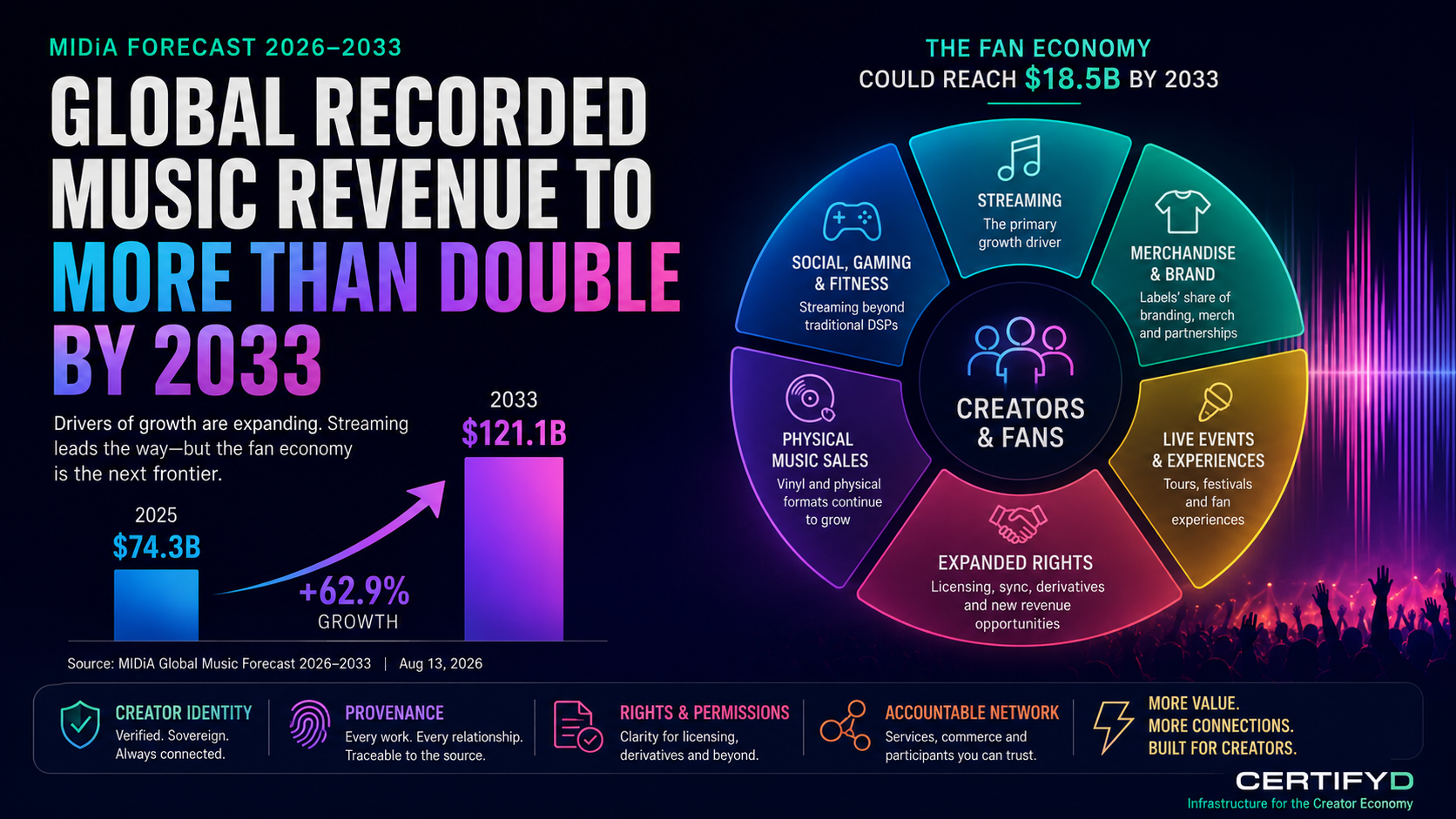
According to MIDiA's new Global Music Forecast 2026-2033, global recorded music revenue is projected to reach $121.1 billion by 2033, up 62.9% from $74.3 billion in 2025.
Streaming is expected to remain the industry's primary growth driver. But one of the report's most interesting predictions is what happens around the stream: MIDiA expects expanded rights and a growing "fan economy" to become increasingly important as traditional streaming growth begins to mature in established markets.
For creators, that's a significant shift.
The Fan Economy Could Reach $18.5 Billion
MIDiA projects the fan economy could be worth $18.5 billion by 2033.
Its definition extends well beyond conventional Spotify or Apple Music streaming. It includes physical music sales, music consumed through social, fitness and gaming platforms, and expanded rights that give labels participation in areas such as merchandise, branding and live events.
MIDiA VP of Music Strategy Tatiana Cirisano argues that the industry's next growth phase will require pulling new economic levers both inside and outside the subscription model.
That's important because it changes what a music business actually looks like.
A recording isn't simply something uploaded to a streaming service.
It can sit at the center of a much larger network of commercial activity.
One Creator. Many Economic Relationships.
A song can generate streaming revenue.
But the same creative identity can also support physical releases, merchandise, licensing, live performances, brand partnerships, fan experiences, remixes, derivative works and new forms of distribution through gaming and social platforms.
That creates an increasingly interconnected economy:
Creator → Work → Rights → Distribution → Fans → Merchandise → Licensing → Derivatives → Experiences → Commerce
Each new opportunity can also introduce another participant.
Publishers, labels, manufacturers, retailers, licensing companies, distributors, promoters and technology providers can all participate in different parts of the creator's business.
The opportunity is enormous.
So is the infrastructure problem.
Streaming Isn't the Entire Creator Economy
For much of the last decade, music-industry growth has been discussed primarily through streaming.
Subscriber counts increased. Catalogs became more valuable. Streaming became the dominant recorded-music business model.
MIDiA's forecast suggests the industry's next phase will be broader.
Streaming remains critical, but music companies are increasingly looking for ways to capture value from the economic activity surrounding artists and their audiences.
That makes the relationship between a creator and their fans more important.
It also makes the relationships surrounding the creator's intellectual property more important.
Who owns the work?
Who is authorized to license it?
Who can manufacture merchandise?
Who can create a derivative?
Who participates in a transaction?
Who should receive a share of the resulting revenue?
As the number of commercial opportunities increases, those relationships become harder to manage with disconnected systems.
Where Certifyd Fits
This is where the MIDiA forecast becomes particularly relevant to Certifyd.
Certifyd is being built around a creator's identity and intellectual property rather than around a single distribution channel.
A work can maintain its provenance. Contributors can remain attributable. Rights and permissions can remain connected to the work. Derivative works can maintain relationships with their originals, including structured clearance processes where approval is required.
Commerce can then exist around those relationships rather than becoming disconnected from them.
The distinction matters.
The goal isn't to create another platform that owns the creator's audience or becomes another intermediary between the creator and the market.
It's to give creators and the businesses around them infrastructure for establishing verifiable, accountable relationships.
The Fan Economy Needs More Than Fans
An $18.5 billion fan economy doesn't appear simply because fans are willing to spend money.
Someone has to manufacture the merchandise.
Someone may distribute a physical release.
Someone licenses the artwork.
Someone operates a fan experience.
Someone clears a derivative.
Someone provides commerce.
Someone may provide publishing, rights administration or another specialized service.
Certifyd's network model creates the possibility for those businesses to participate as service providers without requiring a single central company to perform every function.
The creator remains connected to the work while accountable participants provide services around it.
That becomes increasingly important as creator businesses expand beyond conventional streaming.
Provenance Can Extend Beyond the Recording
The same principle applies to physical and commercial products.
If a creator's intellectual property becomes merchandise, for example, provenance doesn't have to stop at the recording.
A rights holder can establish authorization. A licensing partner can establish its relationship to the intellectual property. A manufacturer can establish authorization to produce a product. A retailer can establish authorization to sell it.
The same underlying concept can extend across other parts of the creator economy:
Who created this?
Who controls it?
Who was authorized?
What was created from it?
Who participated?
Those questions become more valuable—not less—as the number of ways to monetize creative work increases.
More Revenue Means More Complexity
MIDiA also expects music retail revenues to grow faster than trade revenues as digital services increasingly bundle music with other forms of audio entertainment and retain revenue that isn't shared with music companies.
Meanwhile, subscription pricing is expected to continue evolving, eventually contributing to renewed growth in average revenue per user.
Taken together, the forecast describes a music economy that is becoming larger, but also more complicated.
The industry isn't moving toward one dominant revenue source.
It's moving toward more revenue sources, more products, more services, more participants and more ways for fans to interact economically with creators.
That creates opportunity, but it also creates more relationships that need to be managed.
The Creator Is the Common Thread
Streaming platforms will change.
Retailers will change.
Social platforms will change.
New AI, gaming and fan platforms will emerge.
But the creator and the intellectual property remain the common thread connecting those markets.
That's why the infrastructure underneath the next generation of music matters.
If MIDiA's forecast is directionally right, the industry's next major expansion won't simply come from making the streaming economy larger.
It will come from making the creator economy wider.
The opportunity is to connect creators, intellectual property, fans, rights, services and commerce without forcing every relationship through another central gatekeeper.
A $121.1 billion recorded-music economy would be significant.
An increasingly connected economy built around everything creators and their fans can do together could be much bigger.
That's the market Certifyd is being built for.
Certifyd covers developments in music, intellectual property and creator commerce and examines what they mean for provenance, rights, ownership and the infrastructure connecting creators with their markets.