
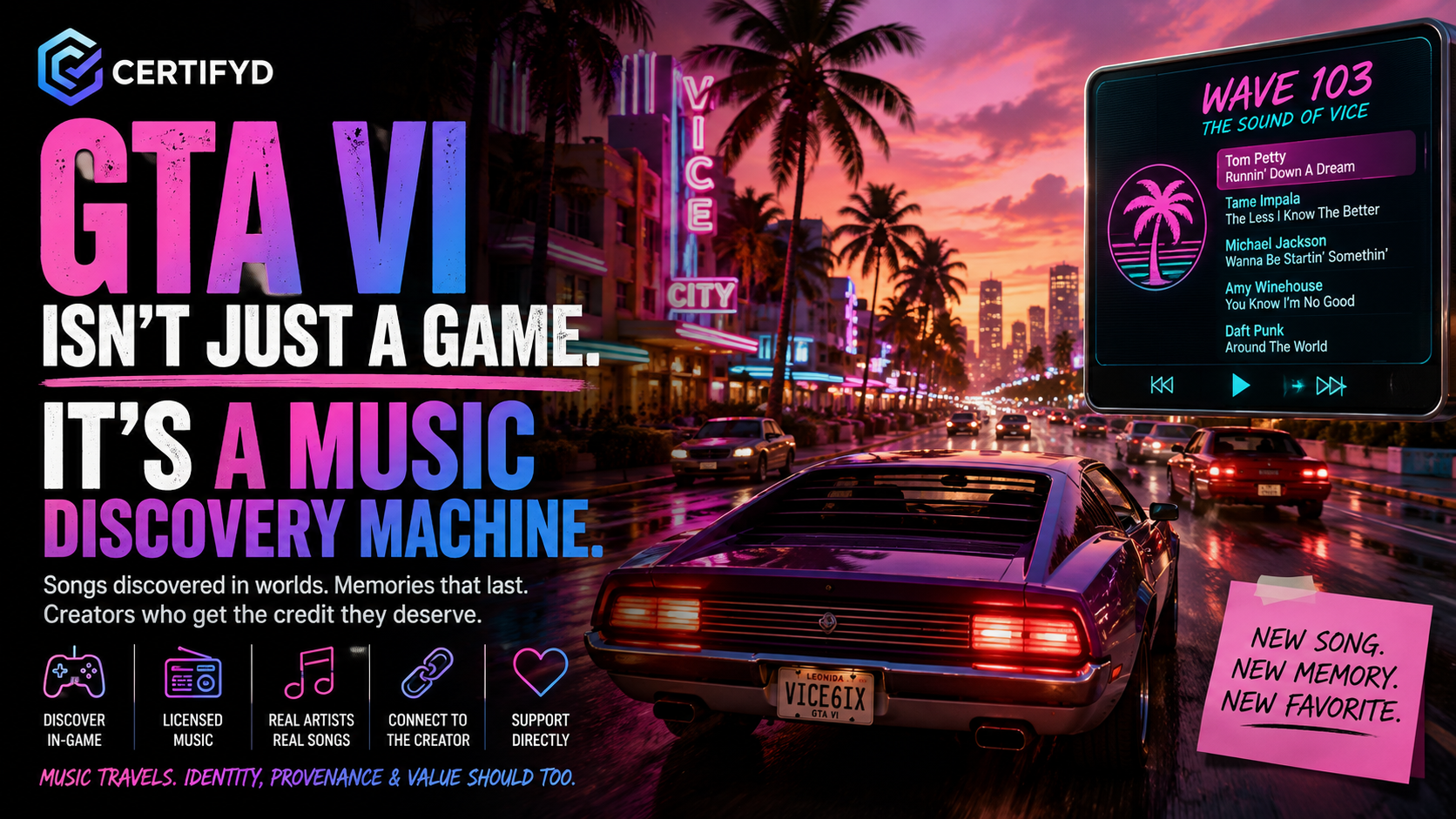
GTA VI Isn't Just a Game. It's a Music Discovery Machine.
Somewhere in Vice City, somebody is going to discover their new favorite song while stealing a car.
That's one of the strange powers Grand Theft Auto has accumulated over the years. Rockstar doesn't simply put background music into its games; it builds radio stations, personalities and musical environments that become part of the worlds players inhabit. Now Grand Theft Auto VI is preparing to do it again, with Digital Music News reporting that the game is packed with licensed music.
That's fun on its own, but there's a bigger idea hiding underneath it. Some of the most important music-discovery platforms of the future might not look like music platforms at all.
You Don't Always Discover Music While Looking for Music
Streaming changed music discovery by putting enormous catalogs behind search boxes and recommendation engines, but discovery has never happened exclusively inside record stores, radio stations or music apps. Sometimes a song finds you. You hear it in a movie, someone plays it at a party, a DJ drops it in the middle of a set, or you're driving a stolen sports car through a fictional version of Florida when something comes on the radio.
That context matters. A song discovered inside a game isn't simply another item in a playlist; it can become connected to a place, mission, character or ridiculous thing that happened while you were playing. Years later, hearing the song can bring the entire experience back. That's a remarkably powerful relationship for a piece of music to have with an audience.
Grand Theft Auto Has Been Doing This for Years
Music has long been part of Grand Theft Auto's identity. The radio stations aren't merely playlists playing underneath the game; they're part of its fictional world, complete with genres, hosts, advertisements and personalities. That makes the experience fundamentally different from pressing shuffle on a streaming service because you aren't necessarily choosing the song. You encounter it.
Those encounters can also happen repeatedly as players spend hours exploring a game world. A track that might receive a few seconds of attention while somebody scrolls through a playlist can instead become associated with driving through a particular neighborhood, completing a mission or simply wandering around. For an artist, that's an interesting kind of distribution because the music becomes part of an experience rather than a piece of content competing for the next click.
A Song Can Live in More Places Than Spotify
The music business naturally spends enormous amounts of time talking about streaming platforms. That makes sense: streaming is one of the primary ways recorded music is consumed. But games, social networks, films, virtual worlds, fitness applications, creator communities and other interactive experiences can all become places where music reaches people.
Increasingly, those environments aren't simply promotional channels pointing back toward a streaming service. They're destinations themselves, sometimes commanding enormous amounts of a person's attention. That creates an interesting question for creators and the music industry: what does music infrastructure look like when the places where music is discovered keep multiplying?
Discovery Is Only the Beginning
Hearing a song is one thing. Discovering everything around it is another.
Someone who hears a track inside a game may want to know who made it, who contributed to it, whether it's the original recording, what else the artist has released or where they can support that artist directly. They might want a physical release, an alternate version or simply a way to follow the creator beyond the game where the discovery happened.
Today, answering those questions usually means jumping between platforms. The game provides one piece of the experience, a streaming service provides another, social platforms hold much of the artist's audience, merchandise lives somewhere else, and release information may be maintained by distributors and other intermediaries. The song can travel remarkably well across the internet, while the identity, history and relationships surrounding its creator remain fragmented.
Music Needs to Travel With Its Context
This is where provenance becomes more interesting than a line of metadata buried inside a database. A digital work has a history: it has a creator, it may have contributors, and it can have releases, versions, permissions, commercial relationships and connections to other works. As music moves through more environments, preserving those relationships becomes increasingly useful.
The ideal future isn't one where every game, platform and application creates another disconnected version of an artist and their work. It's one where the work can move while remaining connected to the creator and the history behind it. That's a very different architecture from repeatedly uploading fragments of the same identity and information into somebody else's platform.
The World Around the Song Is Getting Bigger
Certifyd Core is being built around that idea. Creators can establish identity, works, provenance, release records, permissions and commerce under infrastructure they control. External services can then become places those works travel rather than becoming the only authoritative home of the creator's identity and history.
Games are a particularly fun example of why that matters. Imagine discovering an independent artist while exploring a game world and having that work remain connected to a creator-controlled identity and ecosystem. A listener could discover other releases, understand the provenance of the work, support the creator or establish a direct relationship without requiring the game itself to become the permanent intermediary between them.
The game can provide the discovery. The creator doesn't have to surrender everything that comes after it.
Maybe the Next Great Music Platform Isn't a Music Platform
GTA VI will be judged as a game. People will talk about its world, characters, missions, graphics and whatever spectacular chaos Rockstar has created, but players are also going to spend a considerable amount of time listening to music inside that world. Some will hear songs they already love, while others will discover something completely new without ever opening a music app.
That's the larger shift worth paying attention to. Digital media increasingly appears inside games, social spaces, virtual worlds and experiences that weren't built primarily for music. For creators, distribution can therefore become much bigger than getting onto another playlist.
Your work can travel almost anywhere. The important part is making sure the connection back to you can travel with it.