
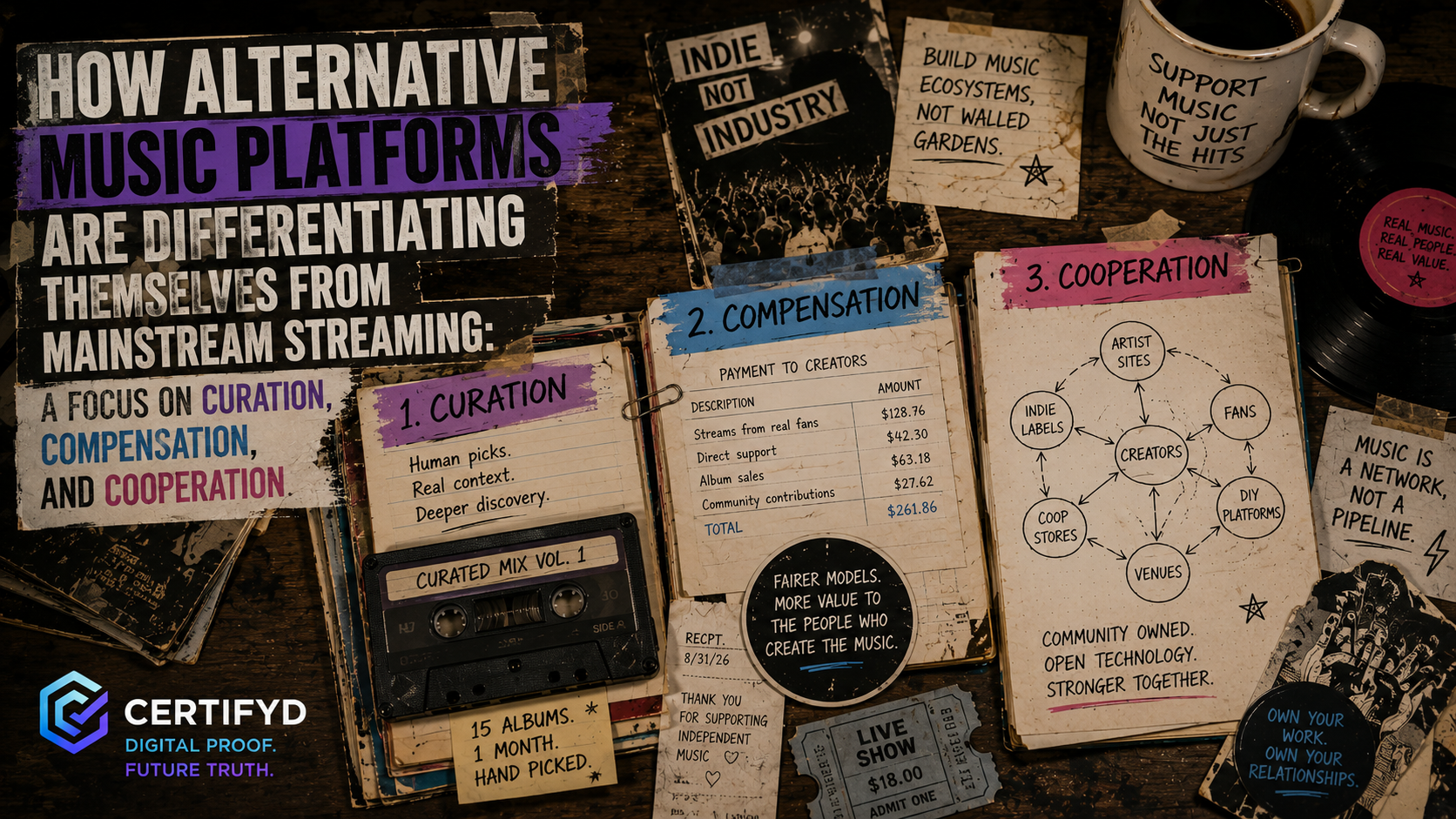
How Alternative Music Platforms Are Differentiating Themselves from Mainstream Streaming: A Focus on Curation, Compensation, and Cooperation
For years, nearly every conversation about fixing music streaming has eventually run into the same question: how do you build a better Spotify?
Maybe that's the wrong question.
A growing collection of smaller music services is experimenting with very different ideas about how people discover music, how artists get paid and even who should own the infrastructure connecting them. Individually, none appears likely to displace the dominant streaming services anytime soon. Taken together, however, they suggest something more interesting than another streaming competitor: a music ecosystem in which different services can solve different problems.
Music Ally explored that emerging landscape in a guest column by Northeastern University music industry professor Ryan Blakeley, who examined alternative platforms through three broad ideas: curation, compensation and cooperation. The services vary enormously, from full-catalogue streaming companies to tiny curated catalogs and cooperative marketplaces, but their differences reveal just how many assumptions about digital music are being reconsidered.
What If More Music Isn't the Answer?
Mainstream streaming solved an enormous problem. For a relatively small monthly payment, listeners gained convenient access to catalogs containing tens of millions of songs. That abundance became one of streaming's defining advantages, but it also created another problem: when virtually everything is available, helping somebody decide what deserves their attention becomes increasingly important.
Some alternative services are responding by deliberately offering less.
Cantilever takes perhaps the clearest approach. Inspired by the curated film service Mubi, it carries only 15 albums at a time, with each available for a month. Releases are accompanied by editorial material or artist reflections, leading the company to describe the service as a "music magazine you can listen to." Lume takes a related approach by encouraging listeners to enter the "world of an album," with artists able to package music alongside material such as demos, photography, tour videos and essays. :contentReference[oaicite:1]{index=1}
Qobuz approaches the same problem at a much larger scale, combining a catalog of more than 100 million tracks with human-curated playlists, editorial content and detailed discography guidance. Vocana and Coda lean more heavily on communities, tastemakers and social interaction as ways of discovering music. The common thread isn't simply opposition to algorithms; it's the belief that context itself can have value. :contentReference[oaicite:2]{index=2}
That's a meaningful change in thinking. Streaming spent years optimizing access to music. These services are experimenting with what happens around the music: why somebody should listen, who recommended it, what the artist intended and what else surrounds the work.
The Payment Experiment Is Getting More Interesting
The second area of experimentation is familiar: how artists get paid.
The dominant streaming model generally pools revenue and distributes royalties proportionally according to listening activity. Several alternative services are testing user-centric approaches instead, where a subscriber's listening contributes specifically to the artists that subscriber actually plays. Cantilever, Vocana and Lissen use variations of that idea. :contentReference[oaicite:3]{index=3}
Other experiments go further. Juniper plans to calculate royalties using total listening time rather than simply counting streams. Coda retains a pro-rata model but allows subscribers to choose an artist who receives an additional dollar from the company's margin each month. Tapedeck and the forthcoming Sawtooth are experimenting with pay-per-play systems, introducing something mainstream streaming spent years trying to eliminate: friction. :contentReference[oaicite:4]{index=4}
That friction is intentional. The theory is that there is a class of listener who doesn't merely want unlimited access for the lowest possible price. These are people who buy records, go to shows, purchase merchandise and actively want more of their money to reach the artists they care about.
None of these models has magically solved music economics. User-centric royalties redistribute an existing pool rather than making the pool larger, while pay-per-play asks listeners to accept costs that unlimited streaming trained them not to think about. Music Ally also points to the fundamental problem facing any new full-catalogue service: licensing major catalogs requires money and scale, while achieving that scale can itself depend on having the major catalogs. :contentReference[oaicite:5]{index=5}
The experiments matter precisely because they're experiments. Instead of assuming the current streaming model is the inevitable final form of digital music, these companies are testing whether different groups of listeners might accept different relationships with music.
Then There's a Much Bigger Question: Who Owns the Platform?
Curation changes discovery. Alternative payment models change how money moves. Cooperation asks a more fundamental question: who ultimately controls the system?
That question became particularly visible after Bandcamp changed hands twice, first through its acquisition by Epic Games and later through its sale to Songtradr. Whatever the merits of an individual owner, the episode demonstrated a structural reality of conventional platforms: a service can build its reputation around an artist-friendly community while ownership and strategic control remain somewhere else.
Some newer projects are attempting to change that architecture.
Subvert, Mirlo and jam.coop are experimenting with cooperative structures that distribute ownership or governance rather than concentrating it exclusively among conventional shareholders and executives. Subvert has gone particularly far, building a multi-stakeholder cooperative with workers, artists, labels and supporters as member classes. Music Ally reports that the organization has nearly 30,000 members, each with a vote in its governance. :contentReference[oaicite:6]{index=6}
That is a much more ambitious experiment than tweaking a royalty calculation. It asks whether the people creating value inside a music ecosystem can also participate in controlling it.
But even cooperation has a scaling problem. A small community-owned service still needs technology, resources, users and sustainable economics. Decentralizing ownership doesn't automatically make those problems disappear.
That's where one of the most interesting ideas in the entire Music Ally piece appears.
What If the Alternative Isn't One Platform?
Mirlo and jam.coop are exploring open-source technology and the possibility of federation. Chris Lowis of jam.coop describes people discussing a model involving many smaller sites, potentially operated by individual artists, communicating with one another while still gaining some of the benefits of working together. :contentReference[oaicite:7]{index=7}
That changes the question completely.
Instead of asking which alternative platform can accumulate enough artists, listeners, capital and catalog to defeat Spotify at Spotify's own game, imagine an ecosystem where no single service needs to do everything.
One service might be exceptional at human curation. Another could build beautiful album experiences. Another could specialize in independent discovery. A marketplace could handle physical products. A game could introduce millions of people to a song. Communities could form around genres, scenes, labels or individual creators.
The internet already works this way in many respects. What's missing is a durable way for the creator and the work to remain connected as they move between those experiences.
That's a different problem from building another streaming app.
Creators Need Infrastructure, Not Just Another Destination
This distinction matters to Certifyd because Certifyd isn't trying to become the next Spotify.
Certifyd Core starts with creator-controlled infrastructure. A creator can establish identity, works, release records, provenance, permissions, commerce and relationships without requiring one central platform to become the permanent authoritative home for all of them.
That becomes particularly useful in the kind of ecosystem these alternative services are beginning to imagine. A creator shouldn't necessarily have to choose one company to provide discovery, community, commerce, identity and distribution forever. Different applications and communities can provide different experiences while the underlying relationship between the creator and their work remains intact.
This doesn't make platforms unnecessary. Good platforms create enormous value by aggregating audiences, designing experiences, providing discovery and solving specific problems. The distinction is between using a platform to build something and allowing the platform itself to become the only place where what you built exists.
Federation makes that distinction especially important. If the future really does include many smaller services communicating and cooperating, creators will need identity and works that can participate in that network without being recreated from scratch inside every new destination.
Maybe Nobody Needs to Beat Spotify
There is a healthy dose of realism in Music Ally's analysis. Alternative platforms have failed before, and some of today's experiments will probably fail too. Full-catalogue licensing is expensive, acquiring paying listeners is difficult, and most consumers continue to place enormous value on convenience. The article concludes that niche services are unlikely to overturn Spotify's dominance and questions whether the market could even sustain dozens of alternatives. :contentReference[oaicite:8]{index=8}
But perhaps overthrowing Spotify is an unnecessarily narrow definition of success.
The more interesting development is the number of assumptions now being tested simultaneously. Does discovery have to be algorithmic? Does every service need every song? Does streaming have to be unlimited? Should every listener's subscription be divided according to what everyone else listens to? Does a music community have to be owned by a conventional corporation? Does every new idea need to become another giant platform?
Curation, compensation and cooperation offer different answers to those questions. None, by itself, provides a complete replacement for the existing music economy.
Together, they point toward something else: not one alternative platform, but an alternative way of thinking about the network.
And that may ultimately be much more interesting than building another Spotify.