
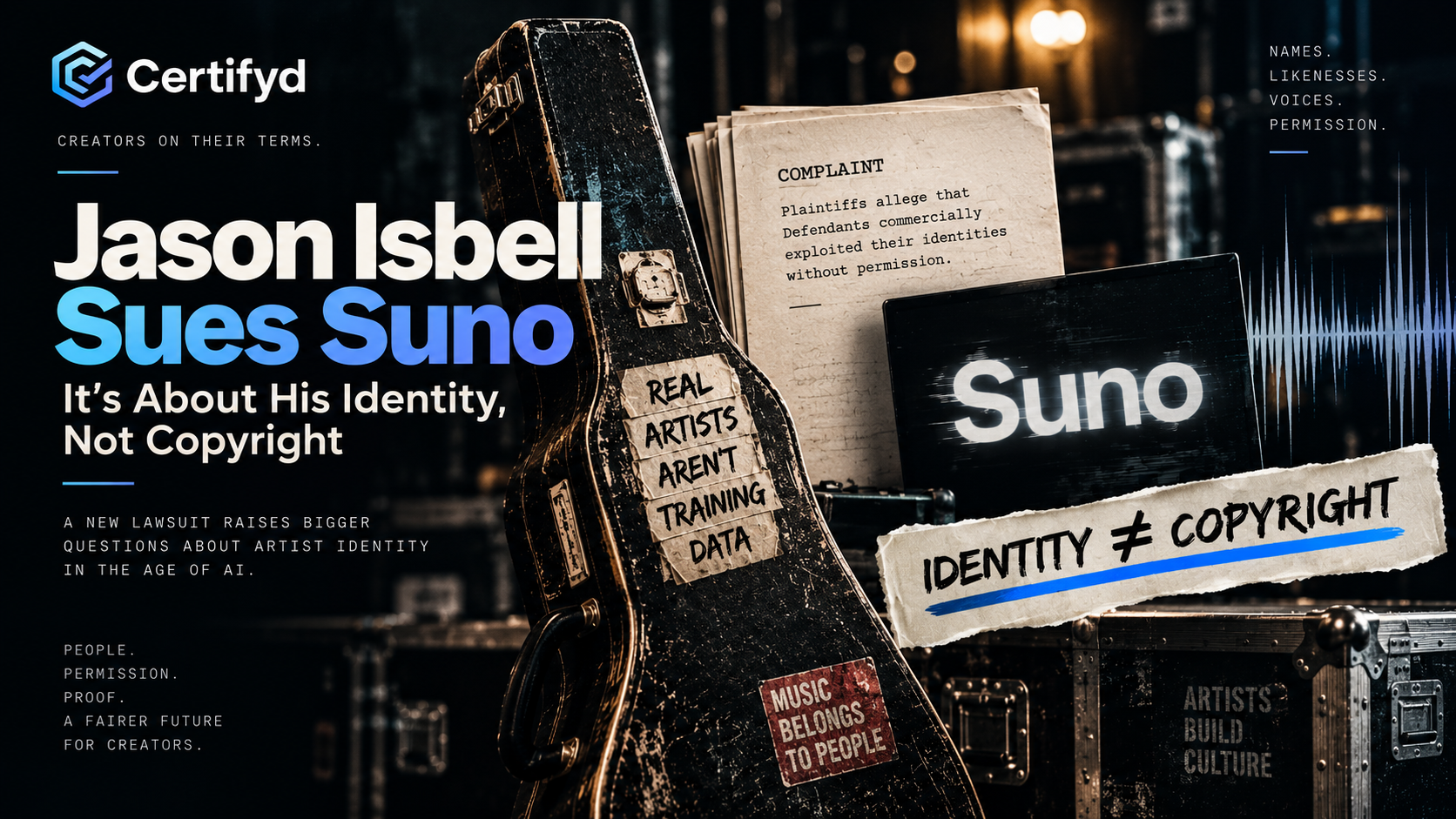
Most of the music industry's fight with generative AI has been framed as a copyright fight. Who owns the recording? Who owns the composition? Was copyrighted music used for training? Does an AI-generated output infringe an existing work?
A new lawsuit against Suno asks a different question: Who owns the artist?
Jason Isbell, David Lowery, Guy Forsyth and Eduardo Calle filed a proposed class action against Suno in federal court in Massachusetts on August 31. Unlike many of the lawsuits now surrounding generative AI, their complaint doesn't make a copyright claim. Instead, the musicians accuse Suno of commercially exploiting their identities without permission.
That distinction could become increasingly important as AI moves deeper into music.
A Song and an Artist Are Not the Same Asset
According to the complaint, Suno built technology capable of responding to musicians' names by generating music, descriptions and imagery that evoke those musicians. The plaintiffs also allege that Suno processed and stored identifying characteristics of performers' voices. Suno disputes the allegations and says its tools are designed to create new, original music with safeguards against misuse.
Whatever the courts ultimately decide, the case exposes an important architectural problem. A musician exists across several overlapping systems of rights and relationships. There are compositions, recordings, publishing interests, royalty interests, trademarks, publicity rights, contracts and licenses. Then there is the human being whose identity connects those things together.
Owning or licensing one part of that system doesn't necessarily give somebody control over everything else.
The lawsuit points directly at that distinction. It argues that a record company's ability to license a recording does not, by itself, authorize an AI company to use the performer's identity. The complaint even points to Suno's licensing arrangements as evidence that names, images, likenesses and voices can require separate permission.
That's bigger than an AI-training dispute. It's a question about where authority begins.
The Industry Has Databases for Works. Identity Is Harder.
The music business has spent decades building systems for identifying creative works. Recordings can have ISRCs. Compositions can have ISWCs. Releases can have UPCs. Publishers, labels, distributors and collecting societies maintain enormous databases describing ownership and commercial relationships.
Artist identity is considerably messier.
A Spotify profile is not the artist. A YouTube account is not the artist. A record-label database entry is not the artist. Neither is a name typed into an AI prompt. They are representations of an identity maintained inside somebody else's system.
That distinction becomes increasingly important when software can do more than display an artist's name. AI systems can potentially generate music associated with that name, imitate recognizable characteristics, produce imagery, create promotional material and participate in commercial activity.
At that point, knowing who the artist is isn't enough. The system also needs to know what somebody is authorized to do with that identity.
Permission Needs Structure
We've already seen another version of this problem in the Mary J. Blige/Suno advertising controversy. There, the central question wasn't whether Mary J. Blige existed or whether the company knew who she was. It was whether the person arranging a commercial relationship actually had authority to act for her.
The Isbell lawsuit approaches the same infrastructure problem from another direction. A useful digital identity system for creators therefore needs to express more than identity. It needs relationships and permissions.
An artist might authorize a manager to negotiate certain agreements. A label might control particular recordings without controlling the artist's publicity rights. A publisher might administer compositions without having authority over the performer's voice. An estate might inherit some rights after an artist dies while other rights remain elsewhere.
Those distinctions already exist legally and commercially. The digital infrastructure representing creators should be capable of expressing them too.
Identity Should Be a Root, Not a Profile
This is where creator-controlled infrastructure starts to matter.
Certifyd's approach to identity isn't based on making another profile that creators maintain inside another platform. The more interesting possibility is establishing creator identity as a root from which verifiable relationships can extend.
A creator can be connected to a work. A work can be connected to rights holders. A creator can establish a relationship with a manager, publisher, label or collaborator. Permissions can have scope. Relationships can change. Authority can potentially expire or be revoked.
Other services don't necessarily need to own those records. They need a reliable way to verify them.
That reverses a familiar architecture. Instead of every platform independently deciding who an artist is and who can act for them, authoritative information can begin with the creator and move outward.
The platform becomes a consumer of identity rather than its owner.
AI Is Making an Old Problem Impossible to Ignore
None of this started with generative AI. Artists have always had managers, agents, labels, publishers, lawyers and representatives acting on their behalf. Music rights have always been divided among different parties. Unauthorized releases, impersonation and disputes over representation existed long before anybody could generate a song from a text prompt.
AI changes the scale and speed of the problem.
A system capable of generating media instantly needs equally machine-readable ways of understanding permission. Otherwise, we're building extraordinarily sophisticated systems for creating content on top of surprisingly primitive systems for establishing who authorized what.
The Isbell case is particularly interesting because it separates the creator from the creator's works. Copyright can help answer who controls a song or recording.
It doesn't completely answer who controls Jason Isbell.
That requires another layer. And as AI makes identity itself increasingly programmable, that layer may become just as important as the rights infrastructure the music industry spent the last century building.