
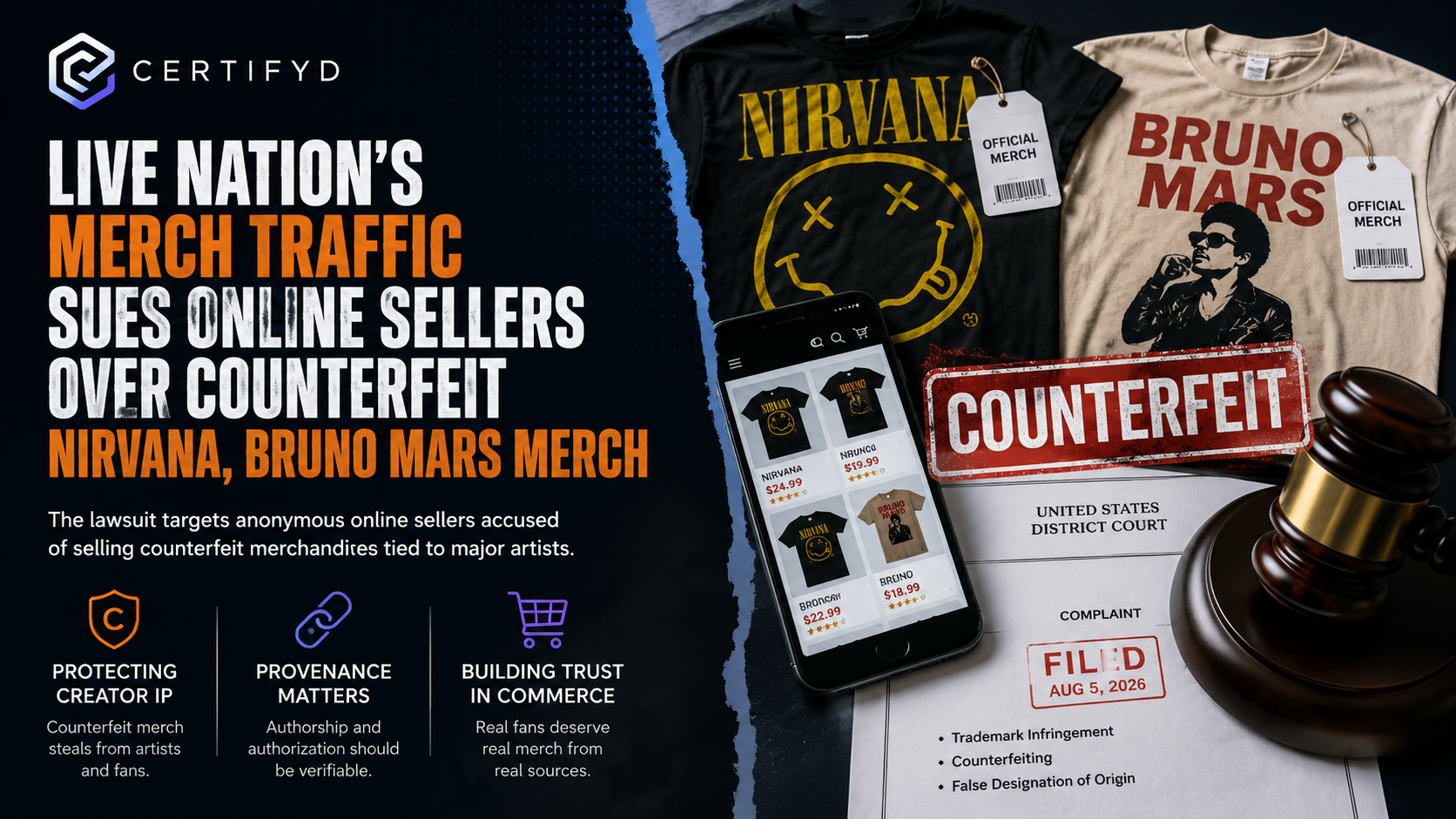
Live Nation’s Merch Traffic Sues Online Sellers Over Counterfeit Nirvana, Bruno Mars Merch
Counterfeit artist merchandise is moving far beyond bootleg T-shirts sold outside concert venues.
Live Nation Entertainment subsidiary Merch Traffic has filed a trademark lawsuit against a group of anonymous online sellers it accuses of selling counterfeit merchandise associated with artists including Nirvana, Bruno Mars, Harry Styles, Avenged Sevenfold, Eazy-E, The Notorious B.I.G. and The Cure.
The complaint was filed August 5 in the U.S. District Court for the Northern District of Illinois. Merch Traffic describes itself as the exclusive U.S. licensing agent for the artists named in the complaint. :contentReference[oaicite:0]{index=0}
The Fight Has Moved Online
Music merchandise counterfeiting isn't new. What's changing is the infrastructure behind it. Merch Traffic has previously pursued alleged bootleg merchandise connected to physical concert venues. This lawsuit instead targets e-commerce operators that the company says use aliases to conceal their identities while selling through online storefronts.
According to the complaint, some of those stores are designed to appear to consumers as legitimate authorized retailers, outlets or wholesalers.
That creates a bigger problem than simply copying a T-shirt.
How does a fan know whether the merchandise they're buying is actually authorized?
Merch Traffic Turns to the Lanham Act
The lawsuit brings two counts under the Lanham Act: trademark infringement and counterfeiting, and false designation of origin.
Merch Traffic is seeking injunctive relief, an accounting of the sellers' profits and potentially significant damages. The complaint also asks the court to require third-party providers to stop displaying the defendants' listings and advertisements.
It's another example of the enormous amount of work required to establish authenticity after potentially counterfeit goods have already entered the market.
Rights holders must identify suspicious products, determine who's selling them, establish infringement, pursue enforcement and then work with marketplaces and other service providers to have the products removed.
Detection Versus Provenance
There's a parallel here with another issue currently facing the music industry: AI.
With AI-generated music, much of the industry is developing systems that attempt to determine what something is after it has already been created. Counterfeit merchandise presents a similar problem.
Enforcement asks:
Is this product counterfeit?
Provenance allows us to ask a different question:
Can this product prove that it's authorized?
Those are fundamentally different approaches.
What If Official Merchandise Could Prove It?
Consider how legitimate artist merchandise actually reaches a fan. An artist or rights holder controls intellectual property. A licensing company may receive authorization to commercialize it. A manufacturer is authorized to produce merchandise. A retailer is authorized to sell it. Finally, a fan purchases the product.
That creates a commercial chain:
Creator → IP → License → Manufacturer → Product → Authorized Seller → Fan
Today, much of that information exists across contracts, databases and companies that don't necessarily communicate with one another. The product itself may provide the consumer with very little evidence of that history.
That's a provenance problem.
Where Certifyd Is Going
Certifyd is already being built around connected, verifiable relationships between creators, intellectual property, permissions, derivatives and commerce. Extending that provenance into physical creator goods is part of our partnership planning. The idea is not that Certifyd needs to manufacture merchandise or become another online marketplace.
Instead, the network can provide infrastructure through which the participants who already perform those jobs establish verifiable relationships.
A creator establishes the root identity. A rights holder can establish authorization. A licensing partner can establish its relationship to the intellectual property. A manufacturer can establish its authorization to produce specific products. A retailer can establish its authorization to sell them.
The result is a chain of provenance that can potentially travel alongside the product.
A Network of Accountable Participants
This becomes particularly powerful when provenance is combined with Certifyd's network model.
Manufacturers, licensing companies, retailers and other trusted businesses don't necessarily need Certifyd to perform their jobs for them. They can participate as accountable service providers.
That creates the possibility of an open creator-commerce network where businesses can provide services while creators maintain a verifiable relationship to their intellectual property.
Instead of trusting a storefront because it says "official merchandise," consumers and commercial partners could eventually verify the relationships behind that claim.
Authentication Before Enforcement
Trademark enforcement isn't going away, nor should it. Deliberate infringement still requires legal remedies. But lawsuits happen after something has gone wrong. Provenance creates an opportunity to establish the legitimate commercial path first. A marketplace could potentially verify whether a seller is authorized. A retailer could verify its supplier. A fan could verify that a product came through an authorized chain.
A creator could maintain a clearer record of who has permission to manufacture and sell products associated with their intellectual property. It makes legitimate commerce easier to identify.
Creator Commerce Needs Chain of Custody
Music, merchandise, licensing and retail are often treated as separate businesses. From the creator's perspective, they're all extensions of the same intellectual property.
A song can become a recording. The recording can generate artwork. The artwork can become merchandise. That merchandise can be licensed to manufacturers and distributed through retailers around the world. Every step creates another relationship around the creator's original intellectual property.
The Merch Traffic lawsuit demonstrates what can happen when unauthorized sellers insert themselves into that chain. The next generation of creator infrastructure should make the legitimate chain easier to prove. Because in a global creator economy, saying something is official shouldn't be the end of the story.
We should be able to verify who authorized it.
Certifyd covers developments in music, intellectual property and creator commerce and examines what they mean for the infrastructure creators use to own, license and monetize their work.