
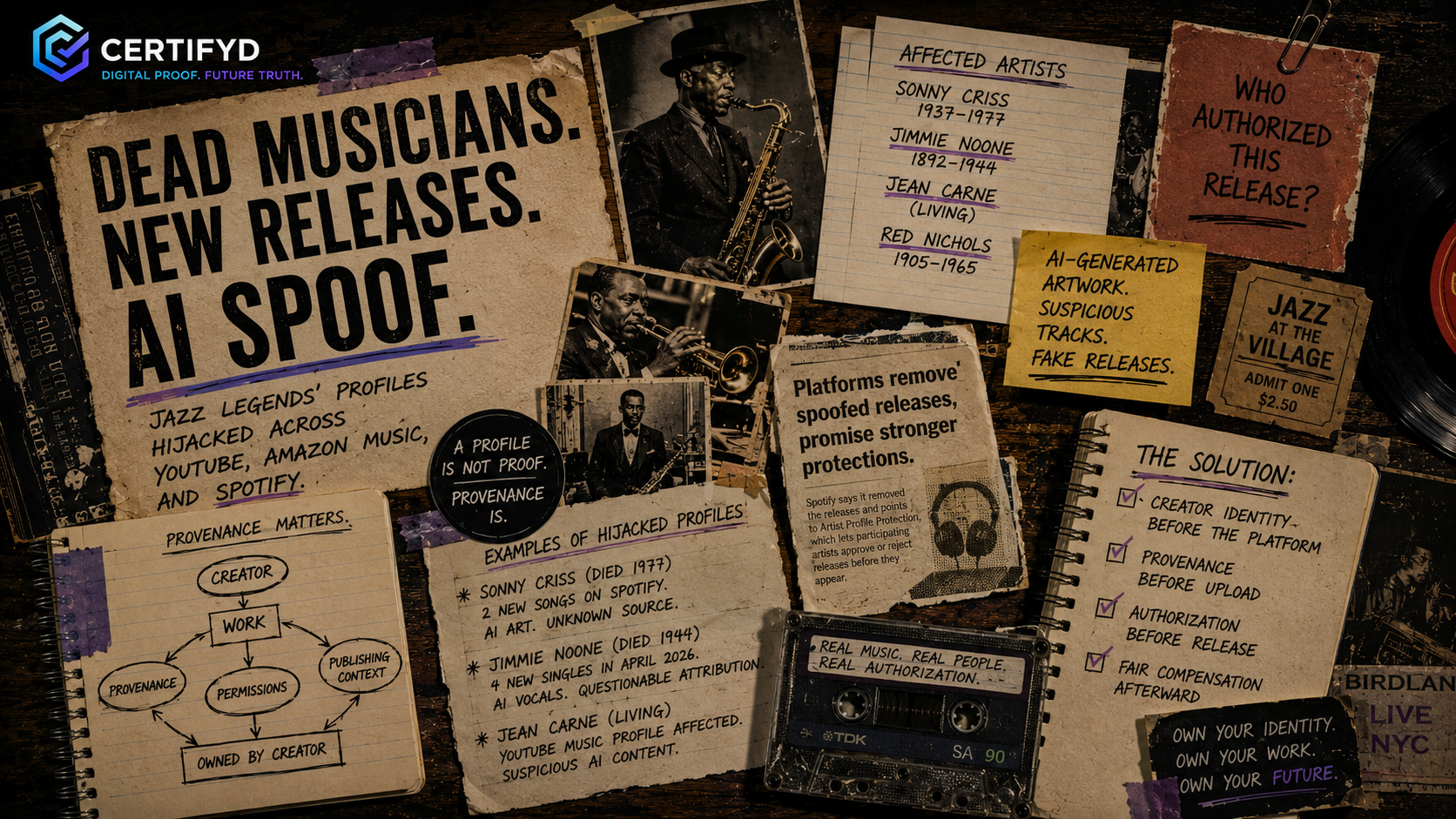
Multiple YouTube, Amazon Music, and Spotify Profiles of Jazz Legends Were Hijacked to Churn Out AI Slop
William "Sonny" Criss died in 1977.
Nearly half a century later, his Spotify profile apparently had new music.
Digital Music News reports that profiles belonging to several jazz musicians have been inundated with suspicious releases across Spotify, Amazon Music and YouTube. Criss was among them, alongside artists including vocalist Jean Carne, cornetist Red Nichols and clarinetist Jimmie Noone. The releases reportedly arrived with AI-generated-looking artwork and music that had little obvious connection to the artists whose names appeared above it.
AI slop is certainly part of this story. But there's a more fundamental problem underneath it.
Somebody managed to make music appear as though it belonged to artists who apparently had nothing to do with releasing it.
Sonny Criss Hasn't Released Anything Since 1977
The Criss example makes the absurdity immediately obvious.
Digital Music News, citing reporting by Futurism, says two new songs appeared on Criss' Spotify profile with generic anime-style cover art. The tracks were attributed to a composer named "Zainul Irpan," while their origins were difficult to establish. They weren't identifiable remixes of existing Criss recordings, according to the report.
There is also a fairly significant biographical problem with the releases: Criss died in 1977.
Jimmie Noone's case is even more extreme. Noone, an influential clarinetist and bandleader, died in 1944. Yet four new singles attributed to him reportedly appeared in April, including pop ballads featuring what sounded like an AI-generated female vocalist. Their contemporary artwork stood in obvious contrast to the black-and-white imagery associated with Noone's actual recordings.
Jean Carne's YouTube Music profile was reportedly affected as well. Unlike Criss and Noone, Carne is alive, making the problem impossible to dismiss as merely bad stewardship of historical catalogs.
These weren't fake artist pages sitting somewhere obscure on the internet. The questionable releases appeared within profiles carrying the identities of established musicians.
The Profile Became the Proof
That's what makes this story more interesting than another example of bad AI music.
When someone opens an artist page on a major streaming service and sees a new release, there is an implicit assumption built into the interface: this belongs here.
The artist's photograph is there. Their catalog is there. Their name is above the release. Years of legitimate recordings establish the context. The platform has effectively created a visual chain of trust, even though the listener usually has no idea what happened behind the scenes before a new recording appeared.
For decades, that assumption was probably good enough most of the time.
Generative AI changes the economics of abusing it.
Producing something that vaguely resembles jazz no longer requires assembling musicians, booking a studio or even knowing much about Sonny Criss. Cover artwork can be generated just as easily. Once those costs approach zero, the expensive part of impersonating an established artist isn't necessarily creating the fake content.
It's getting the content attached to a trusted identity.
In these cases, somebody apparently succeeded.
Spotify Is Trying to Fix the Door
Spotify told Futurism that the offending releases had been removed and said protecting artist identities is a priority. The company also pointed to Artist Profile Protection, a feature designed to allow artists to review incoming releases and approve or decline them before they appear on a profile.
That's a meaningful response. It also reveals something about the architecture of the problem.
If a release can reach an artist profile before the artist or their authorized representatives have established that it belongs there, verification is happening too late in the process.
The platform receives something claiming to belong to an artist. Systems then have to determine whether that claim is legitimate, whether the uploader was authorized and, increasingly, whether the music itself may have been generated.
AI detection can help with one part of that problem. Better distributor controls can help with another. Artist approval systems can provide another checkpoint.
But all of them are ultimately trying to answer the same question:
Who authorized this work to speak in this creator's name?
An Artist Profile Isn't an Artist Identity
The internet has gradually blurred two very different things.
There is the artist.
And there is the artist's account on a platform.
For practical purposes, we've learned to treat them as the same thing. A Spotify artist page represents the artist on Spotify. A YouTube Music page represents the artist on YouTube. A social account represents the creator on a social network.
That works until somebody else gains the ability to publish through the representation.
Then the distinction becomes obvious.
Sonny Criss' identity didn't suddenly start releasing music in 2026. A database associated new recordings with a profile bearing his name.
That's not a semantic difference anymore. It's an infrastructure problem.
The creator's identity and the platform's representation of that identity are not necessarily the same thing.
Provenance Should Begin Before Upload
This is where provenance becomes useful, but not in the vague sense of attaching another metadata field to a song after it has already entered the system.
Provenance should begin with the creator.
A work can carry evidence about where it originated, who published it, when it was released and how it relates to the identity behind it. That doesn't magically determine copyright ownership or settle every rights dispute, but it can establish a much stronger history than "somebody successfully uploaded this under the right artist name."
That distinction becomes increasingly important when producing convincing fake material becomes cheap.
The question shouldn't only be whether an AI detector thinks a recording sounds synthetic. A perfectly human-made fraudulent recording would still be fraudulent if it were falsely published under Sonny Criss' identity.
Likewise, an artist could intentionally use AI tools and legitimately authorize the resulting work.
AI detection and creator authorization are different problems.
The jazz-profile incidents make that distinction unusually clear.
Creator Identity Should Exist Before the Platform
Certifyd is being built around a different starting point.
With Certifyd Core, creator identity and records associated with works can originate under infrastructure controlled by the creator rather than existing exclusively as entries inside somebody else's platform. Release records, provenance and other relationships can then travel outward as the work moves through different services.
That doesn't mean Spotify, YouTube, Amazon Music or any other platform becomes unnecessary. Platforms remain enormously useful for distribution and discovery.
It changes which thing is authoritative.
Instead of a platform profile being the primary evidence that a work belongs to an artist, the platform can become one destination where a work connected to an established creator identity appears.
That's a subtle architectural difference until something goes wrong.
Then it becomes the whole story.
AI Is Making an Old Weakness Expensive
Artist impersonation didn't begin with generative AI. Neither did bad metadata, fraudulent uploads, catalog collisions or unauthorized releases.
What AI changes is scale.
Music, artwork and plausible-looking releases can now be generated faster and more cheaply than at any previous point in the history of recorded music. That means systems built around trusting uploads and cleaning up mistakes afterward are going to face increasingly hostile economics.
The solution can't simply be getting better at recognizing slop after it arrives.
We also need better ways to establish who creators are, which works actually came from them and who was authorized to publish those works in the first place.
Because if a musician who died in 1944 can suddenly drop four new singles, the problem isn't just that AI has become convincing.
It's that somewhere along the way, we started treating the profile as proof of the person.