
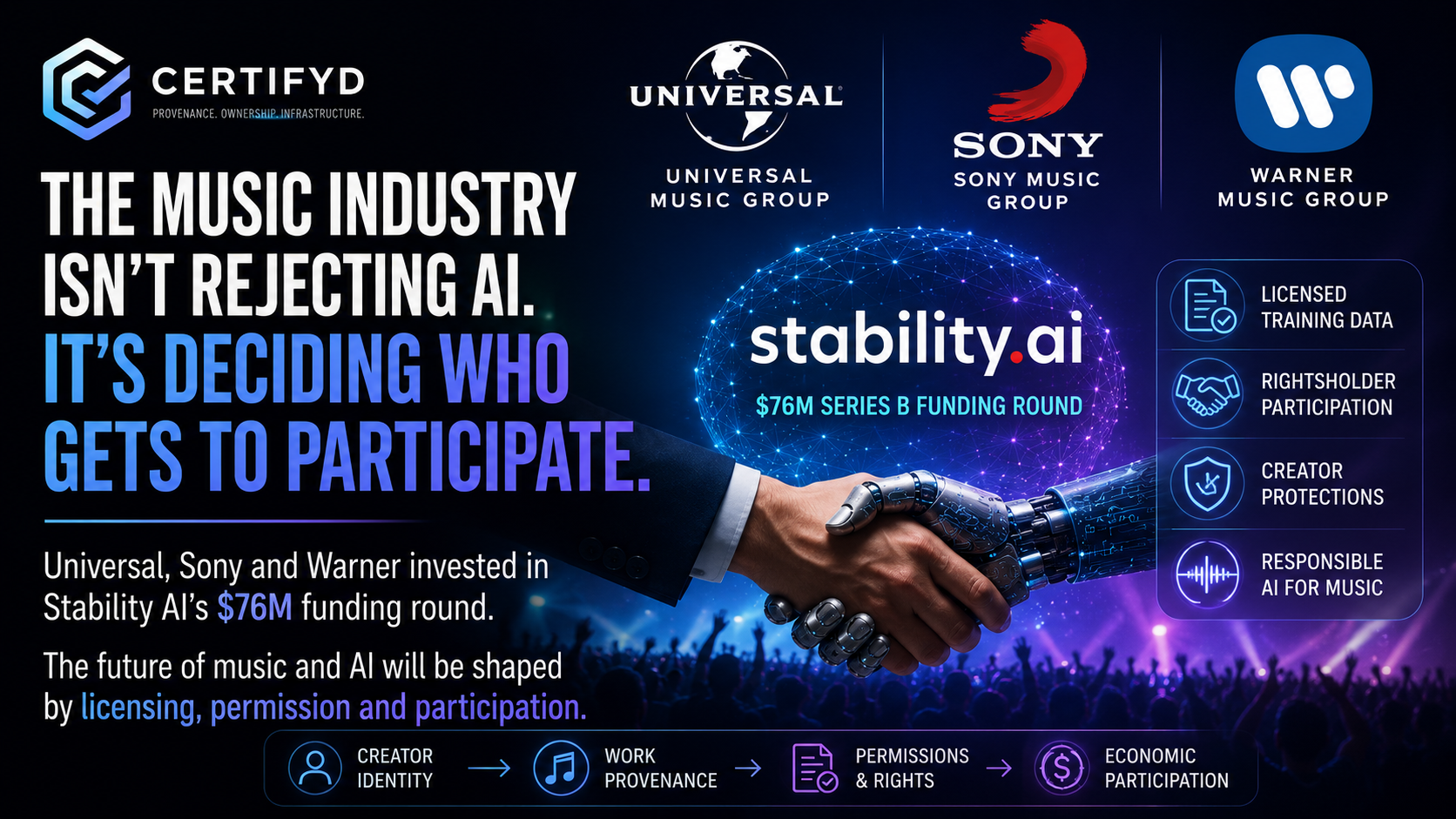
The Music Industry Isn't Rejecting AI. It's Deciding Who Gets to Participate.
For the past several years, the relationship between the music industry and generative AI has often been framed as a battle: technology companies on one side, musicians and rights holders on the other. Lawsuits over training data, warnings about synthetic music and fights over copyright have made that framing understandable, but a new investment involving the world's three largest music companies suggests the reality is becoming considerably more complicated.
Universal Music Group, Sony Music Group and Warner Music Group have all invested in Stability AI as part of a new $76 million Series B funding round. Electronic Arts, AMD Ventures and other investors also participated, bringing Stability AI's total funding under its current leadership to $232 million. The company says the new capital will support creative-production products, applied research and professional services.
The significance isn't simply that three enormous music companies invested in an AI startup. It's that they're investing in one while the music industry is simultaneously trying to establish rules around what generative AI should be allowed to do with music.
The industry isn't rejecting AI.
It's beginning to decide what legitimate AI looks like.
From Fighting AI to Owning Part of It
Universal and Warner weren't strangers to Stability AI before this investment. Universal announced a strategic alliance with the company in October 2025 to develop professional AI music-creation tools, while Warner followed with its own partnership the following month.
Both relationships were built around an important qualification: the models were supposed to be responsibly trained.
Universal has explicitly positioned its AI strategy around supporting technologies that can benefit artists while opposing unlicensed training and copyright infringement. Warner has taken a similarly clear position, saying its AI agreements should involve licensed models, economic terms that reflect the value of music, and meaningful artist and songwriter control over the use of their names, likenesses, voices and songs.
Now those relationships are becoming financial ones.
The labels aren't merely negotiating with an outside technology provider. They're becoming investors in a company attempting to build the commercial AI infrastructure that musicians, producers and entertainment companies may eventually use.
That tells us something important about where the industry's AI debate is heading.
The Argument Was Never Really "AI or No AI"
Generative AI has often been discussed as though the music industry eventually has to make a binary decision. Either it embraces AI and abandons creators, or protects creators by keeping AI out.
That was never particularly realistic.
Musicians have adopted new technology throughout the history of recorded music. Synthesizers, sampling, digital recording, pitch correction, drum machines, software instruments and countless other technologies changed what creating music looked like without eliminating human creativity.
AI will likely become another part of that technological history.
The much harder questions concern what happens underneath the tool. What material was used to train it? Did the people controlling that material authorize the use? Were creators compensated? Can artists decide whether their voice, likeness or work participates? What rights exist in the resulting output?
Those questions aren't arguments against AI.
They're questions about permission and participation.
Stability AI appears to understand that distinction.
Stability Is Making Licensing Part of the Product
Stable Audio 3.0, released earlier this year, is particularly relevant to the investment. Stability says the model family was trained on fully licensed data, and its developer documentation says the training material came from the AudioSparx music library while honoring opt-out requests and compensating creators.
The company is also positioning the models directly inside professional creative workflows. Stable Audio can generate music, stems, samples and sound effects, and Stability has introduced a DAW plug-in designed to put the technology inside software environments musicians already use.
This creates an interesting competitive proposition.
Stability isn't merely arguing that licensed AI is ethically preferable to unlicensed AI. The company has acknowledged that responsible training isn't enough by itself. A licensed platform ultimately has to provide a creative experience good enough that musicians actually choose it.
That's an important evolution in the debate.
If licensed AI is slower, worse or dramatically more restrictive than the alternatives, creators will have little incentive to use it. The long-term challenge is therefore not merely establishing permission around training data but proving that a permissioned model can compete technologically.
The major labels are now financially invested in finding out whether it can.
The Music Industry Is Drawing a Boundary
At almost exactly the same moment, another part of the music industry is trying to establish where AI belongs once the finished music reaches the public.
Industry groups and major labels have pushed for chart rules requiring AI-assisted recordings to remain substantially human-made, use properly authorized AI services, comply with copyright and related rights, avoid manipulation and appropriately disclose the use of generative AI.
Australia has now moved further in that direction, with ARIA excluding music that is wholly or predominantly AI-generated from its charts while leaving room for recordings where AI assists a substantially human creative process.
Put these developments beside the Stability investment and the emerging position becomes much clearer.
The music industry isn't saying AI cannot participate in music.
It's beginning to say that the conditions of participation matter.
A model trained on properly licensed material is different from one trained without permission. AI assisting a musician is being treated differently from a machine generating substantially the entire recording. Transparent use is being distinguished from undisclosed use, while authorized commercial relationships are being distinguished from systems that simply ingest creative work first and argue about permission later.
Those distinctions are going to define much of the next phase of AI music.
The Real Fight Is Over Authorization
This also helps explain why some of the apparent contradictions in the industry's AI position aren't necessarily contradictions at all.
A record company can sue or challenge one AI company over alleged unauthorized use while investing in another AI company operating through licenses and commercial agreements. From the label's perspective, those actions can represent the same position rather than opposing ones.
The question isn't necessarily whether the technology generates music.
The question is whether the rights underneath that technology have been respected.
That principle extends beyond major labels. Independent musicians, producers, songwriters and creators face exactly the same underlying question, except they generally have considerably less negotiating leverage.
If someone's work contributes value to an AI system, what proves that they authorized it? If permission was granted, what were the terms? If compensation is due, how is the creator identified? If permission is later withdrawn where a contract permits it, how is that decision communicated and enforced?
These are not merely copyright questions.
They're infrastructure questions.
Permission Needs a Record
The AI industry is beginning to discover something the music industry has struggled with for decades: rights become difficult to enforce when the records describing those rights are fragmented across different systems.
A license is useful because it establishes permission. But as AI models consume enormous amounts of creative material and outputs move through increasingly complex production chains, knowing that "licensed data" was used may eventually not be enough.
Which works were licensed? Who controlled them? What rights were granted? For which model? Under what conditions? Was an artist allowed to opt out? Did a later version of the model use the same material?
The more sophisticated generative systems become, the more valuable durable provenance around those relationships becomes.
This is where technologies around creator-controlled identity and signed provenance become particularly interesting. A creator should be able to establish a verifiable relationship with their work, and permissions involving that work should be capable of producing evidence that survives beyond the database of whichever company happened to arrange the transaction.
That doesn't replace copyright law or contracts.
It makes the history surrounding those agreements easier to prove.
Where Certifyd Fits
Certifyd Core is being built around a related idea: creators should be able to establish cryptographically verifiable relationships between their identities, their work and the permissions surrounding that work without requiring Certifyd itself to become the permanent authority over every interaction.
That matters in a world where content increasingly moves between creators, platforms, applications and machines. Provenance can establish where a work originated, signed records can establish claims around it, and relationships between original and derivative works can remain visible as creative material moves through a network.
AI makes that architecture more relevant because the number of possible relationships surrounding a creative work is exploding.
The future isn't simply going to contain "human music" and "AI music." It will contain human-created music, AI-assisted music, licensed generative elements, synthetic performances, authorized voice models, derivatives, samples and combinations of all of them.
A binary AI label cannot describe all of that.
Provenance can describe considerably more.
This Could Be the Beginning of an AI Licensing Economy
There's also an economic dimension to the Stability investment that shouldn't be overlooked.
If licensed training becomes commercially competitive, creative catalogs aren't merely protected assets. They can become valuable inputs into new forms of technology.
That creates a very different conversation from one in which AI companies scrape everything available online and rights holders attempt to stop them afterward. A permissioned market allows creators and rights holders to decide whether they want to participate and negotiate what that participation is worth.
The major labels have enough scale to negotiate those relationships today.
The more interesting long-term question is whether independent creators will eventually have comparable tools.
An independent musician shouldn't need to become Universal Music Group to express machine-readable terms around their work. They should be able to identify themselves, identify the work, establish permissions and participate economically when those permissions create value.
That's where the creator economy could become much more interesting than the current fight between AI companies and large rights holders.
AI Isn't Going Away. The Rules Are Arriving.
The $76 million going into Stability AI isn't evidence that the music industry's concerns about generative AI have disappeared.
It may be evidence that those concerns are becoming more sophisticated.
Universal, Sony and Warner clearly believe AI will play some role in the future of creative production. Their investment suggests they would rather help shape that future—and participate economically in it—than simply watch it develop from the sidelines.
At the same time, the industry is establishing boundaries around licensing, human involvement, disclosure and authorization.
That's the story.
The music industry isn't rejecting artificial intelligence. It's beginning to distinguish between AI that operates inside a rights framework and AI that asks forgiveness after consuming the work.
For creators, the important question therefore isn't simply whether AI wins or loses.
It's whether the systems being built around it can answer something much more fundamental: who created the work, who gave permission to use it, and who gets to participate in the value that follows?
Those questions existed long before generative AI.
AI is simply making them impossible to ignore.
Certifyd covers developments in music, technology and the creator economy and examines what they mean for creator ownership, provenance and independent digital infrastructure.