
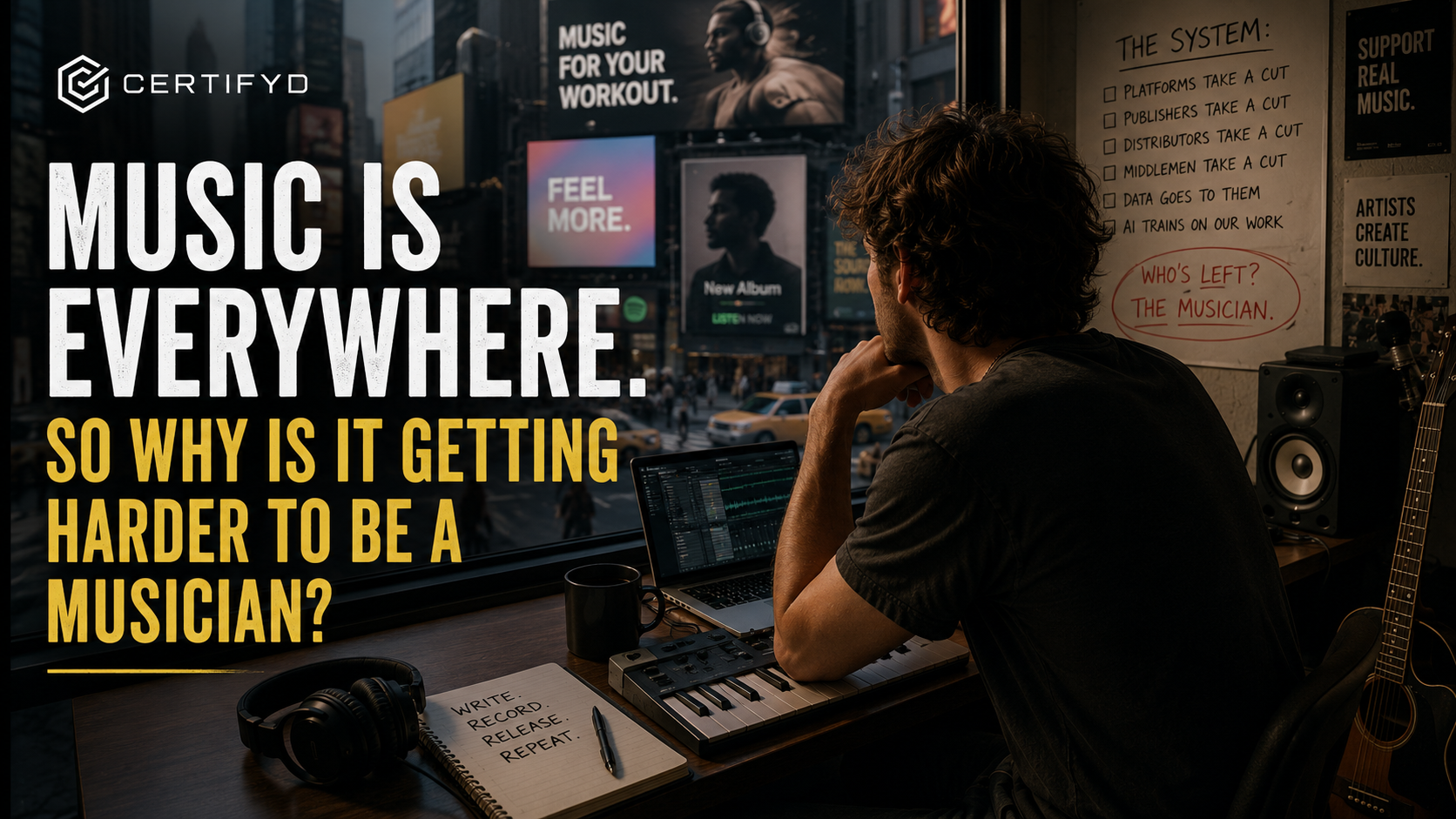
Music Is Everywhere. So Why Is It Getting Harder to Be a Musician?
There may be more demand for music today than at any point in history.
Music fills streaming services, social platforms, films, television, games, advertisements, restaurants, gyms, stores, podcasts and millions of videos uploaded every day.
And increasingly, music is becoming an input for artificial intelligence.
Yet the people actually making music can find it extraordinarily difficult to turn that demand into a sustainable career.
That contradiction was the focus of a recent Digital Music News commentary by musician and A&R executive Michael Whalen: "Our Culture Is Filled With Music With No Place for Musicians."
His question is uncomfortable but important:
Can music become more valuable to the economy while musicians themselves become less economically valuable to the systems distributing it?
Increasingly, the answer appears to be yes.
Music Has Become Infrastructure
Music used to be primarily sold as a product.
You bought a record, cassette, CD or download.
Streaming fundamentally changed that relationship.
Music increasingly functions as infrastructure inside other products and experiences.
A song keeps someone watching a video.
A playlist keeps someone inside an app.
Music creates atmosphere in a restaurant.
A recording becomes part of a game.
A catalog becomes an investment asset.
A composition can become training material for an AI system.
The economic usefulness of music has expanded dramatically.
But that doesn't automatically mean the person who created it participates proportionately in the value being created around it.
That's the real issue.
The Creator Is Becoming Disconnected From the Work
Digital distribution solved an enormous problem: access.
A musician can theoretically distribute a recording globally almost instantly.
But distribution and ownership are not the same thing.
Neither are distribution and economic participation.
Once creative work enters today's digital ecosystem, it can move through platforms, distributors, publishers, licensing systems, social networks, algorithms and increasingly AI systems.
Every step can create additional value.
But the relationship between that value and the original creator can become increasingly difficult to see.
Who created the work?
Who owns it?
Who contributed to it?
Who has permission to use it?
Who created a derivative?
Who should participate economically when the work generates new value?
These are not simply royalty questions.
They're infrastructure questions.
AI Makes the Problem More Obvious
Artificial intelligence didn't create this disconnect.
It makes it much easier to see.
AI systems can potentially generate enormous quantities of music and music-like content at extremely low marginal cost.
That creates an extraordinary technological capability.
It also introduces a fundamental economic question:
Does AI increase the capabilities of musicians, or reduce the industry's need to economically involve musicians at all?
Those are very different futures.
An artist using AI to experiment with arrangements, production, voices or new forms of collaboration can remain at the center of the creative process.
But an economic system capable of generating enormous amounts of usable music without negotiating with creators has a very different incentive structure.
The important question therefore isn't simply whether AI music is good or bad.
It's whether creators retain identity, ownership, permission and economic participation as these systems evolve.
Infinite Music Doesn't Mean Infinite Opportunity
The economics become even more difficult when supply approaches infinity.
Every musician already competes with an enormous historical catalog.
They also compete with thousands of new recordings entering the market.
Now add potentially enormous quantities of machine-generated music.
The amount of available music can grow dramatically faster than human attention.
That means simply creating more content cannot be the long-term economic solution for creators.
The scarce assets become something else:
identity, relationships, authenticity, rights, provenance and direct audience connection.
Knowing who created something — and having a meaningful relationship with that creator — becomes more important when content itself becomes abundant.
This Is Why Creator Infrastructure Matters
Certifyd isn't trying to solve the problem by promising musicians more streams.
Nor do we believe another centralized platform automatically fixes the economics of the creator economy.
We're approaching the problem from a different direction.
The creator should remain connected to the work.
The work should remain connected to its provenance.
Collaborators should remain connected to their contributions.
Permissions should be identifiable.
Derivative works should retain relationships with the works they came from.
And commerce should be capable of happening between participants without requiring a centralized platform to own every relationship.
That creates a different foundation for the creator economy.
Instead of asking a platform to remember who created something, creators and their collaborators can maintain those relationships as part of the infrastructure itself.
From Platforms to Networks
This distinction becomes increasingly important.
Platforms generally create relationships between users inside infrastructure controlled by the platform.
Networks allow independent participants to establish relationships with one another.
Artists, producers, publishers, rights holders, fans, retailers and service providers don't necessarily need one company sitting permanently in the middle of every interaction.
They need ways to establish identity, provenance, permission and trust.
That is a much larger idea than music distribution.
It means creators can operate infrastructure of their own and connect directly with other participants.
The creator doesn't disappear when the work leaves the application.
The relationship travels with the work.
The Fan Economy Makes This Even More Important
The next phase of the music economy is already expanding beyond streaming.
Merchandise, memberships, licensing, experiences, derivatives, physical products, collaborations and direct commerce all create economic relationships around creative work.
That creates an opportunity.
A musician doesn't necessarily need billions of anonymous streams if they can build meaningful economic relationships with a smaller number of people who value what they create.
But those relationships need infrastructure.
Identity matters.
Ownership matters.
Permission matters.
Provenance matters.
And the ability for creators to participate directly in the economic activity surrounding their work matters.
Music Doesn't Have a Demand Problem
That's perhaps the strangest part of the current music economy.
People clearly still want music.
Technology companies want it.
Advertisers want it.
Streaming services want it.
Social platforms want it.
Film and television want it.
Games want it.
Fans want it.
AI companies want it.
The problem isn't whether music has value.
The question is how that value finds its way back to the people who create it.
The next generation of creator infrastructure should make that relationship easier to establish, not easier to erase.
Because a future containing unlimited music but fewer people capable of making music professionally isn't necessarily progress.
The goal shouldn't simply be more music.
It should be an economy where the people responsible for creating culture have a meaningful way to participate in the value that culture creates.
That's a much harder problem.
And it's the one worth solving.
Certifyd covers developments in music, technology, intellectual property and creator commerce and examines what they mean for the infrastructure creators use to own, publish and monetize their work.