
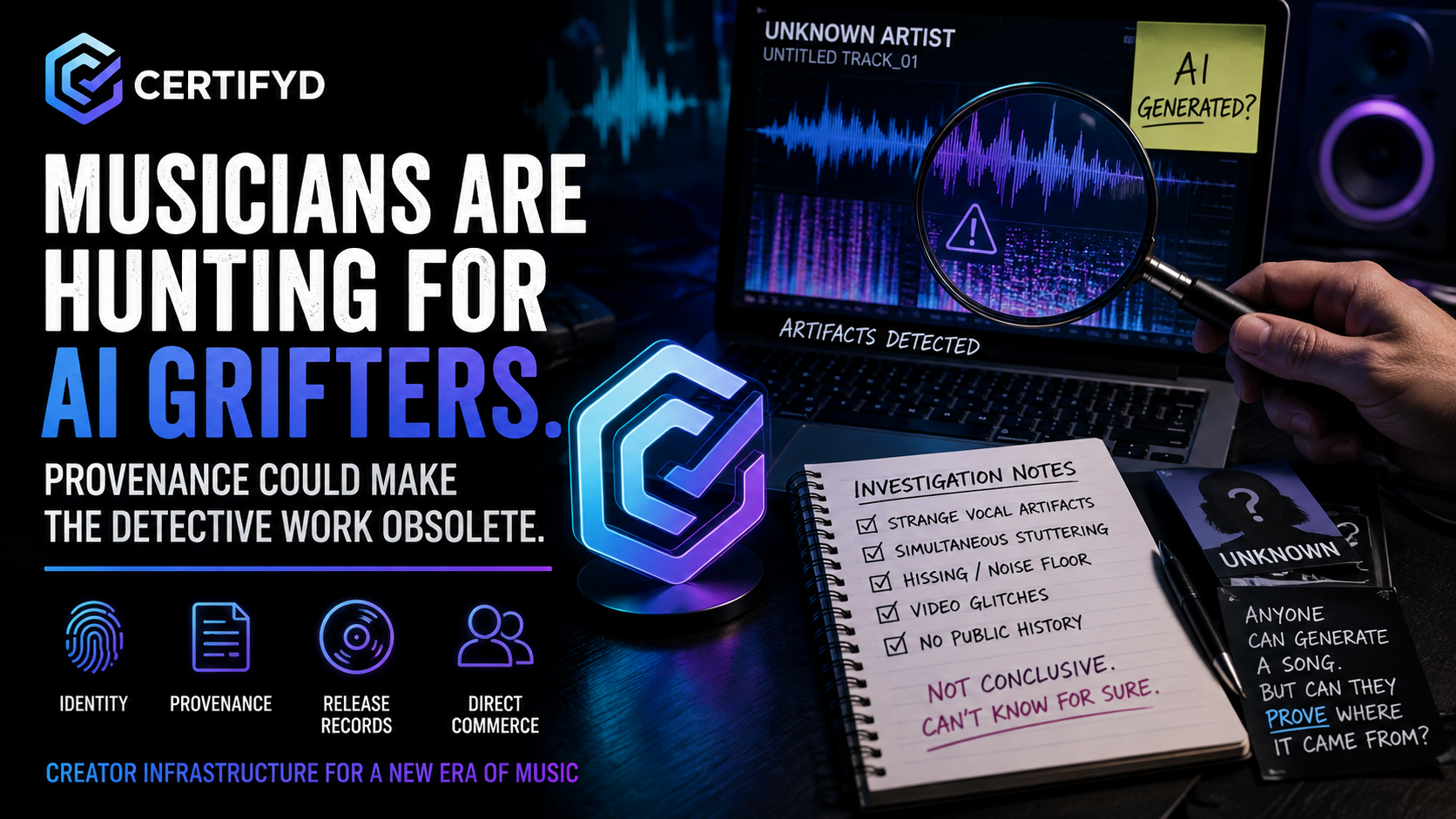
Musicians Are Hunting for AI Grifters. Provenance Could Make the Detective Work Obsolete
Musicians are becoming detectives.
As generative AI makes it increasingly easy to produce convincing songs, some artists are scrutinizing suspicious releases themselves: listening for audio artifacts, studying production choices, examining videos and comparing tracks against the recognizable fingerprints of generative tools.
The Verge recently documented the emerging callout culture inside electronic dance music, where producers Max "H4RRIS" Harris and Nihil Young have publicly questioned music they suspect was created using generative AI. Their investigations expose a problem that is much bigger than whether any particular song was made with Suno.
When anyone can generate something that sounds increasingly like human-created music, how does a listener know who — or what — actually made it?
Musicians Are Trying to Solve the Problem by Ear
Harris has become particularly vocal about suspected AI music. As a producer, he looks for characteristics that don't make sense to him as human production decisions.
He told The Verge that some AI-generated tracks exhibit strange artifacts: vocals and melodic elements stuttering simultaneously, unusual hissing, or musical elements behaving as though the model has difficulty separating the components of the source material. Visual material can create suspicions too, particularly when accompanying videos contain familiar generative-AI glitches.
Young has been making similar observations. According to The Verge, his posts about musicians using Suno helped inspire Harris to begin producing his own callout videos.
The concern isn't purely aesthetic. Young argues that generative systems make it possible for people to feed existing copyrighted recordings into tools and produce apparently new works derived from them. He told The Verge that if this can happen to major artists, it can happen to essentially anyone with a catalog.
There is an important complication, though.
Neither experience nor careful listening produces certainty.
Suspicion Isn't Provenance
The Verge points out that there is no definitive evidence that some of the artists Harris has questioned actually generated their music using AI. Harris could be wrong.
That distinction matters enormously.
The same technological shift that makes synthetic music difficult to identify also creates the possibility of falsely accusing human creators of using AI. A producer might recognize artifacts associated with generative systems and still arrive at the wrong conclusion.
AI detection tools could help, but detection creates another technological arms race. Generators improve. Detectors improve. Generators learn to avoid detectable artifacts. Listeners are left trying to determine which machine they should believe.
That is a fundamentally different problem from provenance.
Detection asks:
Can we determine how this file was probably created by examining it after the fact?
Provenance asks:
What can the creator demonstrate about where this work came from?
The distinction is going to matter more as synthetic media improves.
The Artist Is Becoming Part of the Product
For most of recorded-music history, listeners rarely needed cryptographic evidence that a musician existed.
A record arrived with a recognizable artist, label, artwork, credits and distribution chain. There could certainly be fraud, ghostwriting, impersonation and disputed authorship, but manufacturing and distributing convincing fake artists at enormous scale was difficult.
Generative AI changes those economics.
AI-created artists are already reaching meaningful audiences. The Verge notes that AI-generated music has appeared on major charts and that Hallwood Media signed AI avatar Xania Monet to a multimillion-dollar recording agreement. Deezer, meanwhile, has reported that AI-generated tracks represent more than half of new music being uploaded to its platform. :contentReference[oaicite:1]{index=1}
At that scale, the identity behind a work starts becoming valuable information in its own right.
Listeners may increasingly want to know not simply whether they enjoy a song, but whether the artist exists, whether the artist made the work they claim to have made, whether AI participated in its creation, and whether the people whose work contributed to it authorized that use.
That makes creator identity part of the product.
A Label Saying "Human-Made" Isn't Enough
Streaming platforms have begun introducing labels and disclosure systems around AI-generated music. Those efforts can help, but they still leave the platform in the position of deciding what information appears beside a work.
The stronger model begins with the creator.
A creator should be able to establish an identity they control, associate works with that identity, create records around releases and preserve information about where those works originated.
That doesn't magically prove every creative claim. Provenance is evidence about origin and history; it isn't automatically legal proof of authorship or ownership.
But it changes the architecture of trust.
Instead of uploading an anonymous audio file and asking Spotify, YouTube, SoundCloud or another platform to determine what it is later, a creator can begin with an established identity and a history of works connected to it.
Platforms can then consume that information rather than becoming its sole authority.
This Is What Certifyd Is Building Toward
Certifyd Core is designed around creator-controlled identity, provenance, release records, permissions and commerce.
A creator operating Core can establish their identity independently of a streaming or social platform and create records connecting that identity to their work. Those records can preserve information about origin, publication and relationships between works while remaining part of infrastructure controlled by the creator.
This becomes particularly interesting in an AI environment.
Imagine two songs arriving online tomorrow.
One appears from an account created last week. There is little information about who created it, how it was produced or where it originated.
The other is associated with an established creator identity, a history of releases and provenance records created as the work moved through its lifecycle.
Neither record requires a listener to accept a platform's declaration that something is "100% human." It simply gives the second creator something increasingly valuable:
a history that can be verified rather than merely claimed.
AI Makes Provenance More Important, Not Less
There will probably never be a perfect technological test for determining whether every piece of media was created by a human, an AI system or some combination of the two.
And perhaps there shouldn't be.
AI itself isn't necessarily the problem. Creators will use generative tools in radically different ways. Some will reject them entirely. Others will incorporate them into legitimate creative workflows. The important questions will increasingly concern identity, disclosure, permission and origin.
Right now, musicians like Harris and Young are trying to answer those questions by listening carefully, comparing tracks, examining visual clues and publicly investigating suspicious artists. The Verge's reporting makes clear both how sophisticated that detective work is becoming and how uncertain its conclusions can remain. :contentReference[oaicite:2]{index=2}
That uncertainty is the real story.
The internet is entering an era where producing convincing media is becoming cheap, fast and abundant. In that environment, simply possessing a finished file tells us less and less about where it came from.
The scarce thing may no longer be the ability to make something that sounds real.
It may be the ability to prove the history behind it.