
Musixmatch Adds Label Hub as LyricFind Debuts Verified Artist Program
The music industry has become extraordinarily good at distributing recordings. A song can move from an artist's computer to streaming services, social networks, video platforms and markets around the world remarkably quickly. The information surrounding that song is more complicated because every destination needs to know what the work is, who created it and who has the authority to change the information attached to it.
Musixmatch and LyricFind have both announced products aimed at improving that process. Musixmatch is giving labels more sophisticated tools for managing lyrics and catalogue information, while LyricFind's new Verified Artist Program allows artists to claim their catalogues and manage lyrics and translations directly. Both are responding to a legitimate problem in digital music.
But there is a deeper architectural problem neither model appears to solve.
The artist gets more control over the record. The company still controls the system where the record lives.
Musixmatch Is Building Better Tools for Labels
Music Ally reports that Musixmatch has launched Musixmatch Pro for Labels, bringing together tools for label teams including AI transcription and time-syncing, curation, lyric distribution and what the company calls "catalogue intelligence." Musixmatch is also positioning lyrics as promotional infrastructure, giving labels ways to create lyric-driven assets for digital and social channels.
This isn't a small experiment. More than 400 labels were introduced to the product during its beta phase, according to Music Ally. That reflects how important the information surrounding a recording has become as music moves through an increasingly complicated digital ecosystem.
A release is no longer represented simply by an audio file. Lyrics, credits, artwork, identifiers, translations, ownership information and other metadata can travel alongside it, often through completely different systems. Whoever maintains those records therefore occupies an increasingly important position in the infrastructure surrounding the music.
LyricFind Gives Artists More Direct Control
LyricFind is approaching the same broad problem from the artist side. Its Verified Artist Program allows musicians to claim their catalogues, submit new lyrics and translations ahead of releases, and use AI transcription tools. Music Ally reports that the program is free for artists and points users toward additional tools for creating video and visual assets.
The phrase "claim their catalogues" is important. Before somebody can authoritatively alter information attached to a recording, the service needs some confidence that the person making the change actually has a legitimate relationship to that work. Verification gives artists a more direct role in establishing that relationship instead of leaving platforms to infer authority from whoever happens to have access to an account.
That's useful functionality, particularly in an environment where incorrect attribution, fraudulent uploads and hijacked artist profiles have become increasingly visible problems. But claiming a catalogue inside LyricFind is still fundamentally different from owning the infrastructure where the authoritative relationship between creator and work originates.
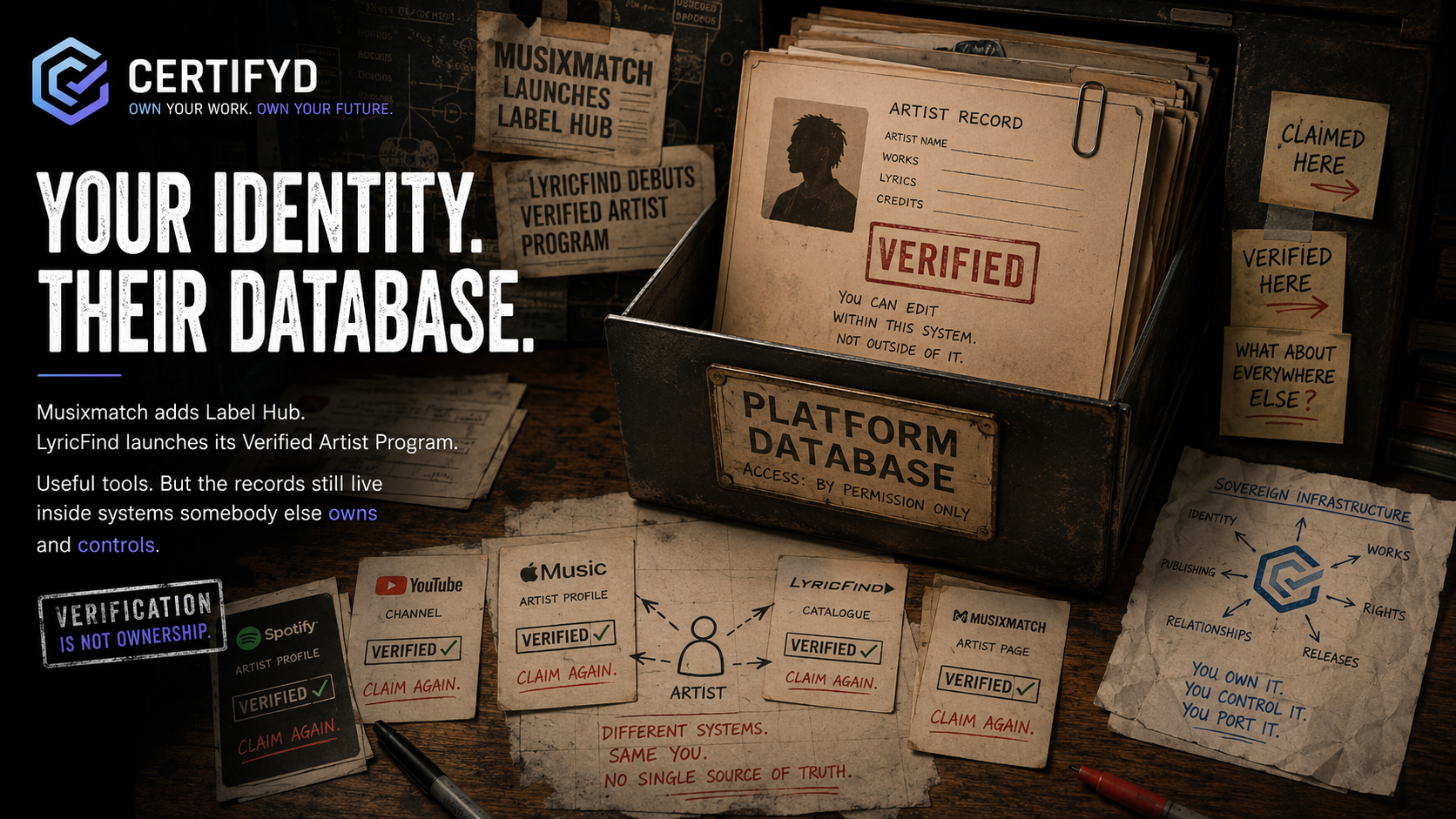
Your Identity. Their Database.
Most internet verification begins with an account inside somebody else's system. You create the account, provide whatever evidence the company requires, and the company decides whether the record representing you should be considered verified. The badge may belong to your profile, but the verification relationship itself exists within infrastructure controlled by the service.
Catalogue claims work in much the same way. An artist can gain permission to manage information, correct lyrics or establish a relationship with particular recordings, but those records still exist inside the provider's database. The creator has been granted greater authority within the system without becoming the origin of the system.
That distinction becomes important when the artist leaves. A verification relationship established inside one service doesn't automatically become an identity that another service can independently recognize. The creator moves to the next database and, in some form, establishes themselves again.
The artist hasn't changed. The infrastructure has.
Centralized Verification Doesn't Become Creator Ownership
There is a tendency to describe greater access to platform records as greater ownership. Those aren't necessarily the same thing.
A centralized service can give creators excellent administrative tools. It can provide exports, APIs, verification programs and sophisticated controls over the information associated with their work. Those features can make the service substantially better for artists without changing the fundamental architecture underneath it.
The company still operates the database. It determines how accounts are created, how verification works, what information can be stored, how that information can be accessed and ultimately whether the service continues to exist under the same terms.
That isn't unique to Musixmatch or LyricFind. It is how most of the modern internet has been built.
The problem is that creators now conduct enough of their professional lives through these systems that the distinction between access to your information and control of your infrastructure matters considerably more than it once did.
The Music Industry Keeps Reconstructing the Same Artist
An artist might have an authoritative relationship with a distributor, a verified Spotify profile, an official YouTube channel, a social account with a verification badge and now a claimed catalogue inside a lyrics service. Labels, publishers, collecting societies and other industry databases may maintain additional records describing the same person and many of the same works.
Each system has legitimate reasons for maintaining its own records and deciding what it trusts. The strange part is that the creator at the center of all of them usually isn't the common source.
Instead, the industry repeatedly reconstructs the artist.
This becomes increasingly awkward as music escapes the traditional boundaries of music platforms. Recordings now surface in games, social networks, fitness applications, virtual environments, creator tools and new discovery experiences. Every additional destination potentially creates another representation of the artist and another database that has to establish some relationship between identity and work.
The internet has become extremely good at moving the song while remaining surprisingly inefficient at moving authoritative information about who created it.
What If the Artist Were the Starting Point?
The conventional architecture effectively begins:
Platform → account → verification → artist
A creator-controlled architecture can begin differently:
Artist → identity → work → verification by services
That doesn't mean every company must blindly trust whatever a creator publishes about themselves. Spotify, LyricFind, Musixmatch, YouTube, distributors and other services should still determine what evidence they require and what information they are willing to display.
The difference is that they wouldn't necessarily need to create the creator's digital identity from scratch.
An artist could establish an identity and relationship to their work before arriving at the destination. A service could then verify the relationship between that identity and the account or catalogue it maintains. The platform remains free to operate its own product, while the creator no longer needs the platform itself to be the original source of their digital existence.
The Authority Has to Start Somewhere
This is the architectural distinction Certifyd Core is built around.
Core is locally operated creator infrastructure. Rather than requiring identity, works, release records and publishing context to originate exclusively inside a centralized Certifyd database, creators can operate the infrastructure where those records begin and make them available to a wider network.
That doesn't require replacing specialized services. A lyrics company can remain excellent at lyrics, a streaming service can remain excellent at streaming, a distributor can distribute music, and a social network can connect artists with enormous audiences. Creator sovereignty isn't about refusing to use platforms; it's about changing the relationship between the creator and the platforms they choose to use.
The creator can bring something with them.
Their identity doesn't have to begin at the login screen. Their relationship to their work doesn't have to exist solely because a platform database says it does. Applications can become destinations and services around the creator rather than containers in which the creator's professional identity must permanently reside.
Verification Is Useful. Sovereignty Is Different.
LyricFind's Verified Artist Program recognizes that artists should have more direct authority over information attached to their music. Musixmatch's label tools recognize that accurate catalogue information has become an important operational layer of the music business. Both developments illustrate how valuable authoritative music data has become.
But better controls inside centralized databases shouldn't be confused with creator-controlled infrastructure.
If the artist can claim the record but the provider remains the ultimate custodian of the database, the architecture hasn't fundamentally changed. The artist has a better seat inside somebody else's system.
That may be a worthwhile improvement. It just isn't the destination.
The more interesting future begins when verification becomes a relationship between a service and an identity that exists independently of that service. A platform profile can then represent the creator without needing to become the creator.
That distinction matters because the music industry is going to keep creating new destinations for music. Creators shouldn't have to reconstruct themselves every time another one appears.
Your identity. Your work. Their application.
Not the other way around.