
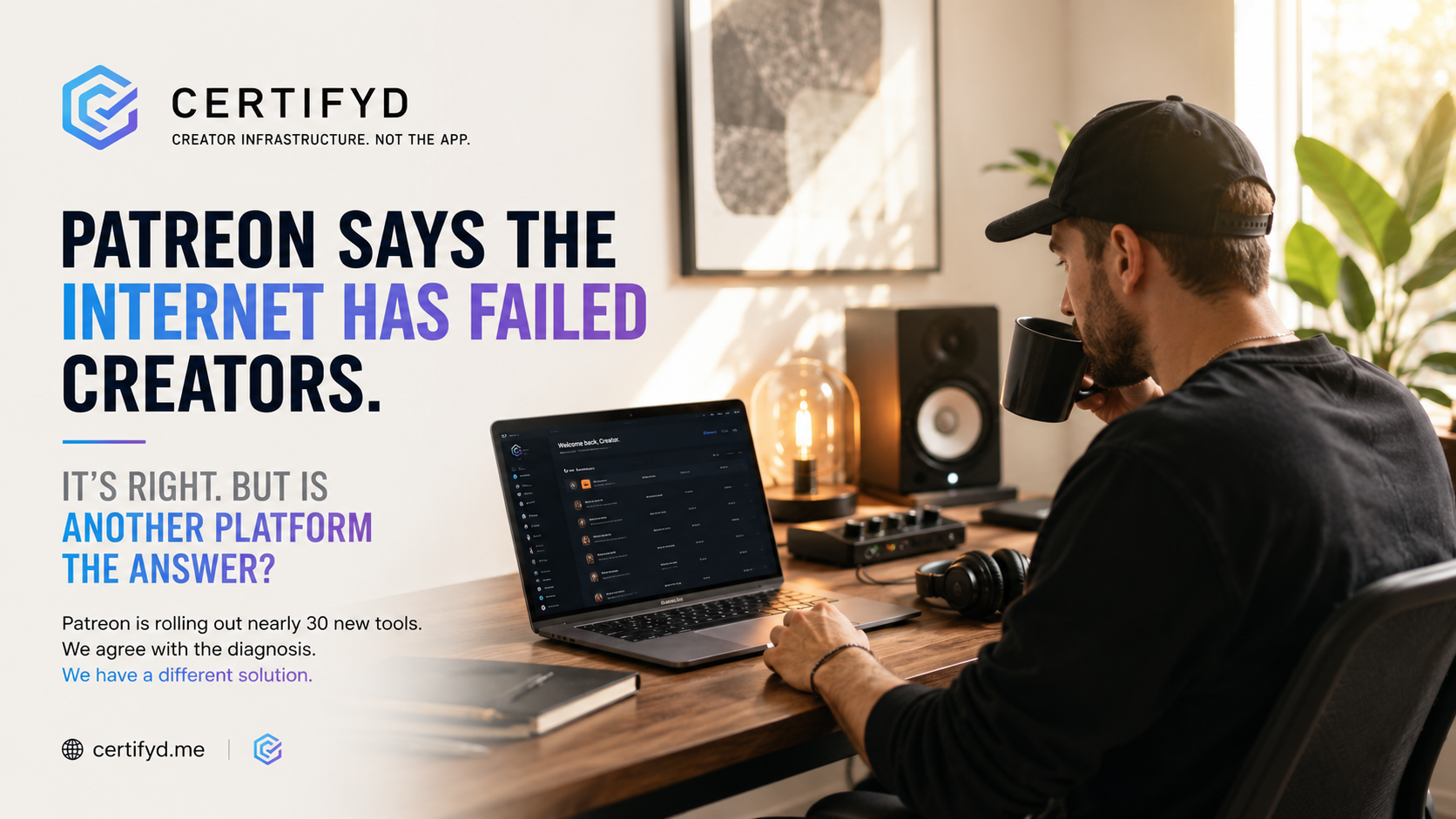
Patreon Says the Internet Has Failed Creators. It’s Right. But Is Another Platform the Answer?
Patreon has spent more than a decade building an alternative to the advertising-driven creator economy. Now the company is making a much bigger argument about what went wrong with the internet itself.
Following layoffs last month, Patreon CEO Jack Conte has previewed nearly 30 new features spanning discovery, community, video, analytics, safety and other parts of the creator experience. As reported by Digital Music News, Conte framed the expansion around what he described as the failure of the current internet for creators and fandoms.
It's a compelling diagnosis. Creators spent years being told that social media would give them direct access to audiences around the world, but those relationships increasingly became mediated by algorithms, recommendation systems, advertising models and platforms capable of changing the rules whenever they wanted.
Patreon wants to build something better. The more interesting question is whether a better platform is enough.
Patreon Is Trying to Fix a Real Problem
Patreon's argument isn't simply that creators need another collection of engagement tools. The company is explicitly contrasting durable creator-fan relationships with an internet increasingly optimized around short-term attention, and its new roadmap appears designed to give creators more ways to build communities and sustainable businesses rather than endlessly chase reach.
That distinction matters because a creator can accumulate hundreds of thousands of followers and still have remarkably little control over the relationship with those people. The platform determines whether a post appears in their feeds, which content receives distribution, what monetization tools are available and, ultimately, whether the creator continues to have access to the platform.
Patreon has historically offered an alternative by making the economic relationship more explicit. Instead of depending entirely on advertising or algorithmic reach, creators can build memberships supported directly by their audiences. The announced expansion into discovery, community, video, analytics and safety potentially gives those creators more of the tools they previously needed multiple platforms to obtain.
There is a lot to like about that direction. But there is also a structural problem that adding more features cannot necessarily solve.
The Creator Still Lives Inside the Platform
Patreon can give creators considerably more control inside Patreon. That's different from creators controlling the underlying relationship itself.
If discovery happens through Patreon, community lives on Patreon, video is delivered through Patreon and commerce runs through Patreon, then Patreon remains an intermediary between the creator and the audience. That doesn't make Patreon bad; it simply makes Patreon a platform, and platforms ultimately operate according to rules established by the companies that own them.
Those rules can change because of economics, regulation, moderation requirements, acquisitions, leadership changes, technological shifts or simply a different product strategy. We've watched variations of this cycle repeatedly across the creator economy: platforms spend heavily to attract creators, creators build audiences there, the platform becomes important to their businesses, and eventually monetization rules, algorithms, APIs, reach or policies change.
The creator may have built the audience, but the platform still controls much of the infrastructure connecting them to it.
Followers Aren't the Same as Relationships
One of the stranger assumptions inherited from the social-media era is that we routinely talk about creators "having audiences" when technically they often have permission to communicate with accounts maintained by somebody else's platform.
A million followers on a platform isn't necessarily the same thing as controlling a network of one million relationships. The distinction becomes obvious when a creator wants to leave. If their identity, audience relationships, purchases, entitlements, publishing history, reputation and attribution cannot move with them, then the creator doesn't fully control those relationships. They have access to them under the terms of the platform.
This is why follower counts can sometimes create an illusion of ownership. The creator did the work required to build the audience, but much of the connective tissue between creator and fan still belongs to someone else.
Patreon improves this relationship in meaningful ways, particularly by putting direct financial support at the center of its model. But the underlying architectural question remains.
Patreon Sees the Problem. Certifyd Core Starts From a Different Layer.
This is where Patreon's announcement becomes particularly interesting from a Certifyd perspective, because we agree with much of the diagnosis. An internet organized primarily around maximizing attention hasn't produced an especially healthy economic foundation for creators. Creators need stronger relationships with audiences, clearer ownership of their work and economic systems that aren't entirely dependent on advertising or opaque platform accounting.
The difference is that Certifyd isn't trying to solve those problems by building another platform. Certifyd Core is creator infrastructure designed to run under the creator's control. A creator can operate Core on their own computer or persistent device, establish a cryptographically provable identity, publish works, maintain provenance and relationships, and participate in commerce from infrastructure they control.
That changes where the source of authority lives. A social feed, fan application, marketplace or discovery service can provide an experience around a creator, but it doesn't have to become the permanent owner of the creator's identity, catalog or relationships. Certifyd Core remains underneath those applications as the creator-controlled foundation.
This is why Certifyd describes itself as creator infrastructure, not the app. The goal isn't to replace Patreon, social networks, streaming services and marketplaces with one giant Certifyd application. It's to make it possible for applications to interact with creators without requiring those creators to surrender the infrastructure underneath their digital lives.
What Does That Look Like in Practice?
Imagine a musician running Certifyd Core on a small persistent computer they control. Their identity is cryptographically provable, their published works can carry provenance and attribution, relationships with collaborators and derivative works can be represented explicitly, and commerce can operate with defined splits determining how participants share in transactions.
Applications can then form around that Core. Certifyd Social can provide conversation and social discovery. A fan application can present the creator's catalog and media. A marketplace can facilitate commerce, while entirely new applications can be built to interact with the same underlying creator infrastructure.
The important part is what happens when one of those applications disappears, changes direction or simply stops being useful to the creator. Certifyd Core doesn't disappear with it. The creator's underlying infrastructure, identity and works remain under their control.
This doesn't mean every musician needs to become a server administrator or software engineer. Certifyd Core is currently being tested as independently operated infrastructure, and service providers can still help creators host it, maintain it and connect it to useful applications. Convenience and sovereignty do not have to be opposites.
The architectural difference is that instead of the creator existing inside the application, applications can exist around the creator.
Better Platforms Are Still Useful
None of this is an argument that Patreon shouldn't build these features. Patreon has spent years pushing the creator economy toward direct support, memberships and deeper fan relationships, and its criticism of an attention-driven internet carries weight precisely because the company has spent so long working on the problem.
Better applications, discovery systems, communities and creator tools are all useful. The deeper question is where ownership ultimately sits. A creator shouldn't have to reject good platforms in order to retain control of their digital identity and work.
The web already provides examples of how convenience and ownership can coexist. A business can own its domain while choosing another company to host its website, then change software or hosting providers without surrendering the identity people use to find it.
Creator infrastructure can move toward a similar model. A creator should be able to choose excellent services without requiring those services to own the foundation of their digital existence.
Direct Commerce Changes the Equation
This distinction becomes even more important as the creator economy evolves into a broader commerce economy. Memberships demonstrated that audiences will financially support creators directly, but creator commerce can extend considerably beyond subscriptions.
A musician can sell a work, a fan can support a creator, collaborators can participate through defined splits, and derivative works can maintain economic connections to the works from which they originated. Once those relationships become part of the infrastructure rather than records reconstructed later inside a platform database, new forms of creator-to-fan and creator-to-creator commerce become possible.
Certifyd Core is being built around those kinds of relationships. Creators can publish from infrastructure under their control, establish economic relationships such as splits and upstream obligations, and use Bitcoin and Lightning as settlement infrastructure that Certifyd itself doesn't own. Transactions can produce receipts, while the relationships determining who participates economically can exist before the money moves.
The objective isn't simply to eliminate fees or replace one payment processor with another. It's to reduce the number of creator relationships that require a central intermediary to remain functional.
That changes what "direct" can actually mean.
The Platform Can Be Valuable Without Owning the Creator
There is an important distinction here because decentralization is sometimes presented as an argument against platforms themselves. It doesn't have to be.
A great platform can still provide tremendous value through discovery, design, moderation, recommendations, community tools, customer support and convenience. Patreon can build a fantastic creator experience. A social network can build a fantastic social experience. A marketplace can build a fantastic shopping experience.
What changes is the assumption that providing the experience requires owning the underlying creator relationship.
Certifyd Core separates those layers. The infrastructure can remain under the participant's control while applications compete to provide better experiences around it. A creator can use a platform because it is valuable, rather than because leaving it would mean abandoning everything they built there.
That distinction creates a healthier relationship between creators and technology companies. Platforms still have every incentive to build great products, but creators gain considerably more freedom to decide which products deserve their participation.
The Next Internet for Creators
Patreon is right about something fundamental. The internet promised creators direct relationships and then gradually inserted increasingly powerful intermediaries between them and their audiences.
Fixing that is one of the defining opportunities of the next generation of creator technology. Patreon wants to build a platform that treats those relationships better, and there is genuine value in that approach.
Certifyd is asking whether we can go one layer deeper. What if creators could run Certifyd Core as the infrastructure underneath those relationships, then choose which social applications, marketplaces, fan experiences, communities and service providers interact with it?
In that model, leaving an application wouldn't necessarily mean leaving an audience behind. Changing a service provider wouldn't mean rebuilding an identity, and discovering a better application wouldn't require starting a creative life over again.
Patreon says the current internet has failed creators. On that point, we're remarkably close.
The next question is what we build in its place.
The future of the creator economy will undoubtedly need better platforms.
But creators should own the foundation underneath them.
Certifyd covers developments in technology, music and the creator economy and examines what they mean for creator ownership, sovereign infrastructure and direct digital commerce.