
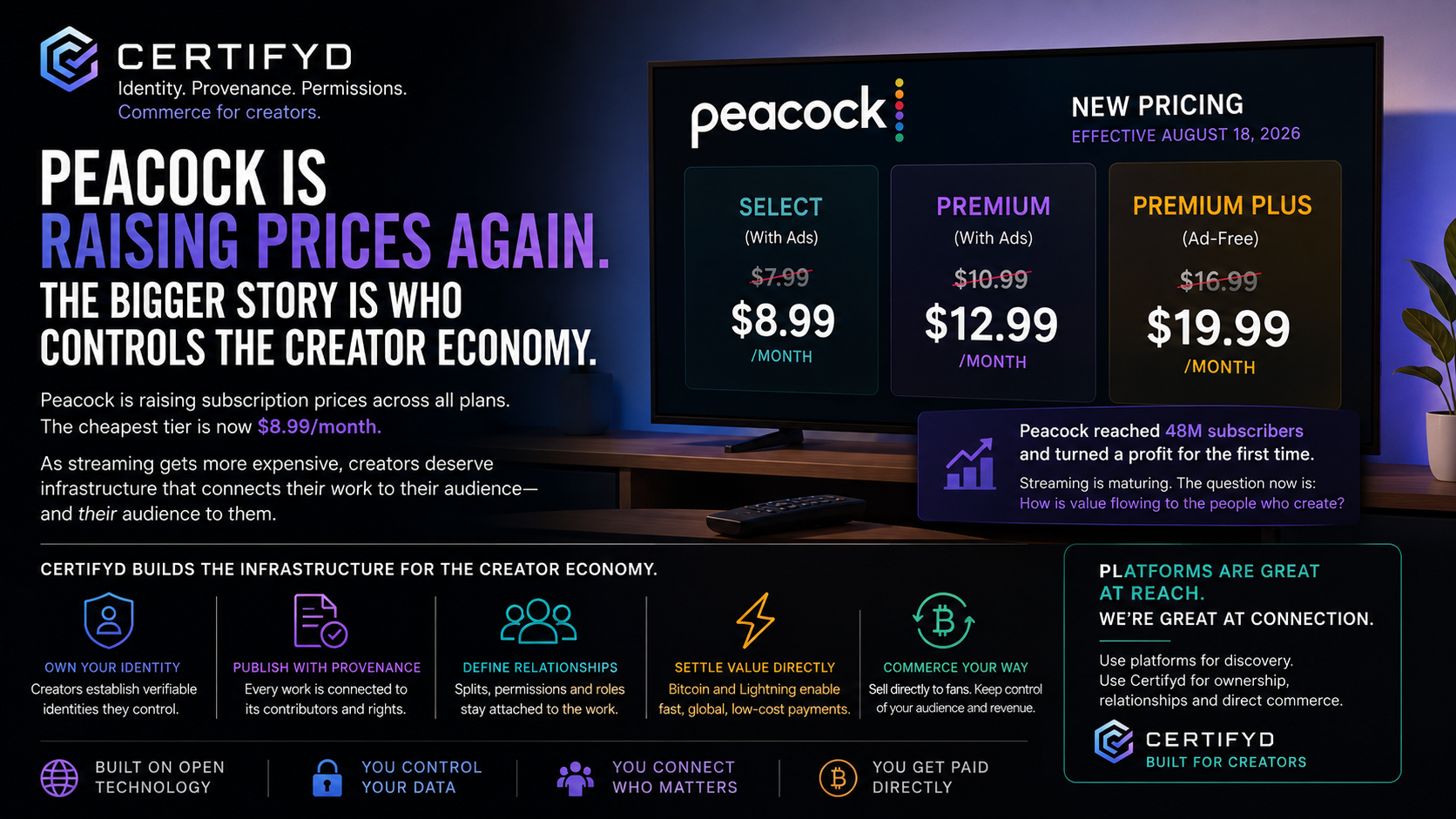
Peacock Is Raising Prices Again. The Bigger Story Is Who Controls the Creator Economy
Streaming was supposed to make entertainment cheaper, easier and more accessible. Increasingly, consumers are discovering that the convenience remains, but the cheap part doesn't.
Peacock has raised prices across its streaming plans, with the changes taking effect August 18 for new and returning subscribers. Its Select tier has increased from $7.99 to $8.99 per month, Premium from $10.99 to $12.99, and ad-free Premium Plus from $16.99 to $19.99.
Existing subscribers will begin seeing the new prices on billing dates on or after September 17. It follows another $3 increase Peacock introduced in July 2025.
Peacock isn't alone. Across streaming, the economics are changing as platforms try to turn enormous audiences, expensive content libraries and years of investment into sustainable businesses.
Streaming Is Growing Up
There is an important detail behind Peacock's latest increase: NBCUniversal recently reported that Peacock had reached 48 million subscribers and turned a profit for the first time.
That makes this more than another story about consumers paying a few dollars more each month.
Streaming businesses spent years prioritizing subscriber acquisition. As the market matures, the emphasis is increasingly shifting toward revenue per customer, retention, bundles and profitability.
Peacock says its higher prices will help it remain competitive while continuing to invest in content and the viewer experience. It has also been adding features, including new mobile experiences, games and subscriber perks, while preparing to become part of a YouTube Premium offering next year.
The result is a streaming market that increasingly resembles the media business it was originally supposed to disrupt: larger bundles, rising prices and powerful intermediaries controlling the relationship between audiences and content.
The Consumer Is Paying More. What About the Creator?
For Certifyd, this is where the story becomes more interesting.
A consumer paying $19.99 instead of $16.99 does not automatically create a more direct economic relationship with the people whose work convinced that consumer to subscribe.
The platform collects the subscription. The platform controls the customer relationship. The platform determines how content is presented, measured and monetized. Compensation then travels through whatever contractual and accounting structures exist behind that content.
That model can work at enormous scale. But it also means the economic relationship between a creator and an audience member can be remarkably indirect.
As subscription prices continue rising, it is reasonable to ask whether increasing the amount of money entering platforms is enough — or whether creators also need better infrastructure for participating in the value created around their work.
Streaming Solved Distribution Better Than Ownership
Streaming has been extraordinarily successful at distribution.
A platform can deliver millions of pieces of content to millions of people almost instantly. What streaming hasn't necessarily solved is the underlying relationship between creator, work, audience and payment.
A creator's identity may exist in one system. Rights information can exist somewhere else. Contributor information can live in contracts and databases. Audience relationships belong to platforms. Payments may pass through several intermediaries before reaching the people attached to the work.
These aren't simply streaming problems. They are infrastructure problems.
Certifyd approaches the creator economy from the opposite direction: start with the creator and the work, establish the relationships around them, and allow commerce to occur on top of those relationships.
A Different Model: Creator-to-Fan Commerce
Certifyd isn't trying to replace Peacock, Netflix, Spotify, YouTube or other large distribution platforms.
Distribution platforms are exceptionally good at reaching audiences.
The opportunity is to make creators less dependent on any single platform for identity, ownership, audience relationships and commerce.
A creator operating their own Certifyd infrastructure can publish work while maintaining a verifiable relationship to it. Contributors and rights relationships can remain connected to that work. Where commerce is enabled, creators can sell directly to supporters rather than requiring every transaction to originate inside a centralized subscription platform.
That creates an important distinction.
Streaming asks: How much should access to the platform cost?
Creator-owned infrastructure asks: How can value move between the people who create something and the people who value it?
Those models don't have to compete. They can coexist.
Bitcoin and Lightning Change the Payment Layer
The payment layer is particularly important.
Certifyd is being built around direct creator commerce with Bitcoin and the Lightning Network available as settlement infrastructure. Instead of requiring every small transaction to move through conventional platform accounting, a buyer can pay for a work and the transaction can produce a verifiable receipt.
Where multiple participants have economic interests in a work, programmable splits can define how value is allocated. That becomes especially useful as creative works become increasingly collaborative and derivative.
The objective isn't to put "crypto" into entertainment for the sake of it. The useful property is much simpler: value can move directly across an open payment network without Certifyd needing to become the custodian of every transaction.
That gives creators another economic rail alongside streaming, subscriptions, advertising, licensing and traditional payment systems.
The Future Probably Isn't Another Subscription
The lesson from Peacock's price increase isn't that streaming subscriptions are failing. Peacock reaching profitability suggests exactly the opposite: the business model is maturing.
But maturity changes the question.
For the past decade, the entertainment industry has focused heavily on where audiences consume content. The next phase may increasingly focus on who controls the economic relationships surrounding that content.
Creators should be able to use large platforms for discovery and distribution without surrendering their entire commercial identity to them. Fans should be able to support creators without every relationship requiring another monthly subscription. Contributors should remain connected to the works they helped create. Payments should be able to follow those relationships.
That is a much larger opportunity than building another streaming service.
More Platforms, or Better Infrastructure?
Consumers aren't going to subscribe to everything.
As prices rise and services multiply, every platform is competing for a larger share of a finite household entertainment budget. Peacock can increase its price. Netflix can increase its price. YouTube can bundle more services. Other platforms can respond with their own subscriptions and packages.
But eventually the consumer still has one wallet.
Creators face a similar problem from the other side. Building a career around a collection of platforms means repeatedly accepting the economics, rules and audience relationships each platform provides.
Certifyd is exploring another layer beneath that system: infrastructure creators can operate themselves, identities they can control, works with persistent provenance, relationships that remain attached to those works, and commerce that can happen directly between network participants.
Streaming isn't going away, and it doesn't need to.
The more interesting future may be one where creators can benefit from the reach of platforms without platforms being the only infrastructure through which their creative economy can exist.
Certifyd covers developments in music, technology and the creator economy and examines what they mean for creator ownership, provenance and direct digital commerce.