
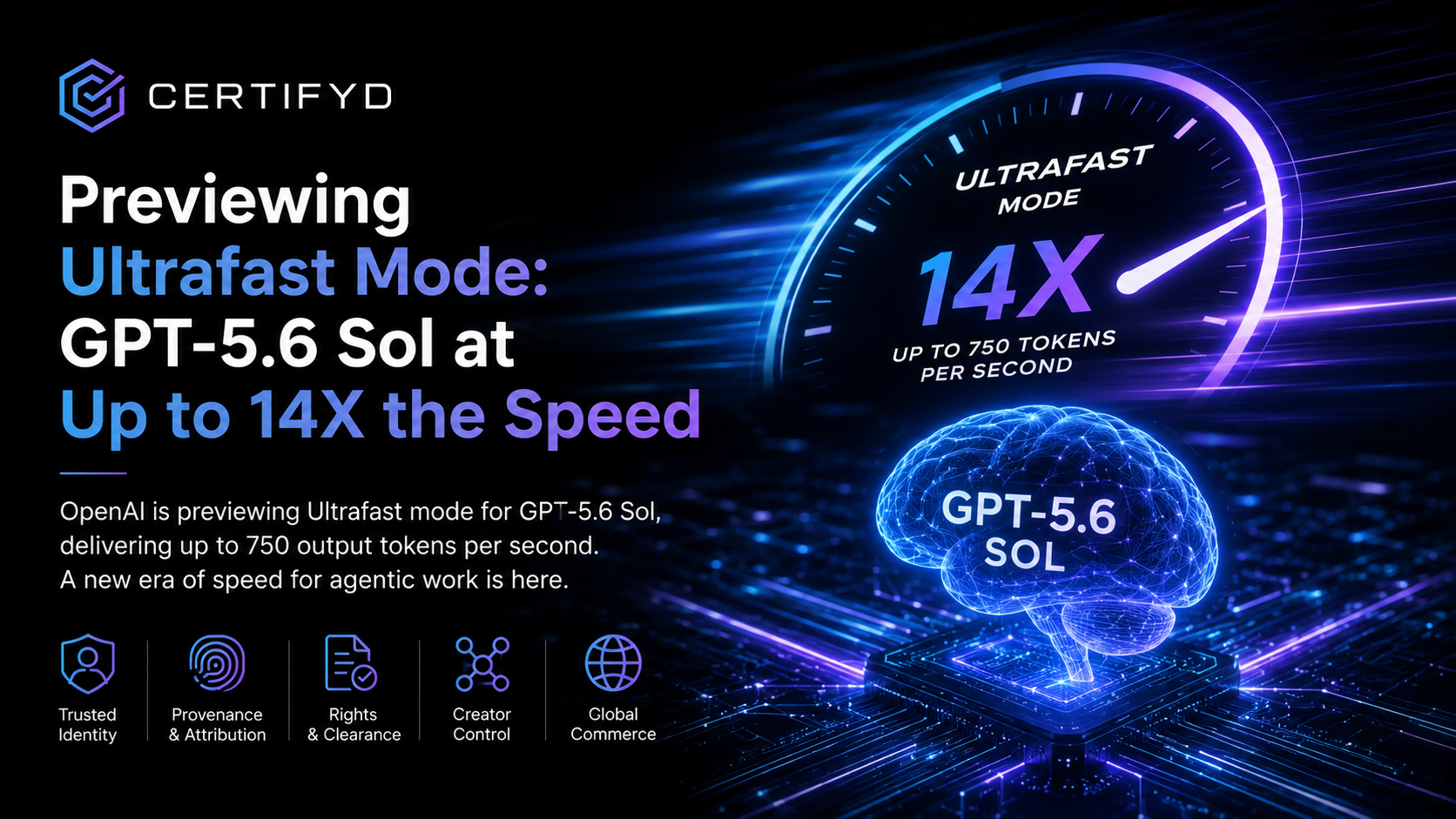
Previewing Ultrafast Mode: GPT-5.6 Sol at Up to 14X the Speed
AI models aren't just getting more capable. They're getting dramatically faster.
OpenAI is previewing Ultrafast mode for GPT-5.6 Sol, a new service tier designed to run its flagship model at up to 14 times the speed of Standard processing.
Powered by Cerebras, the new tier is targeting output speeds of up to 750 tokens per second.
On the surface, this is an inference-speed story.
For Certifyd, the more interesting question is what happens when increasingly capable AI agents can interact with creator-owned infrastructure at those speeds.
From Chatbots to Operators
The first generation of mainstream generative AI was largely conversational.
You asked a question.
The model generated an answer.
Increasingly, that isn't the limit of what these systems do.
Modern AI agents can work across tools, inspect files, interact with software, analyze information, write code and execute multi-step workflows.
GPT-5.6 Sol itself was designed for complex professional and agentic work, including coding, research and long-horizon tasks.
That changes the significance of speed.
A faster chatbot gives you an answer sooner.
A faster agent can potentially complete an entire sequence of work sooner.
Why 750 Tokens Per Second Matters
For a simple question, waiting several seconds instead of one may not matter much.
For an agent performing dozens or hundreds of operations, latency compounds.
Consider an agent helping a creator prepare a release.
It might inspect files, check metadata, review contributor information, identify missing information, prepare publishing records, generate supporting material and help operate the software responsible for publishing the work.
Each individual operation may be relatively small.
Together they become a workflow.
Reducing the time between those operations can change how natural it feels to delegate substantial work to an AI agent.
That's where advances like Ultrafast become more interesting than another benchmark.
Certifyd Is Not Part of Ultrafast
There is an important distinction to make.
Certifyd is not involved in OpenAI's Ultrafast service, and GPT-5.6 Sol does not depend on Certifyd.
The connection is architectural.
Certifyd Core is being developed as independently operated creator infrastructure. AI agents can help people interact with that infrastructure rather than requiring Certifyd itself to become the intermediary performing every task.
That means improvements in agent capability, speed and tool use can potentially make independently operated software considerably easier to use.
AI Can Become the Interface to Infrastructure
Running your own infrastructure traditionally comes with a tradeoff.
You gain control, but you also inherit complexity.
Software needs to be installed.
Services need to be configured.
Problems need to be diagnosed.
Updates need to be applied.
Workflows need to be understood.
For many people, that operational burden is one reason centralized platforms became attractive in the first place.
AI agents create another possibility.
Instead of giving a platform control in exchange for convenience, a creator can increasingly use an AI agent to help operate infrastructure the creator controls.
The creator owns the infrastructure.
The agent helps operate it.
That distinction is central to where Certifyd is going.
What This Could Mean for Certifyd Core
Certifyd Core is designed around creator-controlled publishing and commerce infrastructure.
As agentic AI improves, the interface to that infrastructure doesn't necessarily have to be a maze of configuration screens and technical documentation.
A creator could increasingly express an objective:
"Prepare this release."
"Check whether everyone has accepted their splits."
"Show me what still needs clearance."
"Help me publish this."
"Diagnose why this isn't working."
The agent can then help translate that intention into operations across the creator's own infrastructure.
The faster and more capable those agents become, the less friction there is between intent and execution.
Speed Changes the Economics of Small Operations
This matters particularly for independent creators and small businesses.
Large entertainment companies can employ teams to handle publishing, rights administration, technology, metadata, distribution and operations.
Independent creators usually can't.
AI doesn't eliminate the need for specialists, but it can dramatically increase the amount of work one person can coordinate.
That creates an interesting combination:
Creator-owned infrastructure + AI-operated workflows.
Instead of building another giant platform to perform every function for creators, infrastructure can remain distributed while agents help individual participants operate it.
The Network Still Needs Accountability
Faster AI doesn't remove the need for trust.
If anything, automation makes verifiable relationships more important.
An agent can move quickly, but infrastructure still needs to know which identity is acting, what permissions exist, which work is being referenced and what relationships connect participants.
AI can assist with the operation.
It shouldn't become the source of truth.
Identity, provenance, permissions and accountable relationships need to exist independently of whatever AI model happens to be operating the interface.
That's an important architectural distinction.
The Bigger Shift
Ultrafast mode is notable because 14X faster inference sounds impressive.
But the long-term implication is bigger than response speed.
We're moving toward a world where increasingly capable agents can perform meaningful work at machine speed.
That raises an important question for the creator economy:
What infrastructure will those agents operate?
If every agent ultimately operates inside infrastructure controlled by a handful of centralized platforms, AI could reinforce the same dependencies creators already have.
But if agents can operate software and infrastructure controlled by creators themselves, AI can have the opposite effect.
It can make independence easier.
Infrastructure Becomes Usable Through Conversation
For years, creator ownership has faced a usability problem.
Owning infrastructure sounds appealing until someone has to operate it.
AI agents may change that equation.
The interface to sophisticated infrastructure can increasingly become conversation:
Tell the agent what you want accomplished.
Review what it proposes.
Approve important actions.
Let the agent handle the operational complexity.
The infrastructure remains yours.
The agent becomes the interface.
Ultrafast GPT-5.6 Sol is one more indication of how quickly that interface is improving.
For Certifyd, that's the part worth watching.
Because the future of creator-owned infrastructure may not require every creator to become a systems administrator.
It may simply require infrastructure that their AI agent can operate on their behalf.
Certifyd covers developments in AI, intellectual property and creator commerce and examines what they mean for the infrastructure creators use to publish, own and build around their work.