
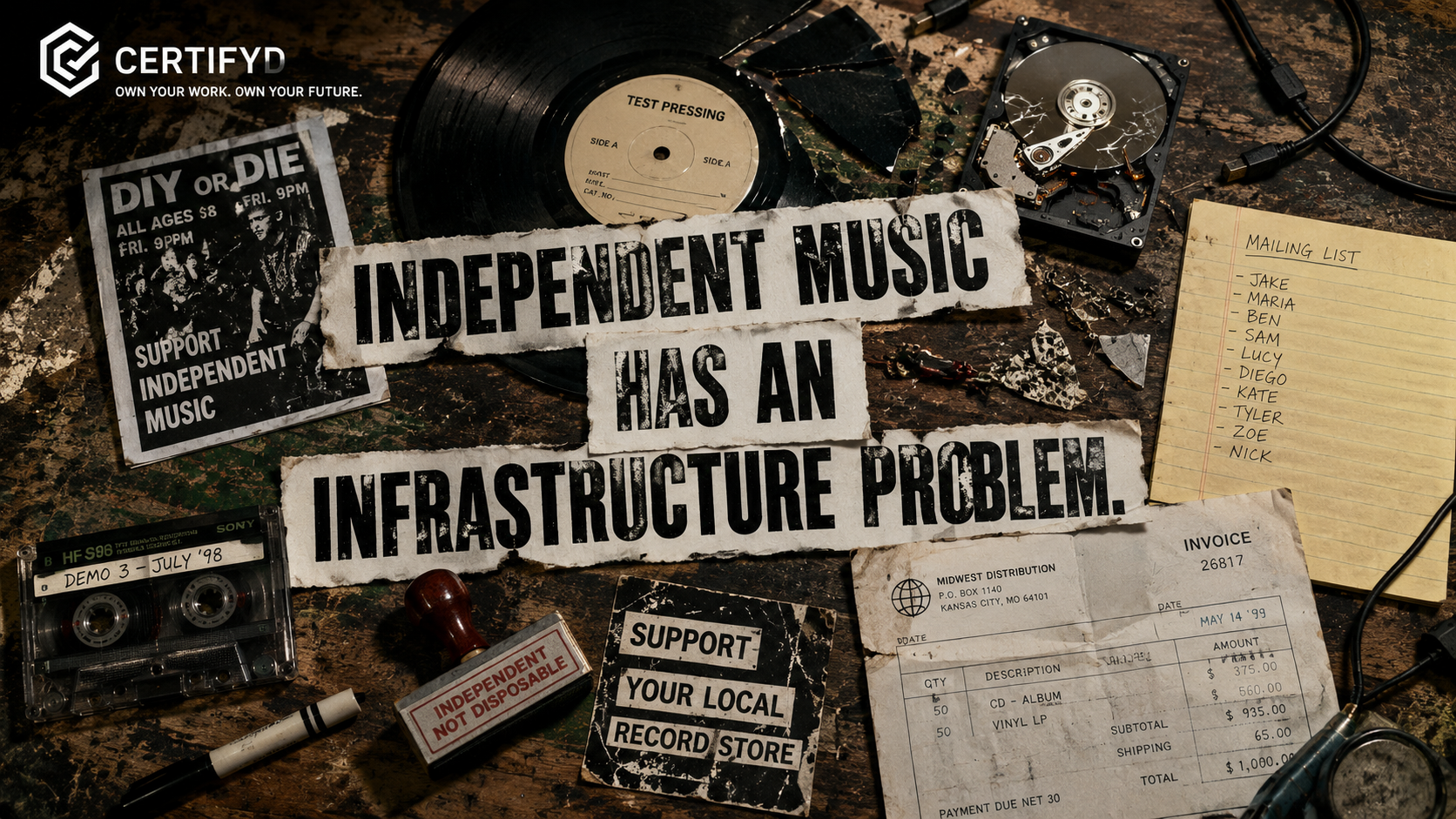
Report explores AI’s indies impact and infrastructure erosion
Independent music doesn't just have an AI problem.
It has an infrastructure problem.
That distinction sits at the heart of a new report from research firm Stvdio and Secretly Distribution examining AI's impact on the independent music sector. Music Ally describes the report as being framed around "a fight for music's infrastructure," which is a much more interesting way to approach the AI debate than simply asking whether machines will generate too much music.
Generative AI is the immediate disruption. The bigger question is what that disruption exposes about the systems independent music already depends upon.
Independence Has Always Been Relative
The independent music business has spent decades building alternatives to the traditional major-label system. Independent labels developed their own networks. Distributors opened routes to market. Digital distribution dramatically lowered the cost of releasing music, while streaming and social platforms gave independent artists access to global audiences that would once have been extraordinarily difficult to reach.
That was real progress.
But much of the infrastructure underneath that independence eventually became infrastructure that independents use rather than infrastructure they control. An artist can independently create a record while depending on outside systems for distribution, discovery, identity, audience access, payments and increasingly the data that determines whether their business is working.
That arrangement can function extremely well. It also means the independence of the creator and the independence of the infrastructure are two different things.
AI is making that distinction harder to ignore.
AI Is Arriving Through Systems Creators Already Depend On
Most of the public fight around AI and music has concentrated on the content itself.
Was copyrighted music used to train a model? Can an AI-generated song infringe a recording? Should synthetic music be labeled? What happens when thousands or millions of generated tracks enter streaming services? How should platforms respond to impersonation, fraud or manipulation?
Those are legitimate questions, and the industry is already fighting over many of them.
But underneath them sits another issue. Independent artists generally don't control the systems where these questions are being decided.
Streaming services decide how AI-generated material is treated inside their catalogs. Technology companies decide how their models operate. Distributors determine what can enter particular channels. Social networks determine how creators reach audiences. Platforms establish the rules around accounts, identity and discovery.
The creator can own the song and still depend on somebody else's infrastructure for almost everything that happens next.
That's the vulnerability the phrase "fight for music's infrastructure" captures.
Owning the Music Isn't the Same as Owning the Route to Market
For independent musicians, ownership has traditionally meant something fairly specific: own your masters, control your publishing, retain your rights and avoid giving away more of the economics than necessary.
Those things still matter enormously.
But digital music has added another layer of dependency that doesn't fit neatly into traditional rights conversations.
A creator might own 100 percent of a recording while their relationship with listeners exists primarily inside Spotify, YouTube, TikTok or Instagram. Their public identity might be represented through accounts maintained by those services. Their audience data might exist inside dashboards they can access but don't operate. Their ability to sell something might depend on payment infrastructure they don't control.
None of that means those services are bad. In many cases, they're extraordinarily useful.
It means ownership of the creative asset doesn't automatically produce control over the infrastructure surrounding it.
AI accelerates the consequences because it introduces enormous amounts of new content, new forms of impersonation, new discovery pressures and new questions about authenticity into systems that creators already depend upon.
The Independent Response Can't Just Be Defensive
There is a danger that the independent music industry's response to AI becomes entirely about stopping things.
Stop unauthorized training. Stop impersonation. Stop fraudulent uploads. Stop streaming manipulation. Stop synthetic catalogs from overwhelming human artists.
Some of those fights are necessary.
But defense isn't infrastructure.
If independent music wants more leverage in the next version of the internet, it also has to ask what systems it wants to build and operate for itself.
What does creator identity look like when it doesn't begin with opening an account on a platform? What does publishing look like when the creator maintains an authoritative record of a work before sending it into distribution? What happens when relationships with listeners can exist outside the database of the company that introduced them?
And perhaps most importantly: can independent systems connect with one another without requiring somebody to build yet another enormous centralized platform?
Those are infrastructure questions.
Independent Doesn't Have to Mean Isolated
This doesn't require every musician to become a software engineer or operate an entire technology company.
Infrastructure can be shared. Services can interoperate. Independent labels, distributors, applications and communities can specialize in different parts of the ecosystem. Creators can still use Spotify, YouTube, TikTok, Bandcamp and whatever comes next.
The important distinction is whether those services are destinations or foundations.
If the creator's identity, catalog and commercial relationships only exist because a particular platform maintains them, then leaving that platform can mean rebuilding significant parts of the business somewhere else.
If those things originate with the creator, platforms can compete to provide useful experiences around them.
That's a fundamentally different relationship.
This Is the Infrastructure Certifyd Is Building Toward
Certifyd Core begins from the premise that creators should be able to operate some of their own digital infrastructure.
Identity can begin with the creator. Works and release records can begin with the creator. Provenance and publishing context can begin with the creator. Commerce can happen through infrastructure the creator operates rather than requiring every transaction and relationship to originate inside a centralized platform.
From there, those creators and works can participate in a broader network.
The point isn't to recreate Spotify on thousands of little computers. It isn't to convince musicians to abandon the platforms where audiences already exist. And it isn't to replace every company currently serving independent music.
It's to create another layer underneath those relationships.
A creator can use a platform without requiring that platform to become the authoritative source of their identity, their work and their entire business.
That is what makes infrastructure different from another app.
The Next Independent Music Movement May Be Technical
Independent music has built infrastructure before.
Independent labels, record stores, distributors, radio stations, venues, promoters, magazines and scenes all emerged because musicians and communities needed systems that the dominant industry either couldn't or wouldn't provide.
The technology changes, but the underlying instinct doesn't.
AI is now putting enormous pressure on the digital systems surrounding music. Some of that pressure will be addressed through law. Some will be addressed through licensing. Platforms will develop new policies, detection systems and verification tools. The major music companies will negotiate deals.
Independent music needs to participate in those conversations.
But it should also be building.
Because the strongest version of independence isn't simply owning the thing you created.
It's having some control over the infrastructure that allows that creation — and the business around it — to exist.
If the emerging fight really is a fight for music's infrastructure, independent creators shouldn't enter it empty-handed.