SoundCloud has launched a limited beta for paid music downloads, and on the surface there is a lot to like. Roughly 200 U.S.-based Artist Pro creators with Fan Support enabled are getting the first access, with SoundCloud reportedly planning to expand availability to more eligible creators later this fall.
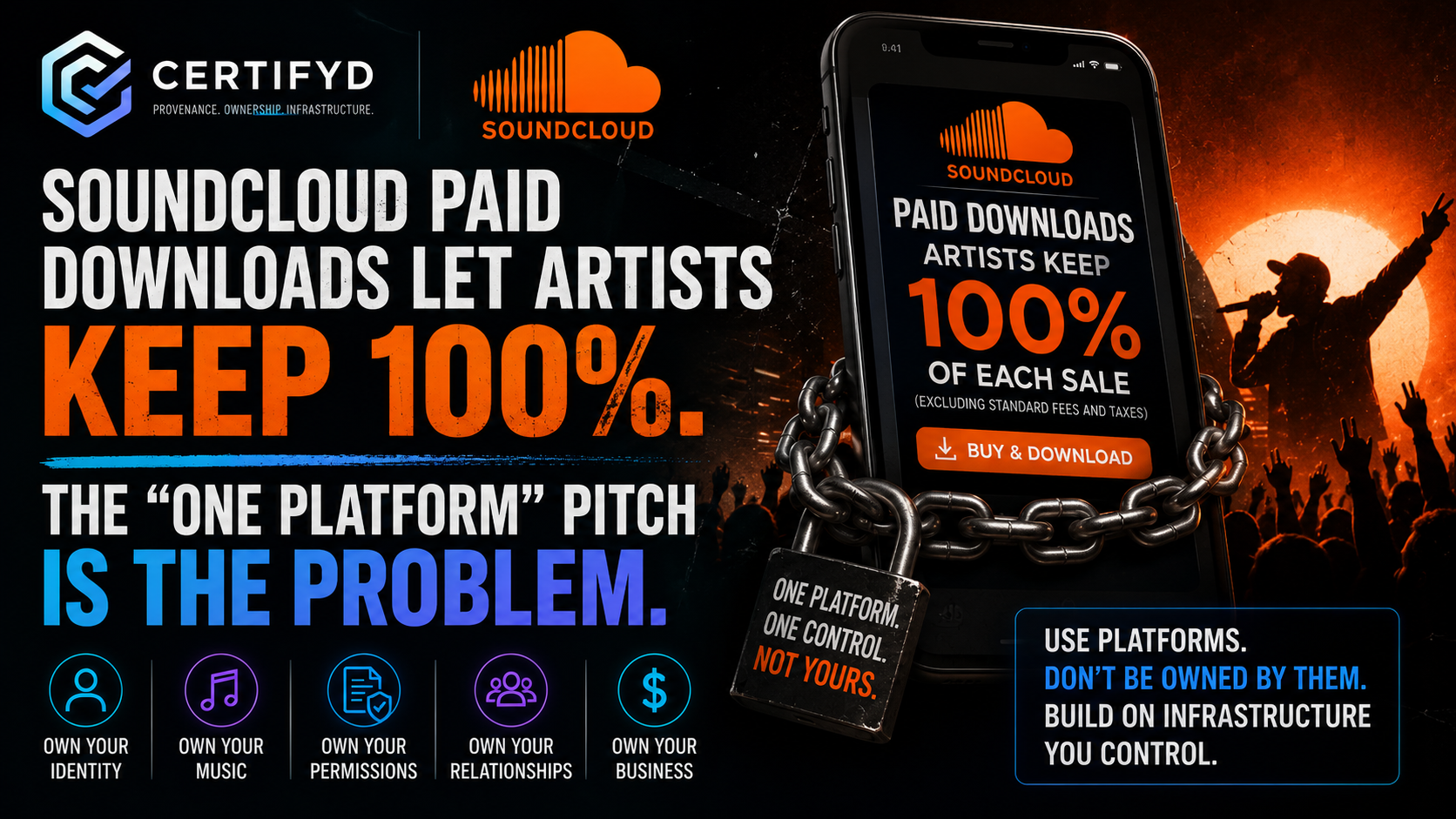
The headline is even better: SoundCloud says artists will "keep 100% of each sale," excluding standard fees and taxes.
Good.
Artists selling music directly to fans is good. Fans actually purchasing music instead of generating fractions of pennies through streams is good. A major music service recognizing that the future of artist monetization extends beyond streaming is good.
Then SoundCloud CEO Eliah Seton explained the larger philosophy behind the company's expansion:
"Artists should be able to build their audience in one place, on one platform."
And there it is.
The creator economy keeps learning the same lesson and then somehow selling it back to creators as innovation.
SoundCloud Paid Downloads Are a Good Idea
Let's separate the product from the philosophy.
Paid downloads make sense.
According to figures SoundCloud provided to Digital Music News, the platform already sends more than half a million users to outside services to purchase music each year. SoundCloud also says 14% of artists it surveyed already sell downloadable music and another 14% want to.
That's meaningful.
For years, the dominant streaming model trained the industry to treat access as the product. But there has always been another kind of fan: someone who doesn't merely want to hear a song but wants to buy something from the artist.
Downloads can serve that relationship particularly well for exclusives, alternate versions, live recordings, demos, B-sides, stems and other material that doesn't necessarily belong inside the conventional streaming catalog.
SoundCloud deserves credit for recognizing it.
And allowing artists to keep the sale proceeds after standard transaction costs is considerably better than inventing another platform tax simply because SoundCloud happens to facilitate the transaction.
None of that is the problem.
"One Place, One Platform" Is the Problem
The problem is the idea that creators should aspire to consolidate their careers inside somebody else's platform.
We've already run this experiment.
Repeatedly.
Creators built enormous audiences on Facebook and discovered that reaching those audiences could eventually require paying Facebook.
Creators built businesses around YouTube and discovered that monetization rules, recommendation systems and eligibility requirements could change around them.
Creators built followings on Twitter, TikTok, Instagram, Patreon, Twitch and countless other services while continually rediscovering the same fundamental distinction:
Having an account somewhere is not the same thing as owning the infrastructure underneath your business.
A platform can be incredibly useful.
It can provide discovery, distribution, payments, community, analytics and an enormous audience.
But the more pieces of a creator's career that become concentrated inside one company's system, the more consequential that company's decisions become.
That isn't sovereignty.
It's convenience purchased with dependency.
SoundCloud Is Becoming Much More Than SoundCloud
This matters because SoundCloud isn't merely adding a download button.
Look at what the company is assembling.
SoundCloud already offers music hosting, discovery, comments, messaging, distribution, monetization and fan-powered royalties. It has added direct Fan Support, where it says creators receive the contribution after payment-processing fees. It offers on-demand vinyl through its elasticStage partnership. It provides artist subscriptions and distribution to other streaming platforms.
And in July, SoundCloud acquired Nina Protocol, the independent music platform built around direct artist support and music ownership.
SoundCloud's own Nina transition page now promotes an increasingly comprehensive proposition: discovery, distribution, audience insights, collaboration, Fan Support, vinyl, royalties and more under the SoundCloud umbrella.
That isn't merely a music-streaming service anymore.
It's becoming creator infrastructure.
Which makes the question of who controls that infrastructure considerably more important.
The Better the Platform Gets, the Bigger the Dependency Gets
This is the uncomfortable part of platform consolidation.
A bad platform isn't particularly dangerous because nobody wants to depend on it.
A really good platform can be.
If SoundCloud gives artists discovery, hosting, distribution, social interaction, fan relationships, direct payments, downloads, physical products and analytics, the obvious response is:
Why would I need anything else?
That's exactly when creators should ask the opposite question.
What happens if I eventually need something else?
What happens if the terms change?
What happens if the fee structure changes?
What happens if an account is suspended?
What happens if a recommendation algorithm changes?
What happens if the company is acquired?
What happens if a feature disappears?
What happens if a creator wants to move their identity, catalog, customers, transaction history or community somewhere else?
The issue isn't whether SoundCloud intends to do any of those things.
The issue is architectural.
If one company sits underneath every important relationship in your creative business, that company becomes a dependency whether it behaves benevolently or not.
"100%" Doesn't Mean You Own the Relationship
This is also why the increasingly popular "artists keep 100%" pitch deserves some scrutiny.
Again, keeping 100% of a sale after unavoidable transaction costs is excellent.
But revenue share is only one dimension of creator ownership.
Suppose a platform gives you 100% of today's $10 transaction while controlling the account through which the customer discovered you, the identity through which you publish, the database containing the relationship, the interface through which the customer purchases, and the infrastructure required to continue doing business with that customer.
Did you receive the money?
Yes.
Do you therefore own the relationship?
Not necessarily.
Creator ownership is bigger than payout percentage.
It includes identity.
It includes data.
It includes provenance.
It includes the ability to publish.
It includes the ability to transact.
And crucially, it includes the ability to take those things somewhere else.
Direct-to-Fan Should Actually Mean Direct-to-Fan
The music industry has started using direct-to-fan so frequently that the phrase risks becoming meaningless.
If a fan buys something from an artist through a centralized platform, that's certainly more direct than a streaming royalty passing through multiple layers of industry accounting.
But technically, there is still someone in the middle.
The platform still operates the system.
That isn't necessarily bad. Intermediaries can provide enormous value, and creators should happily use them when the value exceeds the cost.
The mistake is confusing a useful intermediary with infrastructure the creator actually controls.
Real creator independence doesn't mean refusing to use SoundCloud.
It means being able to use SoundCloud without needing SoundCloud to exist.
That's a very different idea.
SoundCloud Should Be a Powerful Participant, Not the Creator's Entire World
There is an alternative to the "one place, one platform" model.
Creators can operate from infrastructure they control and then connect that infrastructure to services that provide useful capabilities.
SoundCloud can provide discovery.
Another service can provide distribution.
Another can provide social reach.
Another can provide commerce.
And the creator can remain the persistent layer connecting all of them.
In that architecture, platforms compete to provide value to the creator rather than competing to become the container surrounding the creator's entire career.
That distinction sounds technical.
Economically, it's enormous.
If your identity, work and commercial relationships originate from infrastructure you control, switching a service doesn't require rebuilding your digital existence.
Platforms become replaceable participants.
The creator remains.
This Is Why We Built Certifyd Core
This is one of the architectural problems Certifyd Core is designed to address.
Core isn't intended to replace SoundCloud.
In fact, the opposite architecture is more interesting.
A creator can operate their own persistent infrastructure, establish their identity and work from that infrastructure, publish into a peer-to-peer network, establish provenance around their content and participate in commerce without requiring Certifyd to permanently sit in the middle of every transaction.
Other applications can then become interfaces into that creator-controlled infrastructure.
A discovery application can discover it.
A social application can reference it.
A fan application can interact with it.
A commercial service can transact with it.
And a platform like SoundCloud can still be an enormously valuable distribution and discovery channel.
The difference is where the center of gravity lives.
In the traditional platform model, the creator lives inside the platform.
In a sovereign model, platforms connect to the creator.
That's the inversion we're interested in.
SoundCloud Is Moving in the Right Direction — and Drawing the Wrong Conclusion
There is something almost ironic about SoundCloud's latest move.
The company has correctly identified several weaknesses of the streaming economy. Artists need more ways to earn. Fans want deeper relationships with musicians. Some listeners still want to own music. Direct purchases can be more meaningful than anonymous consumption.
SoundCloud is responding by building tools around those realities.
Great.
But the conclusion shouldn't be that artists therefore need more of their careers consolidated inside SoundCloud.
It should be that creators need more control over the relationships these tools are revealing.
If half a million SoundCloud users are already leaving the platform each year to purchase music, that's not evidence that every transaction needs to be captured inside SoundCloud.
It's evidence that fans are willing to follow artists beyond a streaming interface.
That's powerful.
The relationship is bigger than the platform.
Use SoundCloud. Don't Become Dependent on SoundCloud.
Creators shouldn't abandon platforms.
That would be ridiculous.
SoundCloud can be useful. YouTube can be useful. TikTok can be useful. Spotify can be useful. Patreon can be useful. Bandcamp can be useful.
Use all of them if they help.
Take the discovery.
Take the distribution.
Take the audience.
Take the tools.
Take the 100% download revenue.
But don't confuse using infrastructure with owning infrastructure.
And don't accept the idea that the ultimate destination for an independent creator is to place discovery, identity, community, distribution, commerce and fan relationships inside one company's walls.
The creator economy has spent twenty years learning what happens when creators build businesses on rented digital land.
We don't need a better landlord.
We need creators who can own the foundation and choose which platforms they want to build on top of it.
SoundCloud's paid downloads are a good feature.
"One place, one platform" is an awful ambition.