
For all the debate about artificial intelligence and music, sometimes the most revealing problem is considerably more ordinary.
Someone says they represent an artist.
A company believes them.
A deal gets made.
Then the artist says otherwise.
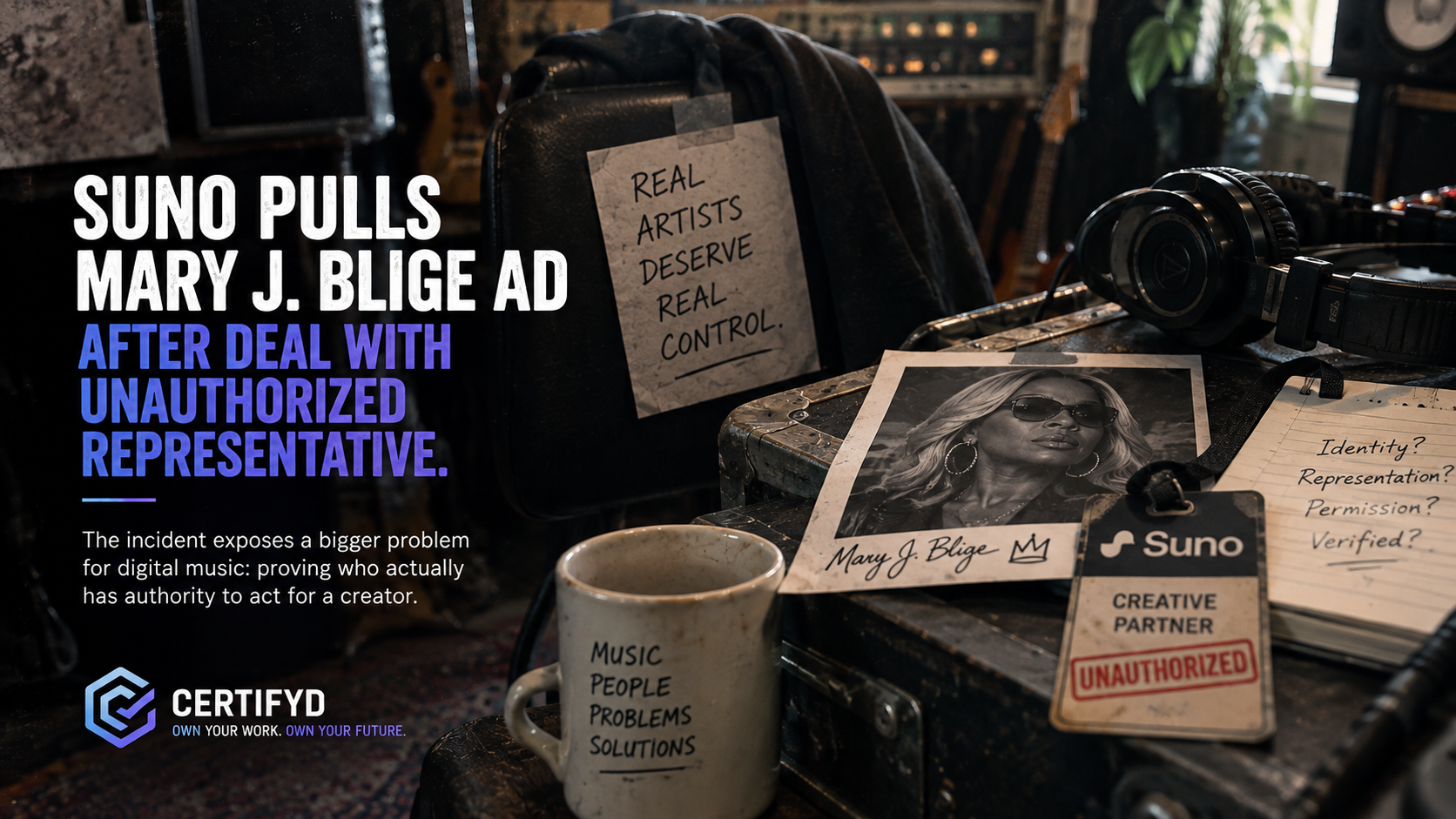
That is essentially the situation Suno now says it encountered with Mary J. Blige. The AI music company pulled an advertisement featuring the R&B star after learning that the person who arranged the campaign was not actually authorized to represent her. Suno said it had entered into a business deal with someone who presented themselves as Blige's official representative and terminated the campaign after learning that wasn't the case and that Blige was uncomfortable with it. :contentReference[oaicite:0]{index=0}
The advertisement showed Blige reacting positively to an AI-generated song during what appeared to be a studio demonstration. It created the impression that she was endorsing Suno and its technology. According to subsequent reporting, however, Blige had not approved the campaign. :contentReference[oaicite:1]{index=1}
That makes this more than another story about an AI company attracting criticism.
It is a story about authority.
Knowing Who Someone Is Isn't Enough
Digital identity is usually discussed as a problem of authentication.
Is this really Mary J. Blige?
Is this really the artist's account?
Is this really the person who created the work?
Those are important questions, but commercial relationships introduce another one that is just as important:
Does this person actually have the authority to act for the artist?
A manager, lawyer, label executive, booking agent, publisher or other representative may legitimately act on behalf of a creator in one context without having unlimited authority in every other context.
Someone might be authorized to negotiate a live performance but not approve an advertising campaign. A distributor might be permitted to deliver recordings without having authority over name, image and likeness. A manager might negotiate business opportunities while particular agreements still require direct approval from the artist.
Identity tells you who someone is.
Authorization tells you what they're allowed to do.
The Suno incident appears to have failed at the second part.
The Internet Is Full of Proxy Relationships
Creators rarely operate alone.
Professional music depends on networks of relationships between artists, managers, labels, publishers, attorneys, distributors, producers, agents, publicists and other people or organizations.
Most of those relationships are perfectly legitimate. In fact, the ability to delegate authority is essential to running a serious creative business.
The problem is that the digital systems connecting those people often reduce complex relationships to something much simpler: an email, an account, a message, a contract attachment or somebody saying they represent somebody else.
That can work remarkably well until it doesn't.
The deeper issue isn't whether companies should trust representatives. They have to. The issue is whether the relationship between the creator and the representative can itself be verified.
There is a substantial difference between:
"This person says they represent Mary J. Blige."
and:
"Mary J. Blige has established that this person is authorized to perform this specific action on her behalf."
The first is an assertion.
The second is a verifiable relationship.
AI Makes an Old Problem More Expensive
Nothing about false or mistaken representation was invented by artificial intelligence.
Artists have dealt with unauthorized agents, fraudulent promoters, fake managers and people overstating their relationships for decades. Entertainment businesses already rely on contracts, lawyers, agencies and professional networks to establish who can legitimately negotiate for whom.
AI changes the scale and speed at which those mistakes can become consequential.
A disputed authorization can now result in an advertisement spreading across social platforms before the underlying relationship has even been publicly questioned. Content can be generated, distributed and replicated quickly. A creator's voice, image or artistic identity can be associated with a technology or campaign in front of millions of people almost immediately.
That makes the authorization layer more important, not less.
The technical question isn't simply whether AI-generated content can be detected or whether an artist's likeness was used. It is whether there is a trustworthy record showing who authorized the activity in the first place.
Creator Identity Needs Relationships Attached to It
This is one reason we think about creator identity differently at Certifyd.
An identity by itself is useful, but a creator's professional existence isn't a collection of isolated identities. It is a network of relationships.
An artist can have relationships with works.
Works can have relationships with releases.
Artists can have relationships with labels, managers, publishers and collaborators.
Those relationships can carry permissions and responsibilities.
That suggests a more useful architecture for creator identity than simply creating another verified profile.
Imagine a creator-controlled identity that can establish:
- this is the creator;
- this work belongs to or was created by this creator;
- this person is the creator's manager;
- this company is authorized to distribute a particular release;
- this representative can negotiate certain commercial activities;
- this permission was granted at a particular time;
- this permission has expired or been revoked.
The point isn't to put every private contract on a public network. It is to make the existence and scope of important relationships independently verifiable when necessary.
Authority Should Be Delegated, Not Assumed
There is an important architectural principle here.
Authority should flow outward from the creator.
The conventional digital model often works in reverse. A platform encounters someone claiming to represent an artist, establishes enough confidence to proceed and then builds its own internal record describing that relationship.
That means every company has to solve the same problem independently.
A creator-controlled model could begin with the creator establishing the relationship.
Instead of:
Representative → company → company decides relationship is valid
the chain could begin:
Creator → representative relationship → company verifies relationship
The company would still decide whether the evidence satisfies its own requirements. It wouldn't be forced to accept every claim simply because it exists.
But it would have something stronger to evaluate than the representative's own assertion.
Certifyd Core Can Go Beyond the Profile
Certifyd Core is being built around creator-controlled identity, works, publishing records, provenance, relationships and commerce.
That means the useful unit isn't just the creator profile.
It is the graph around the creator.
A creator can establish an identity from infrastructure they operate. Works can originate from that identity. Relationships between participants can be recorded. Over time, the same architecture can support increasingly specific forms of delegated authority.
That matters because sovereignty doesn't mean the creator personally performs every business task.
Quite the opposite.
A creator-owned system becomes more useful when the creator can safely delegate.
Managers should be able to manage. Labels should be able to perform the jobs artists authorize them to perform. Distributors should be able to distribute. Agents should be able to negotiate. Applications should be able to interact with those relationships without pretending the application itself is the ultimate source of truth.
The distinction is that those powers originate from a relationship the creator controls rather than merely from access to somebody else's database.
Verification Isn't Just About People
The music industry is beginning to confront creator verification more seriously.
We recently wrote about LyricFind allowing artists to claim their catalogues and about the larger problem of creator identity being reconstructed inside centralized databases. The Suno and Mary J. Blige incident exposes another layer of exactly the same architectural problem.
Knowing who the artist is isn't enough.
A functioning digital creative economy also needs to know who can speak for the artist, who can act for the artist and what they have actually been authorized to do.
That becomes increasingly important as more transactions happen between software systems rather than across conference tables.
AI agents will negotiate.
Platforms will exchange information automatically.
Rights systems will communicate with other rights systems.
Commerce will increasingly happen through software.
If those systems can't distinguish between identity, relationship and authority, automation simply makes the consequences of getting it wrong happen faster.
The Creator Should Be the Root of Authority
Suno says it believed it had made a legitimate business deal and pulled the campaign once it learned that the person involved wasn't actually authorized to represent Mary J. Blige. There is nothing unusual about a company relying on representatives in commercial negotiations, and the available reporting doesn't establish exactly how Suno evaluated that representation before proceeding. :contentReference[oaicite:2]{index=2}
But the episode exposes a weakness that extends far beyond one company.
The internet has built enormous infrastructure for accounts, content and payments while leaving many professional relationships represented by surprisingly fragile signals of trust.
Who are you?
Who do you represent?
What are you allowed to do?
Who gave you that authority?
Can they revoke it?
Those aren't administrative details.
They are infrastructure.
And if creators are going to have meaningful control over their digital businesses, the chain of authority should begin with them.