
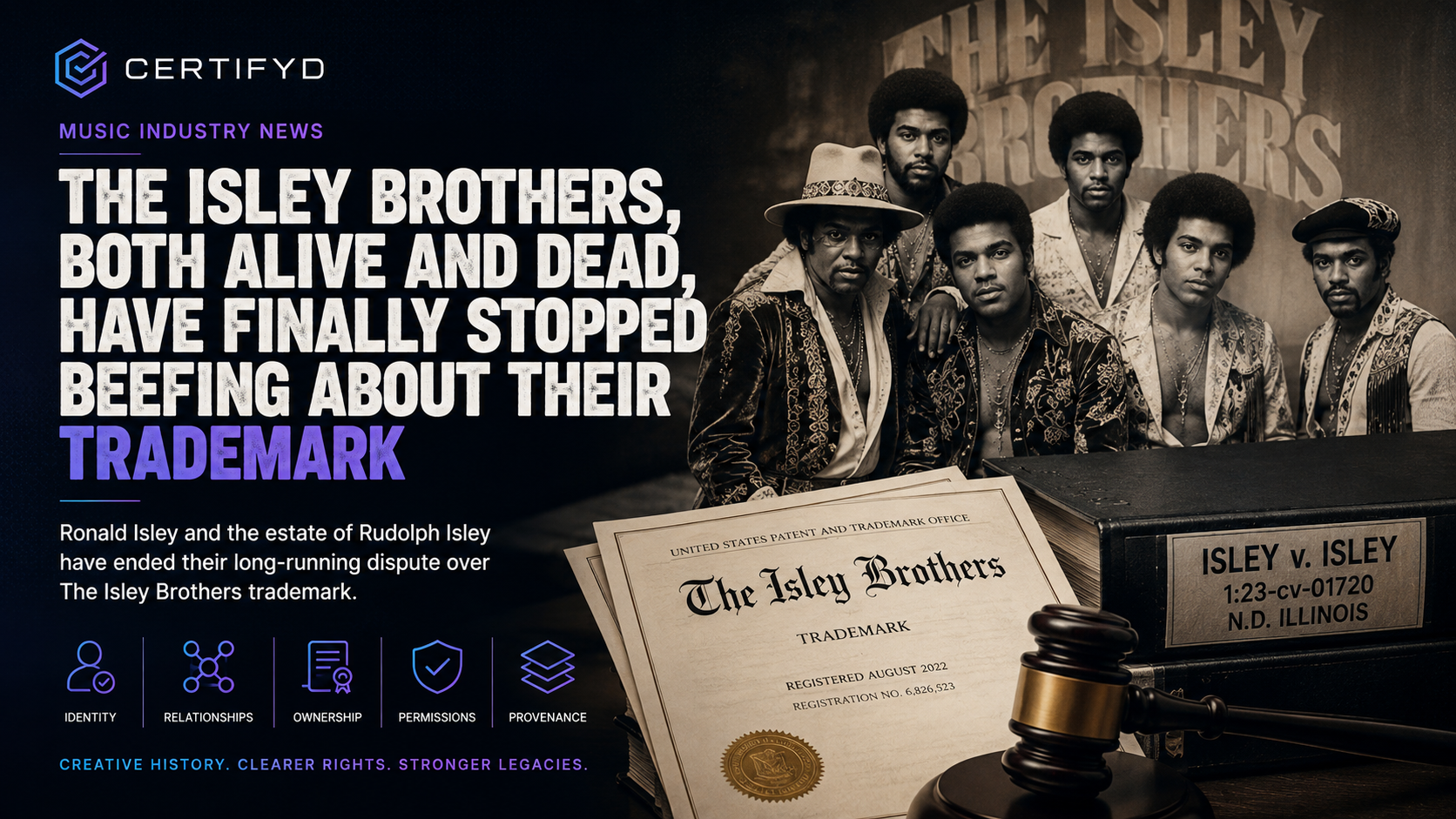
The Isley Brothers, Both Alive and Dead, Have Finally Stopped Beefing About Their Trademark
After more than three years of litigation, Ronald Isley and the estate of his late brother Rudolph Isley have ended their dispute over ownership of The Isley Brothers trademark.
The parties filed a stipulation of dismissal in federal court in Chicago, ending the case without a court ruling on the underlying ownership dispute or public disclosure of the settlement terms.
The dismissal is with prejudice, meaning Rudolph Isley's estate cannot bring the same claims again. Ronald Isley's August 2022 federal registration of The Isley Brothers trademark therefore remains active in his name.
But behind a dispute involving one of the most enduring names in American music is a much broader question for creators:
Who controls a creative identity when the people, partnerships and businesses behind it change over time?
A Dispute Decades in the Making
Rudolph Isley filed the lawsuit against Ronald in March 2023, arguing that The Isley Brothers trademark was jointly owned through their longstanding partnership.
He sought a 50% share of commercial proceeds associated with the mark and an accounting of revenues.
Rudolph died only months after filing the case, but his estate continued the litigation.
The history behind the disagreement stretches considerably further back.
Rudolph, Ronald and O'Kelly Isley Jr. formed The Isley Brothers in Cincinnati around 1954. The group later expanded to include Ernie Isley, Marvin Isley and Chris Jasper.
Those three eventually left to perform as Isley-Jasper-Isley, while ownership and control of The Isley Brothers name remained associated with the group's founding members.
Then the structure changed again.
O'Kelly died in 1986 without a will, and his interests passed equally to his surviving brothers. Rudolph stopped recording and performing with the group in 1989, but according to the allegations described in the case, continued participating in the management and promotion of group assets and receiving royalties associated with recordings and sample licenses.
Decades later, Ronald registered The Isley Brothers trademark in his own name.
That registration became the center of the dispute.
Was There Still a Partnership?
Ronald sought to dismiss the lawsuit by arguing that the original partnership owning the group's trademark had dissolved following O'Kelly's death and that Rudolph retained no rights to the name after leaving the performing group.
The court agreed that the original partnership would have dissolved as a matter of law following O'Kelly's death because there was no express agreement continuing it.
But that didn't necessarily settle the issue.
The complaint also supported the possibility that Ronald and Rudolph subsequently operated as a two-person partnership. Their continued dealings involving the group became relevant, as did allegations that Rudolph continued receiving profits connected to the group's work.
The dispute therefore became about more than whose name appeared on a trademark registration.
It became a question of what happened to the relationships surrounding The Isley Brothers as the group changed over decades.
The Case Is Over, But the Rights Question Is Bigger
The settlement ends this particular dispute, but the circumstances behind it are familiar across the music business.
Creative careers can last for generations. Bands change members. Partnerships evolve. People retire. Rights move between individuals and companies. Creators die and estates inherit their interests.
The intellectual property can continue generating revenue through all of it.
That creates a difficult record-keeping problem.
Who participated in the original partnership? What happened when the partnership changed? Which rights remained with former members? Which rights were transferred? Who was authorized to act on behalf of the group at a particular point in time?
In the Isley Brothers dispute, some of those questions reached back decades.
Creative Rights Need a History
Ownership records don't always tell the whole story.
A trademark registration can identify the registered owner of a mark. A copyright database can document registered claims. Contracts can establish agreements between particular parties.
But creative businesses evolve.
A band name can simultaneously represent a performing group, a catalog, a commercial brand and decades of relationships between members, companies, licensees and estates.
When those relationships change, preserving their history becomes important.
It's the difference between knowing who controls something today and understanding how that control developed.
Provenance Isn't Just About Songs
The music industry's growing discussion around provenance is often focused on recordings, samples and, increasingly, AI-generated content.
But provenance can apply to the relationships surrounding creative property as well.
A useful historical record might look something like:
Creator → Group → Work → Rights → Permission → License → Commerce
If one of those relationships changes, the previous history doesn't need to disappear.
A member leaving a group doesn't erase their contribution to earlier recordings. A rights transfer doesn't erase the previous owner. An estate inheriting an interest doesn't erase the creator from whom that interest originated.
Each event becomes another part of the history.
Where Certifyd Sees the Infrastructure Problem
This is where the Isley Brothers dispute intersects with the work we're exploring at Certifyd.
Not resolving trademark disputes. Not replacing contracts or trademark registries. And certainly not deciding who legally owns a band name.
The infrastructure question is simpler:
Can creative relationships be documented as they happen instead of reconstructed years later?
Our work around identity, provenance, permissions and chain of custody is partly an attempt to answer that question.
A persistent record of participants and their relationships to creative property wouldn't eliminate disagreements. But it could provide better historical context when rights change, works are licensed, members leave, partnerships evolve or ownership passes to another party.
What Happens When a Creator Dies?
Rudolph Isley's death during the litigation adds another dimension to the story.
Music rights regularly outlive the people who created them.
Catalogs continue earning revenue. Trademarks remain valuable. Samples continue being licensed. Estates and heirs inherit interests that may have originated decades earlier.
Any infrastructure designed to document creative rights therefore has to think beyond the lifespan of an account, company or even the creator.
The historical record needs continuity.
If a right passes from a creator to an estate, the original relationship shouldn't simply disappear and be replaced with a new owner in a database. The succession itself is part of the history.
That becomes increasingly important as valuable music catalogs and other creative assets pass between generations.
Better Records Won't Eliminate Disputes
None of this means technology could have prevented the Isley Brothers lawsuit.
The brothers appear to have had a genuine disagreement about the legal consequences of events stretching back decades. Ultimately, questions like those belong in contracts, negotiations and, when necessary, courts.
But better records can change what everyone has to work with.
Instead of reconstructing decades of relationships after a dispute begins, participants can preserve evidence of those relationships while they're happening.
Who participated?
Who left?
What rights remained?
What changed?
Who authorized what?
Who inherited or acquired an interest later?
Those aren't replacements for legal agreements. They're part of maintaining a clearer history around the intellectual property those agreements govern.
The Asset Isn't the Whole Story
The Isley Brothers have been making music in one form or another for more than seven decades.
The recordings survived. The name survived. The royalties survived. The commercial value survived.
So did the complicated relationships surrounding them.
That's what makes this case interesting beyond the immediate trademark dispute.
The music industry has become very good at tracking assets.
The harder problem is maintaining the chain of people, permissions, agreements and ownership changes surrounding those assets over decades.
As catalogs become increasingly valuable and creative rights move between artists, estates, publishers, investors and other rights holders, that history matters.
The Isley Brothers trademark lawsuit is over.
The infrastructure question it exposes isn't:
Can we preserve the history of creative ownership before somebody has to reconstruct it in court?
Certifyd covers developments in music, intellectual property and creator commerce and examines what they mean for the infrastructure creators use to publish, own and build around their work.