
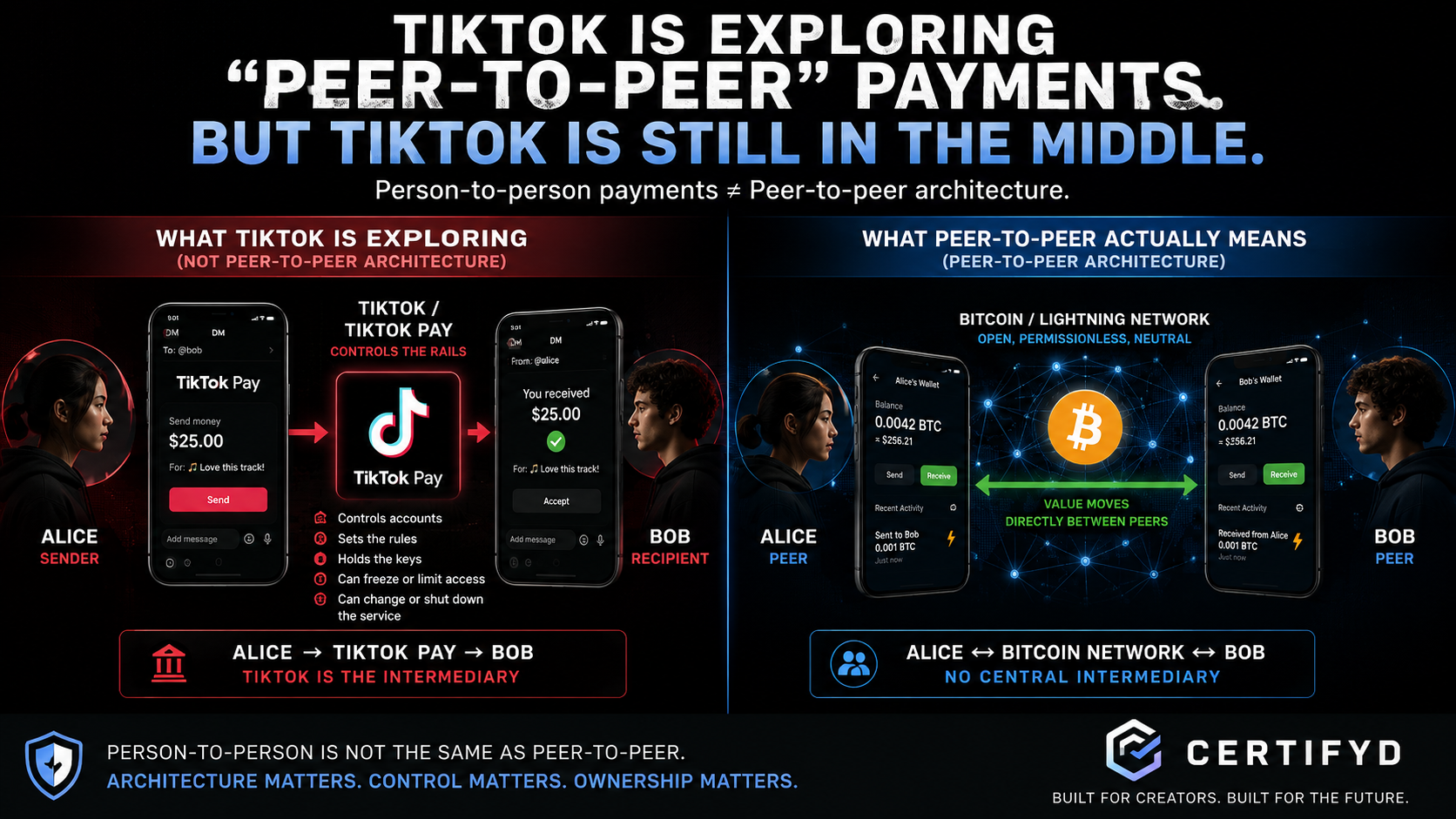
TikTok Calls It Peer-to-Peer Payments. TikTok Is Still in the Middle.
TikTok is reportedly exploring a feature that would allow users to send money to one another through direct messages. TechCrunch, citing Bloomberg, describes the proposed feature as "peer-to-peer payments." Code reportedly discovered in TikTok's U.S. iPhone app suggests recipients could accept payments through DMs, with transactions running through TikTok Pay.
At first glance, "peer-to-peer" sounds straightforward. One person sends money directly to another. But look underneath the interface and something important hasn't changed: TikTok is still in the middle.
That distinction isn't nitpicking over terminology. It gets to one of the biggest questions facing the creator economy: when a platform says something is direct, peer-to-peer or creator-controlled, who actually controls the infrastructure?
Peer-to-Peer Has Two Very Different Meanings
The payments industry commonly uses "P2P" to mean person-to-person. Under that definition, a payment can legitimately be described as P2P simply because one individual is paying another.
In network architecture, however, peer-to-peer means something different. Participants operate as peers rather than depending on a central platform to own and mediate the relationship between them.
Those definitions have become blurred, and that's where the language becomes misleading.
If TikTok's proposed feature operates as reported, the transaction would still broadly look like this:
Person A → TikTok Pay → Person B
The people at either end may be transacting with each other, but the rails between them remain controlled by an intermediary. TikTok operates the application, controls the accounts, determines access to its services and establishes the rules under which users participate.
Calling the endpoints peers doesn't remove the middle.
The Interface Can Look Direct While the Architecture Isn't
This distinction reaches far beyond payments. Modern platforms increasingly offer experiences described as direct-to-fan, creator-owned, community-driven or peer-to-peer. Those terms appeal to something users clearly want: greater control over their digital relationships.
But changing the interface doesn't necessarily change the architecture.
A creator can have "their audience" while a recommendation algorithm determines whether that audience ever sees them. A user can "own" a purchase while access depends on maintaining an account with the company that sold it. Two people can communicate "directly" while a platform retains the technical ability to terminate either account.
Payments can work the same way. Moving money from one person's screen to another person's screen doesn't tell us who controls the infrastructure connecting them.
The button isn't the architecture.
Now Add Discovery, Speech and Money
This becomes considerably more important when one company controls multiple layers of the relationship.
TikTok already controls a powerful content-discovery system. It establishes moderation policies, operates the accounts through which creators reach audiences and determines how content is distributed through its recommendation systems. The platform has also faced years of political controversy and scrutiny over moderation, politically sensitive content and the influence its recommendation algorithms can have over what users see.
Claims of political bias against TikTok come from different directions and individual allegations are often disputed. But we don't need to prove that TikTok favors one political position to recognize the underlying infrastructure problem.
The platform has the power to make these decisions because the platform controls the system.
If payments become another feature inside that same environment, the concentration becomes greater. The company controlling your account and your access to discovery could also control your access to the commercial infrastructure connecting you with supporters.
That doesn't prove TikTok will shut off someone's payments because of a dissenting opinion. It demonstrates something more fundamental: the architecture gives a centralized intermediary the ability to establish the conditions under which both discovery and commerce occur.
For creators, that distinction should matter.
Direct-to-Fan Can Have the Same Problem
The creator economy has its own version of this language problem.
"Direct-to-fan" sounds as though the creator and fan have a direct commercial relationship. Yet many systems marketed this way still look structurally like:
Fan → Platform → Creator
The platform can control the storefront, identity system, audience database, payment account, content hosting and access rules. The creator may receive the money, but the platform owns much of the infrastructure required for that relationship to exist.
That isn't necessarily bad technology. Platforms can provide useful services.
But it isn't the same architecture as:
Creator ↔ Network ↔ Fan
where neither participant requires one particular company to remain permanently in the middle.
Bitcoin Makes the Difference Easier to See
Bitcoin is useful here because the phrase peer-to-peer isn't merely describing who appears on either side of a payment.
Bitcoin was designed as a peer-to-peer electronic cash system. There is no Bitcoin company maintaining the master account database and deciding which users are permitted to participate. Independent participants operate software according to a common protocol.
Lightning extends that architecture with a payment network designed for faster, inexpensive Bitcoin transactions.
Centralized businesses can still exist around Bitcoin. A custodial wallet or exchange can control a user's account, impose rules and introduce an intermediary. But that intermediary exists on top of the network. It doesn't own the underlying Bitcoin protocol.
That's the architectural difference.
A centralized company can build a service on a peer-to-peer network.
And a centralized company can build a person-to-person payment feature without becoming peer-to-peer.
The two shouldn't be confused.
Where Certifyd Takes a Different Approach
Certifyd isn't involved with TikTok or its proposed payment system. But the distinction illustrates why Certifyd is being built around a different architecture.
Certifyd Core runs under the participant's control. Independently operated Core installations can establish relationships across the network rather than requiring every creator, fan and service provider to exist as an account inside one Certifyd-operated application.
That doesn't mean abandoning the things people expect from modern software. Discovery, moderation, commerce, customer service and other services can still exist. Decentralization isn't the absence of services; it's the absence of a requirement that one company control all of them.
Commerce follows the same principle.
Certifyd uses Bitcoin and Lightning rather than creating a proprietary Certifyd currency or payment network that permanently inserts Certifyd between buyers and sellers. Services can be built around those transactions without requiring Certifyd itself to become the monetary intermediary.
The objective isn't to make a centralized transaction look direct.
It's to build infrastructure where the relationship can actually exist without Certifyd owning every layer underneath it.
The Real Test for "Peer-to-Peer"
This gives us a better way to evaluate claims about direct and peer-to-peer technology.
Don't look at the button. Look at what happens if the company disappears.
Can you still control your identity? Can you still possess your work? Can you establish relationships with other participants? Can value still move across the underlying network? Can another provider offer the service without asking the original platform for permission?
If the answer to all of those questions is no, then whatever the interface says, the platform remains extraordinarily important to the relationship.
TikTok's proposed payment feature may prove useful. Sending money through a DM could be convenient, and users may love it.
But convenience isn't decentralization.
And person-to-person isn't necessarily peer-to-peer.
When the transaction still depends on TikTok Pay, TikTok accounts and TikTok's infrastructure, TikTok hasn't disappeared from the middle. The transaction has simply been made to feel more direct.
As platforms increasingly adopt the language of ownership, direct relationships and peer-to-peer commerce, creators should learn to ask the question that terminology can obscure:
Who actually controls the rails?
Certifyd covers developments in technology, music and the creator economy and examines what they mean for creator ownership, decentralized infrastructure and direct digital commerce.