
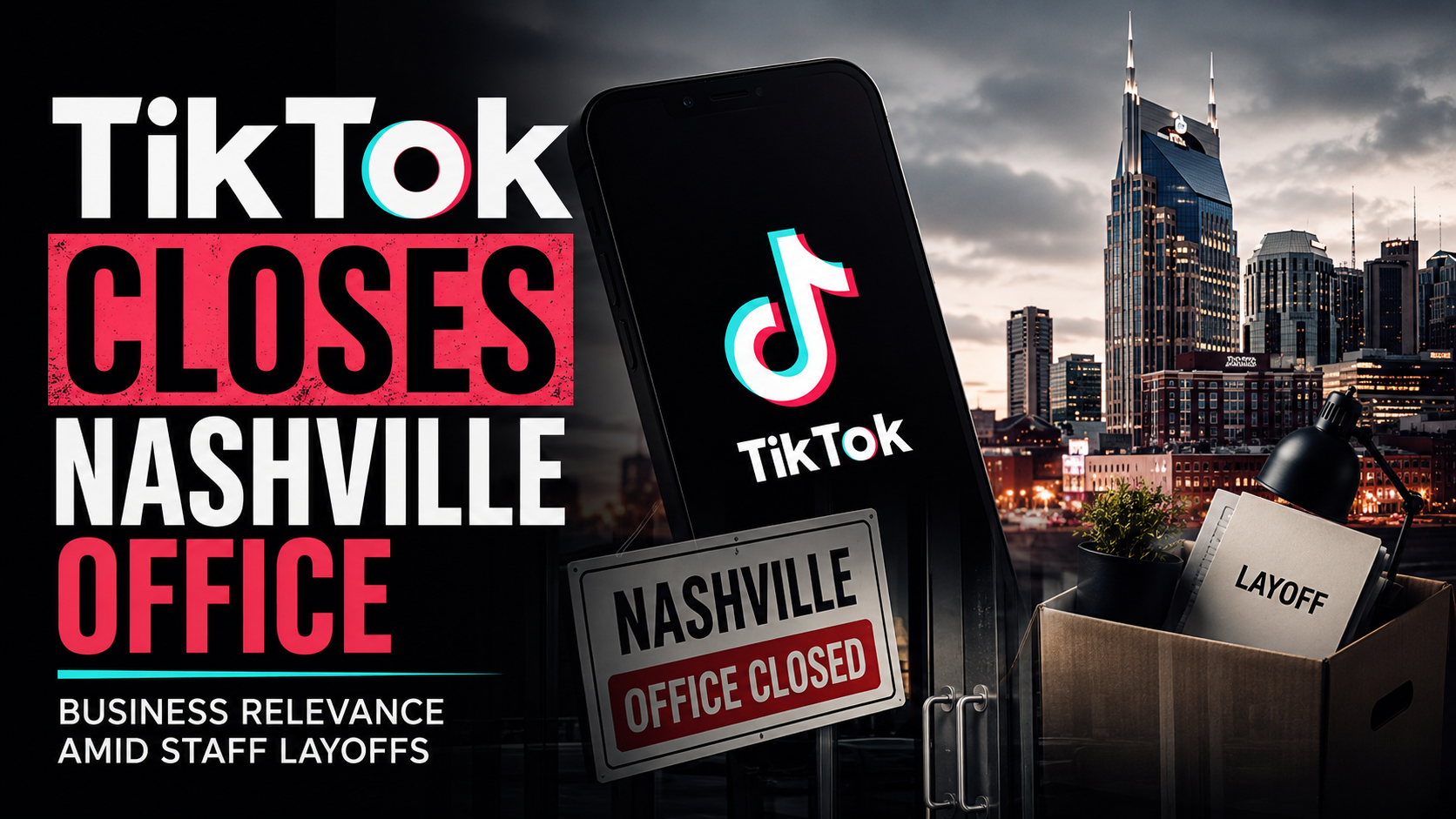
TikTok Closes Nashville Office: Business Relevance Amid Staff Layoffs
TikTok Closes Nashville Office: Business Relevance Amid Staff Layoffs
TikTok has announced it will close its Nashville office on Music Row and lay off employees after operating from the location for roughly two years. The office was originally established to strengthen TikTok's relationships with the music industry, artists, labels and publishers in one of the world's most important music markets.
The move is part of a broader restructuring within TikTok's U.S. operations as the company continues to evaluate costs, organizational priorities and the future direction of its music business.
While the closure does not directly affect the TikTok platform itself, it signals another shift in how major technology companies are approaching investment in the creator economy.
What This Means for the Music Industry
Nashville has become one of the most important hubs for music publishing, artist development and rights management. Having a dedicated Music Row presence allowed TikTok to work closely with record labels, publishers, collecting societies and creators.
Closing that office does not necessarily indicate that TikTok is reducing its commitment to music, but it does suggest that the company believes those relationships can now be managed differently or more efficiently.
Like many technology companies over the past several years, TikTok is continuing to balance growth with operational efficiency as the digital media landscape evolves.
What This Means for Creators
For creators, announcements like this are reminders that platforms constantly evolve.
Business priorities change.
Teams are reorganized.
Products launch and disappear.
Monetization programs are adjusted.
None of these changes are unusual for large technology companies, but they reinforce an important lesson: creators have very little control over the platforms they depend on.
The audience may feel like it belongs to the creator, but the platform ultimately controls discovery, distribution, monetization opportunities and the rules that govern the ecosystem.
Why This Matters to Certifyd
At Certifyd, we believe social platforms are incredibly valuable for reaching audiences.
But they should be marketing channels—not the foundation of a creator's business.
Creators should own the assets that matter most: their identity, their work, their audience and their commerce.
That means building verified creator profiles, maintaining transparent ownership records, establishing direct relationships with fans and creating revenue streams that can exist independently of any single platform.
When creators own their business infrastructure, changes made by any one platform become opportunities to adapt—not existential threats.
Conclusion
TikTok's Nashville office closure is one example of how quickly the creator economy continues to evolve.
For the music industry, it reflects changing operational priorities inside one of the world's largest social media companies.
For creators, it serves as another reminder that platforms will continue to change over time.
The most resilient creators won't be those who depend entirely on one platform—they'll be the ones who use many platforms while owning the identity, audience and business that power their careers.