
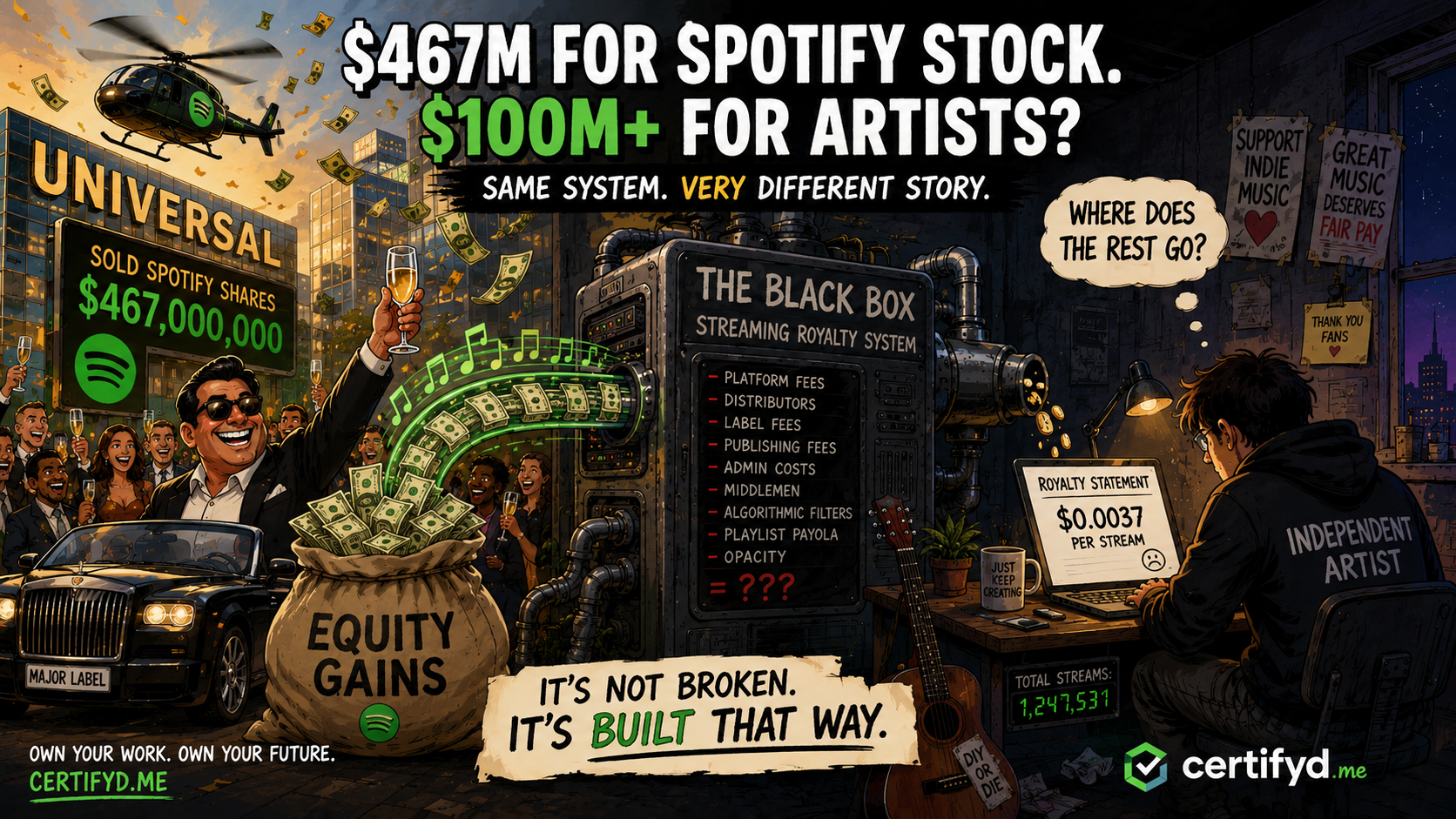
Universal Has Sold a Chunk of Spotify Stock for Around $467M: Artists Will Likely Be Paid Over $100M
Universal Has Sold a Chunk of Spotify Stock for Around $467M: Artists Will Likely Be Paid Over $100M
Universal Music Group has reportedly sold approximately $467 million worth of Spotify shares. Consistent with its policy of sharing proceeds from Spotify equity sales, more than $100 million is expected to be distributed to eligible artists and songwriters.
While this is undoubtedly positive news for the artists who receive these payments, it also raises a much larger question about how value is created—and distributed—within today's music industry.
The Business Impact
Universal's investment in Spotify demonstrates that major music companies generate value from more than just streaming royalties. Beyond licensing agreements and catalog ownership, major rights holders have also benefited from commercial partnerships and equity positions in the platforms that distribute music.
For the largest music companies, streaming is only one source of revenue. Equity appreciation, licensing negotiations, publishing, merchandising, and commercial partnerships all contribute to the overall value they create.
Independent creators, however, rarely participate in these additional sources of value.
The Financial Impact on Artists
Universal's decision to distribute a portion of the proceeds is a positive step, but it does not fundamentally change the economics of streaming.
The artists receiving these payments are primarily those represented within Universal's ecosystem, which includes many of the world's most commercially successful recording artists. Meanwhile, millions of independent creators who collectively produce an enormous amount of music will not participate in this distribution.
This reflects a broader characteristic of today's streaming economy.
Streaming services generally distribute royalties using a pooled, market-share model. Subscription and advertising revenue is collected into a central royalty pool and allocated largely according to each rights holder's share of total streams. Because the largest catalogs account for the greatest percentage of listening, they naturally receive the largest share of royalty distributions.
For many independent artists, even deeply engaged fans do not necessarily translate into proportional earnings because revenue flows through a global pool rather than directly following each listener's subscription.
The Transparency Problem
Perhaps the greatest challenge facing creators is not simply how much they are paid, but how difficult it is to understand where the money went.
Royalties often move through multiple organizations before reaching creators, including streaming platforms, distributors, labels, publishers and collection societies. Each performs its own accounting, leaving artists with limited visibility into how payments were calculated, how ownership was verified, or how much value was retained by intermediaries along the way.
The result is an ecosystem where creators are expected to trust royalty statements generated by systems they cannot independently audit.
The Role of Certifyd
Certifyd was built to solve these structural challenges by giving creators ownership over their identity, their works and their business.
Every creator can establish a verified identity. Every work can carry verifiable provenance. Ownership, contributors, publishing information, ISRCs, derivative approvals and rights relationships can all be recorded transparently from creation through commercialization.
Rather than relying exclusively on opaque royalty statements, creators gain access to infrastructure that supports transparent rights management, direct-to-fan commerce, verifiable payments and collaborative publishing workflows.
Instead of competing for a slightly larger share of a centralized royalty pool, creators can build direct commercial relationships with their audience while maintaining an auditable record of ownership and payments.
Conclusion
Universal's Spotify share sale is an important financial event, and its decision to share a portion of those proceeds with artists is commendable.
However, the announcement also highlights the structural imbalance that exists throughout today's streaming economy. The largest rights holders continue to benefit not only from streaming royalties, but also from equity ownership, commercial partnerships and market concentration, while independent creators remain dependent on systems they cannot fully inspect.
The future of the creator economy should not be built on larger black boxes. It should be built on transparent infrastructure where identity, provenance, rights, commerce and payments are verifiable from beginning to end.
That is the future Certifyd is building.