
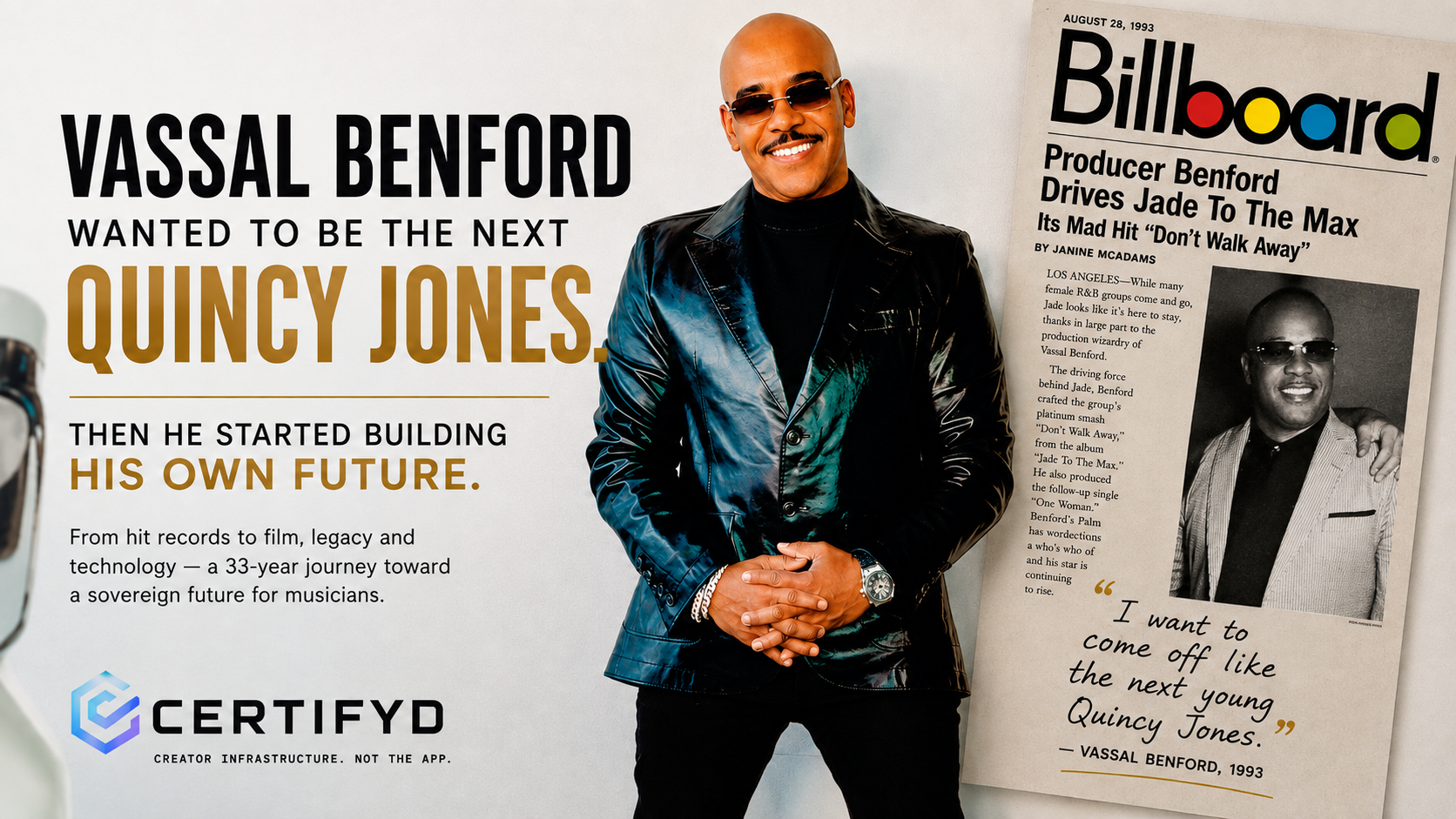
Vassal Benford Wanted to Be the Next Quincy Jones. Then He Started Building His Own Future.
In 1993, Billboard caught Vassal Benford at a pivotal moment in his career. Jade was breaking through, Chanté Moore was emerging, film work was expanding and Benford's reputation as an R&B and pop producer was growing quickly. When asked where he wanted that momentum to take him, Benford didn't exactly aim low: “I want to come off like the next young Quincy Jones.”
More than three decades later, the quote is fun to revisit. Not because Benford became Quincy Jones—there was only one Quincy—but because it reveals how Benford was thinking about his career before most of it had happened. He wasn't interested in spending his life confined to the producer's chair. He saw records as a starting point for something much larger.
In that respect, the young Vassal Benford knew himself pretty well.
Before the Vision, There Were Records
Benford had already earned the confidence. By the time Billboard profiled him, he had become closely associated with Jade, co-writing and co-producing the group's breakout hit “Don't Walk Away” and working on “One Woman.” He also crafted “I Wanna Love You” for Class Act, a film he scored, while his work with Chanté Moore included co-writing “It's Alright.”
Another Billboard report from the period described Benford as the “driving force behind Jade.” The credits help explain why. Across Jade to the Max, Benford's work included production, arranging, mixing, keyboards, composition, multi-instrumental performance and vocal arranging. He wasn't simply delivering tracks to artists; he was deeply involved in constructing the records themselves.
His résumé was already spreading well beyond one group. Work connected to artists including Bell Biv DeVoe, Freddie Jackson, Patti LaBelle, Gladys Knight, Sheena Easton, Ralph Tresvant and others was establishing Benford as a producer comfortable moving between artists and styles. Film was becoming part of the picture as well, with work connected to projects including House Party II, Class Act and New Jack City.
This was still only the beginning.
“We Never Do Demos; We Only Do Records”
One of the best lines from Benford's early interviews has nothing to do with Quincy Jones. Discussing the philosophy at his Palm Tree Productions studio, Benford told Billboard, “We never do demos; we only do records.”
It's a wonderfully Vassal way of putting it. The distinction reflects an era when producers were expected to understand the complete record: arrangement, musicianship, songwriting, vocal production, technology and the identity of the artist all had to come together. Benford's credits from the period repeatedly cross those boundaries.
It also says something about his personality. The instinct wasn't to make something provisional and hope it eventually became real. The instinct was to treat the thing as real from the beginning and build accordingly. That mentality would eventually carry Benford far outside the recording studio.
The Career Refused to Stay in One Lane
The years that followed expanded the résumé considerably. Benford's work became associated with artists including Toni Braxton, Deborah Cox and others across several generations of popular music, while his interests increasingly moved beyond conventional record production.
Film and entertainment became larger parts of his world. Business followed. Eventually, so did the stewardship of creative legacy, including Benford's involvement with the B.B. King Estate and projects intended to carry King's music and story into another generation.
That progression matters because managing creative legacy is fundamentally different from producing the next single. A producer is concerned with what a record should become today. Stewardship forces you to think about what happens to creative work tomorrow: who represents it, who can use it, how its origins are preserved and how new generations interact with something created decades earlier.
For Benford, those questions increasingly intersected with technology. The music business had changed radically around him, and not every change had made musicians more independent.
Technology Freed the Music. It Didn't Necessarily Free the Musician.
The old music industry required enormous infrastructure. Records had to be manufactured, physically distributed, stocked by retailers, promoted through traditional media and supported by organizations capable of operating that machinery. Digital technology demolished many of those barriers and gave musicians capabilities that would have seemed almost impossible when Benford was making records in the early 1990s.
A musician can now record at home, publish globally and reach a listener thousands of miles away almost instantly. Yet while the old gatekeepers weakened, new ones emerged. Distribution became easier, but discovery increasingly became algorithmic. Audiences became followers, while those relationships lived inside databases controlled by platforms. Commerce became digital, but creators still frequently depended on intermediaries to reach buyers, process transactions and receive their money.
The technology changed dramatically. The underlying dependency often didn't.
That's the problem Benford has increasingly become interested in solving.
A Shared Vision of a Sovereign Future
Benford sees a future in which musicians can become sovereign participants in the digital economy. That doesn't mean isolation, rejecting the music business or expecting artists to become their own technology companies. Sovereignty means having the ability to choose the people and services you work with without surrendering control of the underlying identity, work and relationships you've built.
A sovereign creator can still choose a label, manager, publisher, distributor, hosting provider or technology company. In fact, a healthy creator economy needs great service providers. The difference is that those companies provide services to the creator rather than becoming the permanent owner of the infrastructure through which the creator exists.
This is a vision Benford shares with the broader team building Certifyd. It starts from a deceptively simple idea: a musician should be able to benefit from technology without having to surrender themselves to the platform providing it.
For an industry that has spent decades talking about artist empowerment, that's a meaningful distinction. Empowerment granted by a platform can disappear when the platform changes its rules. Sovereignty is about moving control deeper into the architecture.
What Does It Actually Mean to Free a Musician?
“Freeing musicians” can easily become a slogan, so it's worth being specific about what Benford's vision actually means.
Creators today routinely open accounts, upload their work, accumulate followers and establish commercial relationships, but over time enormous portions of their digital lives can become dependent on infrastructure controlled by the company providing the account. A platform may call those people “your followers” and the storefront “your store,” yet the creator often has surprisingly little control over the infrastructure connecting them.
If the platform changes its algorithm, reach can disappear. If it changes its business model, economics can change overnight. If an account is suspended, years of audience development can suddenly become inaccessible. Even when nothing goes wrong, creators remain tenants inside systems they didn't build and don't control.
Benford's idea of freedom isn't that musicians should stop using platforms. It's that using a platform shouldn't require handing that platform permanent control over the musician's digital existence.
That is a much more ambitious definition of artist independence.
Certifyd Is the Infrastructure Bet
This is where Benford's involvement with Certifyd becomes a natural continuation of his career rather than a strange detour into technology.
Certifyd is not trying to solve creator sovereignty by building another conventional platform and asking musicians to move everything into it. Certifyd Core is being developed as infrastructure that can operate under the participant's control. Independently operated installations can participate in a broader network without requiring Certifyd itself to permanently sit between every creator, fan and service provider.
The same philosophy extends to identity, creative relationships and commerce. A creator's digital identity can originate with the creator rather than existing solely as an account issued by a platform. Works can carry attribution and relationships with them, while creators can establish connections across a network that isn't intended to depend on one central Certifyd database owning every relationship.
Payments follow the same logic. Certifyd uses Bitcoin and Lightning rather than inventing a proprietary Certifyd currency or closed payment system. Bitcoin provides an independent monetary network underneath Certifyd, allowing commerce services to exist without requiring Certifyd to own the money or permanently intermediate every transaction.
In other words, the goal isn't to make creators dependent on Certifyd instead of somebody else. The goal is to make Certifyd useful without requiring that dependency in the first place.
Sovereignty Doesn't Mean Doing Everything Yourself
There is an important practical point here. Musicians generally don't want to become network engineers, accountants, payment processors, publicists, lawyers and distributors. Nor should they have to.
A sovereign network can still have companies that make difficult things easy. It can have hosting providers, commerce services, discovery systems, moderation, professional support and businesses that package complicated infrastructure into products ordinary people can actually use. Decentralization doesn't require abandoning convenience or professional services.
What changes is the relationship between the service and the participant. A musician should be able to choose a provider because that provider is excellent, and another provider should be able to compete for that musician's business. Most importantly, leaving one service shouldn't mean losing the identity, work and relationships accumulated while using it.
That's a very different kind of creator economy: one in which service providers compete to serve creators rather than competing to capture them.
From Making Records to Freeing the People Who Make Them
Seen through that lens, Benford's 1993 Quincy Jones comment becomes more interesting.
The young producer admired a model of creative life that extended beyond a single job description. Quincy Jones demonstrated that musicianship could lead into production, film, television, business and institution-building. Benford's own career ultimately followed its own route, but the desire to build beyond the studio was there remarkably early.
Today, Benford is extending that idea from the producer to the musician. Why should a creator's role end at supplying the creative work while someone else necessarily owns the infrastructure around it? Why should an artist's audience exist primarily as accounts inside someone else's database? Why should direct creator commerce require another company to own the financial rails?
Those questions connect Benford's past with what he's trying to build now. The producer who once wanted to expand the boundaries of his own career is now helping pursue infrastructure intended to expand the boundaries of what musicians can control.
##Building the Sovereign Network
Benford's vision for Certifyd is now moving from architecture into the real world. Certifyd Core entered technical beta in 2026, putting independently operated installations into the hands of early network participants and beginning the process of testing how a sovereign creator network behaves outside the development environment.
That stage is important because Certifyd isn't simply trying to build another application. The larger objective is a network in which creators, fans and service providers can operate independently while still discovering one another, establishing relationships and conducting commerce. Technical beta is where those ideas begin becoming infrastructure that other people can actually operate.
For Benford, that makes this an unusually exciting point in the journey. After decades spent making records and building entertainment projects inside systems created by others, he is now helping shape infrastructure around a different premise: musicians should have the ability to control more of the digital world surrounding their work.
Certifyd is still early, but the direction is deliberate. The goal is to make sovereignty increasingly practical until running on creator-controlled infrastructure feels less like an experiment and more like the natural way the creator economy should work.
Maybe Vassal Was Thinking Too Small
Which brings us back to 1993.
A young Vassal Benford tells Billboard that he wants to be the next young Quincy Jones. At the time, with Jade breaking and his production career accelerating, that must have sounded like an enormous ambition.
Thirty-three years later, the comparison matters less than the instinct behind it. Benford's career moved through records, artists, film, business, cultural legacy and eventually technology. Each step widened the territory around the original creative act until the question was no longer simply how to make a great record, but what kind of system the people making those records should have around them.
Today, Benford's answer is increasingly about sovereignty: musicians controlling more of their identity, their work, their relationships and their ability to participate economically, while remaining free to choose the people and companies they want to work with.
That's a long way from the producer's chair.
But perhaps Vassal Benford told us something about himself all those years ago. He was never particularly interested in being confined by the role he already had.
Now he's trying to make sure musicians aren't confined by the platforms they use either.
Not bad for a guy who once thought becoming the next Quincy Jones was aiming high.
Certifyd covers the people, technology and ideas shaping the future of music, creator ownership and sovereign digital infrastructure.