YouTube Is Making It Harder to Earn Money on the Platform
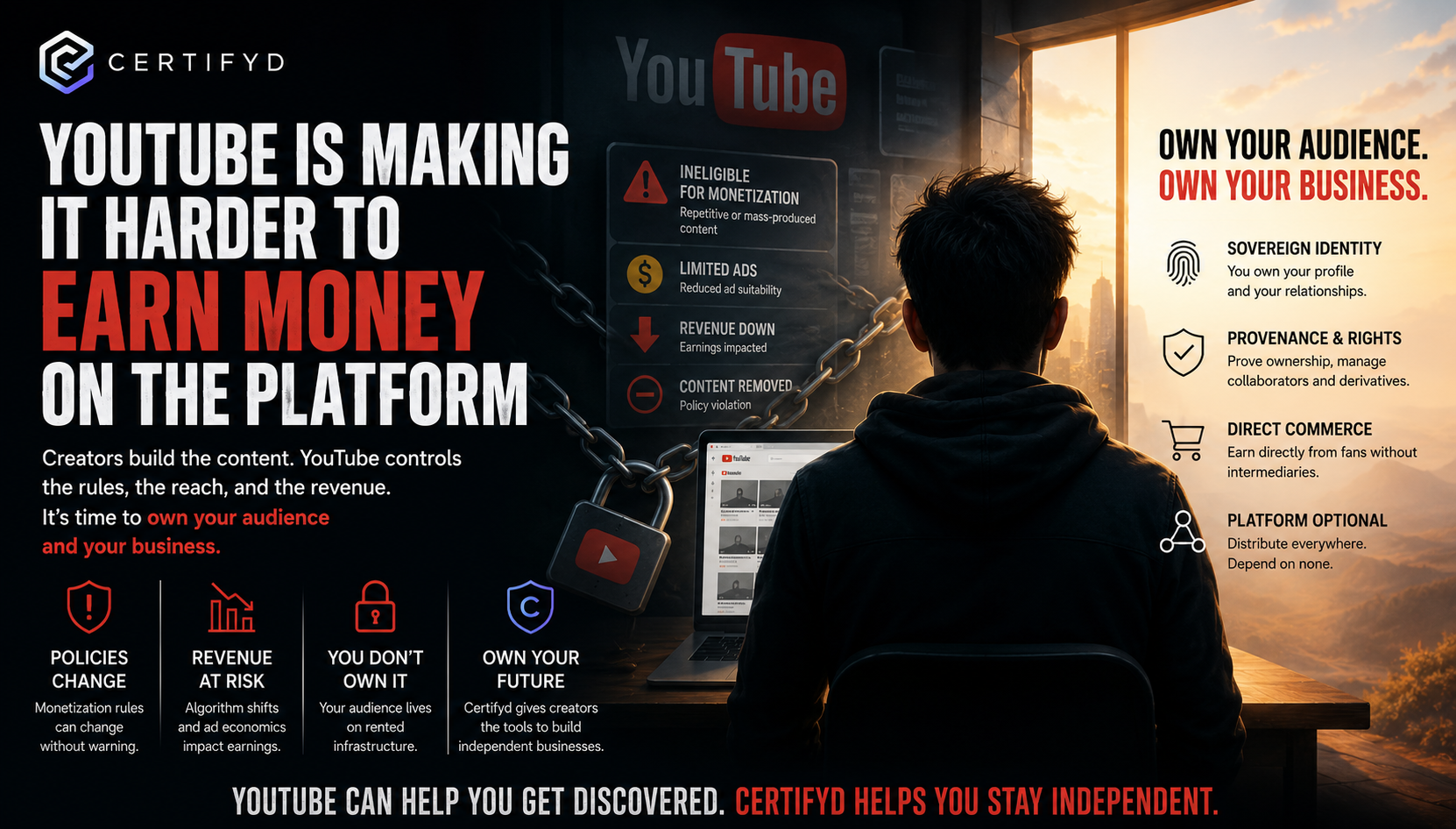
YouTube remains one of the largest distribution channels in the creator economy, but building an audience on YouTube and building a sustainable business are not necessarily the same thing. Creators operate inside a system where monetization rules, recommendation algorithms, advertising economics and platform policies are ultimately controlled by YouTube.
For creators who depend heavily on the platform, that creates a fundamental business risk: you can build the audience, create the content and generate the engagement without actually owning the infrastructure through which that audience is monetized.
The Problem Isn't Just Monetization
YouTube gives creators access to an enormous global audience and provides monetization tools that would be difficult for an individual creator to reproduce independently. That has real value.
The trade-off is dependency. Advertising revenue depends on eligibility, advertiser demand, audience geography, content category and YouTube's monetization policies. Discovery depends heavily on recommendation systems creators don't control. Access to fans is mediated by the platform itself.
That means a successful YouTube channel can still be a business built largely on someone else's infrastructure.
Creators Are Renting the Distribution Layer
This isn't unique to YouTube. Spotify, TikTok, Instagram and other major platforms operate on essentially the same principle: creators provide content, platforms provide distribution, and the platform controls the commercial environment around that distribution.
There's nothing inherently wrong with that exchange. The problem comes when distribution becomes the creator's entire business.
A creator with 500,000 subscribers may have built an enormous audience, but those subscribers are still YouTube users. The creator can't simply take those relationships somewhere else if policies, economics or algorithms change.
That's why we believe platforms should be distribution channels, not the foundation of creator ownership.
Where Certifyd Is Different
Certifyd isn't designed to replace YouTube.
It's designed to give creators infrastructure they can own alongside it.
Creators can establish their identity, publish and prove ownership of their work, maintain provenance, define collaborators and splits, manage derivative relationships, and build direct commerce around their content without requiring YouTube to become the system of record.
YouTube can still do what YouTube does extremely well: distribute video to billions of people.
But the creator doesn't have to make YouTube responsible for everything else.
Distribution Becomes Optional
This changes the relationship between creators and platforms.
Instead of:
Creator → Platform → Audience → Revenue
the creator can begin building an independent foundation:
Creator → Identity → Content → Rights → Commerce
Distribution platforms can then connect to that foundation:
YouTube / Spotify / TikTok / Websites / Apps → Creator
That distinction matters. If one distribution channel changes its rules, the creator's underlying identity, content relationships, provenance and commerce infrastructure don't have to disappear with it.
Own the Relationship, Not Just the Account
A social-media account isn't the same thing as a creator identity.
A subscriber count isn't the same thing as owning an audience relationship.
And platform monetization isn't the same thing as owning a business.
Certifyd gives creators another layer beneath those platforms: a sovereign profile and publishing infrastructure through which their work, identity and commercial relationships can remain connected regardless of where the content is ultimately discovered.
Creators can still use YouTube for reach while directing fans toward experiences and commerce they control.
More Than Advertising
This also opens the door to business models that don't depend entirely on advertising.
Content can support direct purchases, premium releases and fan transactions. Collaborators can participate through defined splits. Derivative works can maintain relationships with their originals. Clearance and approval workflows can establish how new works are authorized.
Instead of asking only "How many views did this get?", creators can begin asking "What economic relationships did this content create?"
That's a fundamentally different way of thinking about creator monetization.
Platforms Are Still Valuable
The point isn't that creators should abandon YouTube.
Quite the opposite.
A platform capable of putting a creator in front of millions of potential fans is incredibly valuable. But distribution and ownership don't need to be the same thing.
Use YouTube for YouTube.
Use Spotify for Spotify.
Use TikTok for TikTok.
But build the underlying creator business on infrastructure that doesn't disappear when a platform changes its algorithm, policies or monetization rules.
The Bigger Shift
The creator economy has spent more than a decade helping people build audiences on platforms. The next stage is helping creators turn those audiences into businesses they actually control.
That requires more than another monetization program. It requires identity, provenance, rights management, direct commerce and infrastructure capable of moving with the creator.
Platforms can provide the audience. Creators should own the business.
That's the distinction Certifyd is building around.