
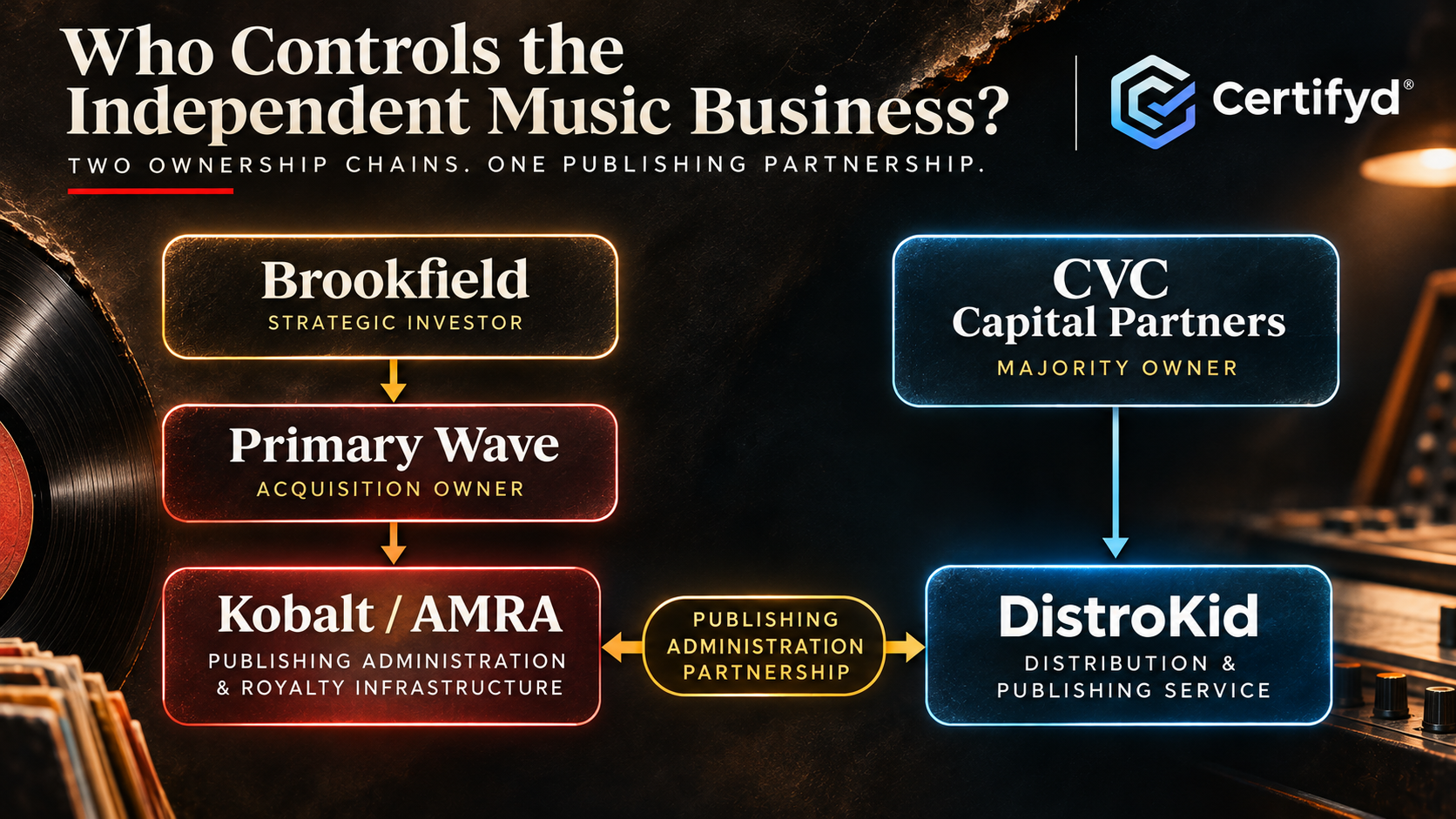
The independent music industry is looking a lot less independent these days.
In July, Primary Wave completed its acquisition of Kobalt, one of the world's largest independent music publishing and royalty administration companies, in a deal reportedly worth approximately $1.5 billion. A few months later, DistroKid launched a new publishing administration service powered by that same company.
Meanwhile, DistroKid itself has changed hands, with private equity firm CVC Capital Partners acquiring a majority stake and Insight Partners retaining a significant minority position. Create Music Group has also invested in the distributor.
Different companies. Different transactions. But a remarkably similar direction.
The infrastructure behind independent music is increasingly being consolidated into the hands of large, well-capitalized businesses.
And while creators are being offered more convenient tools to distribute their music, collect royalties and manage their careers, there's a question the industry doesn't spend nearly enough time asking.
If creators own their music, why don't they own the infrastructure their businesses depend on?
Primary Wave Didn't Just Buy a Music Catalogue
Primary Wave has built its reputation acquiring and developing valuable music rights, including interests associated with some of the industry's most recognizable artists and catalogues.
But its acquisition of Kobalt is different from simply purchasing another collection of songs.
Kobalt operates publishing administration technology, royalty collection systems and rights-management infrastructure used by songwriters and publishers around the world. The acquisition also includes AMRA, Kobalt's global digital royalty collection business.
That means Primary Wave acquired more than music rights. It acquired a significant piece of the machinery responsible for administering and collecting revenue from music rights.
Kobalt continues operating as a separate company under CEO Laurent Hubert, and there's no evidence that the acquisition automatically changes the ownership of copyrights held by its administration clients.
But corporate ownership matters.
Primary Wave now owns a business that sits between a substantial number of songwriters and the systems responsible for tracking, collecting and administering their publishing revenue.
That is a very different kind of asset from a song catalogue.
It's infrastructure.
Now DistroKid Is Bringing That Infrastructure to Independent Artists
On November 11, DistroKid announced the broader launch of DistroKid Publishing, a new service powered by Kobalt.
For eligible songwriters, the offer is straightforward. Pay a one-time $75 setup fee, register qualifying original compositions, and receive 80% of the publishing royalties collected on your behalf.
Artists need at least one DistroKid release and more than $50 in streaming revenue over the preceding twelve months. The service covers eligible mechanical and performance royalties, with collection and payment handled through the DistroKid environment.
For independent musicians who have struggled to understand or collect publishing income, this could be genuinely useful.
Distributing a sound recording and collecting royalties for the underlying composition are different activities. Many artists who write and record their own songs don't fully understand that distinction, and uncollected publishing revenue is a longstanding industry problem.
Kobalt has spent years building infrastructure to address it.
But look at the commercial arrangement.
DistroKid provides the artist-facing account and distribution relationship. Kobalt supplies the publishing administration. Primary Wave owns Kobalt. And DistroKid is now majority-owned by CVC.
Primary Wave does not own DistroKid, and the partnership is not evidence of a coordinated acquisition strategy between the two ownership groups.
What it does demonstrate is how a creator's supposedly independent business can become increasingly dependent on interconnected services operated by large financial and corporate interests.
The artist sees one dashboard.
Behind that dashboard is an expanding network of intermediaries.
The New Music Industry Isn't Just Buying Songs. It's Buying the Pipes.
For years, the most visible form of music industry consolidation involved catalogues.
Investors bought publishing rights, master recordings and royalty interests, treating music as an asset capable of generating predictable long-term revenue.
That market hasn't disappeared. But the infrastructure around those assets is becoming increasingly valuable too.
Distribution, publishing administration, rights data, royalty collection, fan commerce and payment services are all businesses that can generate revenue from creative activity without necessarily owning the underlying songs.
The attraction is obvious.
A company that administers royalties can earn fees across a large catalogue of works. A distributor can serve millions of artists without owning their masters. A platform that combines multiple services can deepen its relationship with creators and potentially increase the value of each customer.
From an investor's perspective, these are compelling businesses.
From a creator's perspective, the question is different.
How many essential functions of your business are you comfortable placing inside infrastructure you cannot operate, independently verify or easily replace?
That's not an accusation against DistroKid, Kobalt or Primary Wave. Publishing administration is complicated, and professional collection services provide real value.
But convenience and independence are not the same thing.
And owning your copyrights is not the same as controlling the systems through which your creative business operates.
Independence Has Become a Subscription
Think about what an independent musician is expected to do today.
Pay a distributor to deliver recordings. Register compositions with the appropriate rights organizations. Appoint publishing administrators where needed. Use social platforms to find an audience. Subscribe to marketing tools. Maintain storefronts, fan databases, analytics services and payment accounts.
Every service solves a problem.
Every service also introduces another commercial relationship, another account and another dependency.
Now those services are increasingly being combined.
DistroKid's expansion into publishing administration makes the creator's experience simpler, but it also moves another function into the distributor's operating environment.
That's the contradiction at the heart of the modern creator economy.
We've spent years celebrating the independence of artists who no longer need traditional record deals, while building an industry where those same artists depend on an expanding collection of privately operated platforms to conduct business.
We've changed the intermediaries without fundamentally changing the architecture.
The music industry calls that progress.
We think it's time to ask whether there's another way.
What If Creators Operated the Infrastructure?
This is the problem we're building Certifyd to address.
Not because publishing administrators are unnecessary. Not because royalty collection is simple. And certainly not because creators should have to rebuild every specialist service themselves.
The problem is that the creator's identity, catalogue, publishing activity, commerce and audience relationships have become inseparable from the platforms operating those services.
Certifyd starts from a different assumption.
The creator should be able to operate the foundation of their own business.
With Certifyd Core, creators can establish cryptographically verifiable identities, organize works and releases, manage publication records and make supported content available through infrastructure running on their own computers.
Certifyd Fan provides discovery and playback across participating creators, while Certifyd Browser extends supported identity verification into existing online platforms.
Supported Bitcoin and Lightning configurations also create opportunities for direct-to-fan commerce without requiring every transaction to originate inside a conventional custodial creator platform.
These capabilities don't replace Kobalt's worldwide publishing administration network. Certifyd is still in beta, and global royalty collection remains a specialized service.
But the architectural distinction matters.
A creator-operated network allows creators to build around infrastructure they control, connecting to specialist services when those services provide value rather than making any one intermediary the foundation of their entire business.
The objective isn't to create another platform that owns the relationship.
It's to make that relationship less dependent on platforms in the first place.
The Next Battle Is Over Who Controls the Network
Primary Wave's acquisition of Kobalt and DistroKid's expansion into publishing administration are not isolated developments.
They reflect an industry in which controlling the systems around music can be as strategically important as owning the music itself.
For investors, that creates opportunities to acquire infrastructure, consolidate services and participate in more of the revenue generated by creators.
For artists, it creates a different challenge.
You can own your masters. You can own your publishing. You can retain your copyrights and still depend on someone else's infrastructure for nearly every meaningful interaction with your audience and your money.
That doesn't make every intermediary bad. It means ownership needs a broader definition.
Who controls your identity?
Who operates your catalogue?
Who maintains the records connecting your work to your business?
Who determines how your fans discover, access and pay for what you create?
And what happens if the company operating those systems is acquired, changes its terms or decides your business no longer fits its model?
Those are infrastructure questions, not simply royalty questions.
The Future of Independent Music Should Actually Be Independent
DistroKid Publishing may help thousands of songwriters collect money they would otherwise miss. Kobalt's technology and international collection relationships are valuable. Primary Wave's acquisition may create opportunities for the businesses and creators involved.
None of that changes the bigger picture.
The companies serving independent musicians are becoming larger, more integrated and increasingly attractive to institutional investors.
The creator economy is generating enormous value.
The question is how much of the infrastructure producing that value creators will ever be allowed to operate themselves.
At Certifyd, we believe the future isn't another consolidated platform promising creators a better deal.
It's a network where creators operate their own infrastructure, establish their own identities, manage their own work and connect directly with fans and service providers.
Because the real measure of independence isn't whether you own your songs while someone else operates your business.
It's whether you have the freedom to operate that business without asking a platform for permission.
We own the catalogue. Why don't we own the network?