
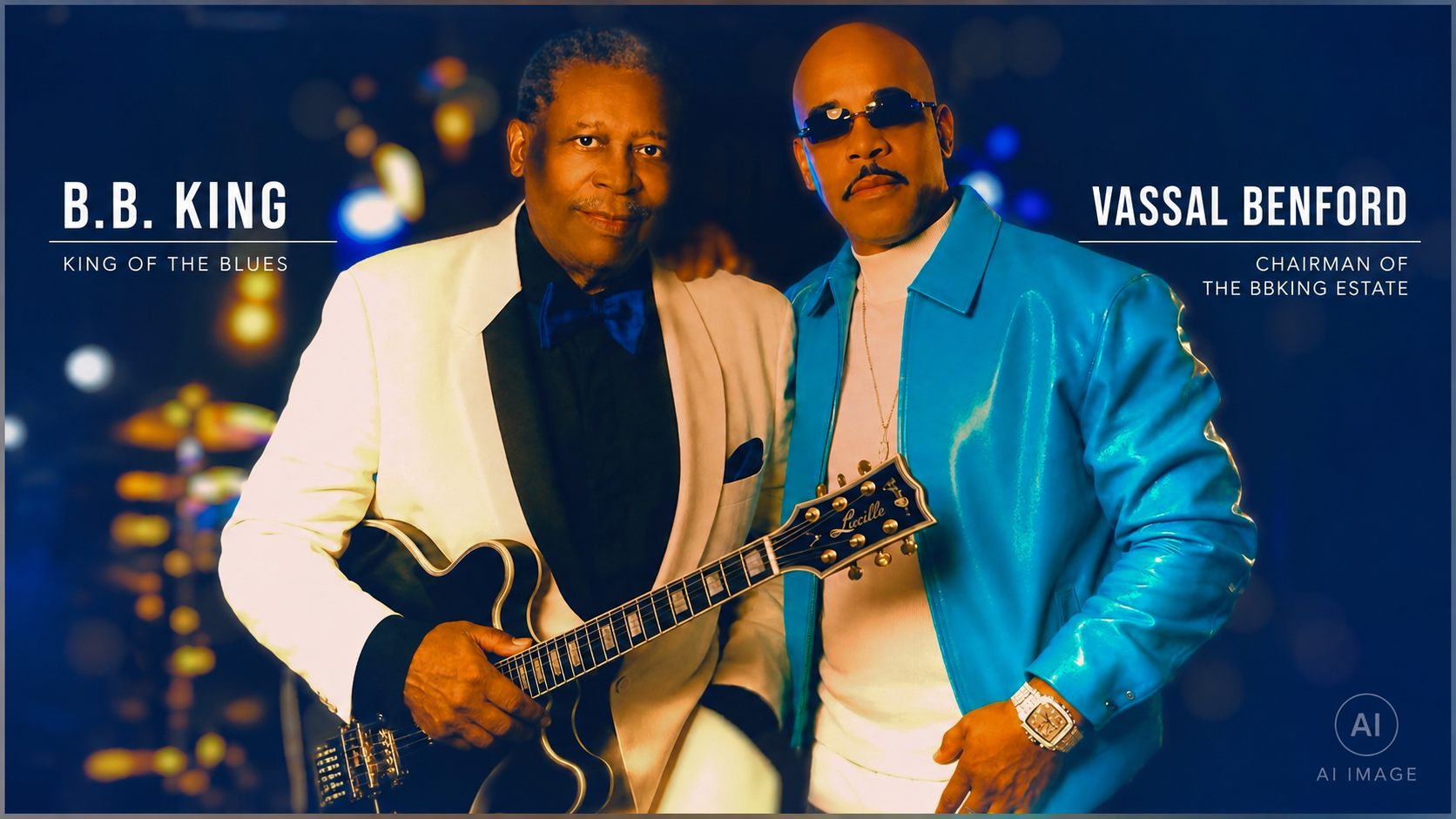
More than a decade after his death, B.B. King's influence remains difficult to overstate. Generations of guitarists have studied his phrasing, singers have borrowed from his emotional delivery, and musicians across genres continue to find inspiration in a man who could communicate more with a single note than most could with an entire solo.
Now, a new feature documentary is being developed to examine the life behind that extraordinary musical legacy, with Grammy-winning producer and music executive Vassal Benford serving as executive producer.
Announced in September 2026, the project brings together the B.B. King Music Company, the Estate of B.B. King and Winter State Entertainment. Filmmaker Leslie Small is attached to direct, with the estate providing access to historical materials, archives and resources that could offer audiences a deeper understanding of the man known worldwide as the King of the Blues.
The significance of that access goes beyond the prospect of discovering footage that audiences haven't seen before. It creates an opportunity to tell a story that extends beyond the familiar performances, hit recordings and legendary guitar.
More than a musical biography
Born Riley B. King in Mississippi in 1925, B.B. King emerged from the American South to become one of the most influential musicians of the twentieth century. His music helped carry the blues to an international audience, influencing generations of performers across rock, soul, jazz and popular music.
His career is well documented, but the extraordinary visibility of his musical achievements can sometimes obscure the complexity of the life behind them. King wasn't simply a guitarist with an unmistakable sound. He was a performer, bandleader and businessman whose career unfolded through decades of profound changes in the recording industry and American culture.
The documentary is expected to explore that journey, from his beginnings in the Mississippi Delta to international recognition. With the participation of King's estate, the filmmakers have an opportunity to draw upon historical knowledge and archival material that can place familiar milestones in a richer context.
An archive can reveal the circumstances surrounding a recording, the relationships behind a performance or the decisions that shaped an artist's career. For someone whose professional life stretched across more than six decades, those details can be just as revealing as the music itself.
Vassal Benford's role in telling the story
Benford's involvement connects the project with an executive whose career has spanned recording, production, entertainment business and the stewardship of musical legacy.
Beyond his executive producer credit on the documentary, Benford serves as CEO of the B.B. King Music Company, according to the September announcement. His involvement reflects a broader effort to introduce King's life and work to audiences across different generations and entertainment formats.
In comments accompanying the original announcement, Benford emphasized the importance of approaching King's story with authenticity and respect, describing the musician as someone whose influence extended far beyond the boundaries of a single genre.
That perspective matters. Preserving the legacy of an artist as influential as King involves more than celebrating familiar achievements. It requires decisions about which stories deserve attention, how historical materials are interpreted and what future audiences will understand about the person behind the recordings.
Benford is working alongside producers Hamid and Camille Torabpour of Winter State Entertainment. Lani Evans, Dr. Mark Smith, Nick Hagen and Sylvester Stewart Jr. are also attached as producers, while Leslie Small brings his experience in documentary filmmaking to the director's role.
The combination of estate participation, archival access and an experienced production team establishes the foundation for a film with the potential to go beyond conventional musical biography.
What the archives can reveal
For artists with long careers, the public catalogue is only part of the historical record. Recordings tell us what audiences heard, but photographs, correspondence, interviews, performance materials and other surviving documents can provide the context that explains how the work developed.
That distinction is particularly important for B.B. King.
His signature guitar, Lucille, and his unmistakable playing style became enduring symbols of the blues. Yet the broader story also includes the people he worked with, the places he performed, the changes he witnessed and the business decisions required to sustain an international career.
The estate's cooperation gives the filmmakers an opportunity to explore some of that history through materials connected directly to King's life. It does not guarantee that every archival discovery will appear in the finished film, but it provides a meaningful starting point for a more complete account.
For younger audiences discovering King through contemporary musicians, streaming services or online performances, such a documentary could help connect the music they recognize with the life and circumstances that produced it.
That's what makes archival storytelling so valuable. The goal isn't simply to preserve material because it's old. It's to preserve enough context for the material to remain meaningful.
A growing effort to preserve B.B. King's legacy
The documentary is one of several projects associated with ongoing efforts to introduce King's work to new audiences.
A separate authorized dramatic feature, Lucille, is also in development through Canton Entertainment in collaboration with Benford and the B.B. King Music Company and Estate. Unlike the documentary, that project is planned as a dramatized account of King's life and his relationship with his famous guitar.
The two productions have different approaches, but they reflect the continuing cultural significance of an artist whose influence has outlived the era in which he first became famous.
At the time of the September documentary announcement, the production had not disclosed a release date or distribution arrangement. Further details about its progress and eventual release remain to be confirmed.
For now, the importance of the project lies in the opportunity it represents. With Benford serving as executive producer, Leslie Small directing and the estate opening access to its historical resources, the filmmakers have the foundations for a documentary that can explore the musician beyond his most recognizable recordings.
B.B. King's music has never stopped finding new listeners. The next challenge is ensuring that the story behind it continues to reach them, too.